1.1 Place value and ordering numbers
Place value in whole numbers and decimals, multiplying and dividing by powers of 10, and ordering integers, decimals, fractions and negative numbers using a number line and the symbols =, ≠, <, >, ≤ and ≥.
Place value
Key terms
- Digit: one of the symbols 0 to 9 used to write numbers.
- Place value: the value a digit has because of its position in a number.
- Integer: a whole number, which can be positive, negative or zero.
- Decimal place: the position of a digit after the decimal point.
- Inequality: a statement that compares two numbers using a symbol such as < or >.
Every digit in a number has a value that depends on its position. In the number 24 307, the digit 4 is in the thousands column so it stands for 4000, but the digit 3 is in the hundreds column so it stands for 300. A zero is a place holder: it keeps the other digits in their correct columns.
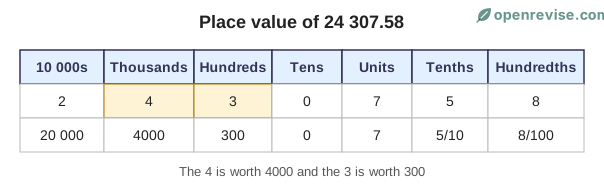
Moving to the right of the decimal point the columns get ten times smaller each time: tenths, hundredths, thousandths. In 24 307.58 the digit 5 is worth 5 tenths (\frac{5}{10}) and the digit 8 is worth 8 hundredths (\frac{8}{100}).
| Column | Value | Example in 3 482.176 |
|---|---|---|
| Thousands | 1000 | 3 |
| Hundreds | 100 | 4 |
| Tens | 10 | 8 |
| Units | 1 | 2 |
| Tenths | \frac{1}{10} | 1 |
| Hundredths | \frac{1}{100} | 7 |
| Thousandths | \frac{1}{1000} | 6 |
Multiplying and dividing by 10, 100 and 1000. The decimal point does not move: the digits move. Multiplying by 10 moves every digit one column left (the number gets bigger); dividing by 10 moves every digit one column right. Use zeros as place holders where needed.
- 3.45 \times 100 = 345 (two columns left)
- 7.2 \div 1000 = 0.0072 (three columns right, with place-holder zeros)
- 0.06 \times 10 = 0.6
Ordering whole numbers and decimals
To order decimals, compare the digits column by column from the left, and only look at the next column if the digits are the same. It helps to write extra zeros so every number has the same number of decimal places.
Worked example. Put 0.4, 0.45, 0.405 and 0.04 in order, smallest first.
Write them with three decimal places: 0.400, 0.450, 0.405, 0.040.
Compare the tenths first: 0.040 has 0 tenths, so it is the smallest. The other three have 4 tenths, so compare hundredths: 0.400 and 0.405 have 0 hundredths and 0.450 has 5, so 0.450 is the largest. Between 0.400 and 0.405 the thousandths decide.
Order: 0.04, 0.4, 0.405, 0.45.
Negative numbers
Numbers below zero are negative. On a number line the numbers get larger as you move to the right, so a number further to the left is smaller. This means -5 is smaller than -2, and -3.5 is between -4 and -3.

Worked example. Put -3, 2, -3.5, -0.5 and 0 in order, smallest first.
Use the number line: the order is -3.5, -3, -0.5, 0, 2.
Ordering fractions
To compare fractions, give them a common denominator or change them to decimals. To order \frac{3}{4}, \frac{2}{3} and \frac{5}{8} use the common denominator 24: \frac{18}{24}, \frac{16}{24}, \frac{15}{24}. The order, smallest first, is \frac{5}{8}, \frac{2}{3}, \frac{3}{4}. As decimals they are 0.625, 0.667 (to 3 d.p.) and 0.75.
Inequality symbols
| Symbol | Meaning | Example |
|---|---|---|
| = | is equal to | 0.5 = \frac{1}{2} |
| ≠ | is not equal to | 0.3 ≠ 0.03 |
| < | is less than | -4 < 1 |
| > | is greater than | 0.7 > 0.07 |
| ≤ | is less than or equal to | n ≤ 5 includes 5 |
| ≥ | is greater than or equal to | n ≥ 5 includes 5 |
The symbol always opens towards the larger number, like a hungry mouth. The line under < or > means the number at that end is included.
Worked example. List the integers that satisfy -3 \le n < 2.
-3 \le n means n can equal -3 or be larger. n < 2 means n must be less than 2, so 2 is not included. The integers are -3, -2, -1, 0, 1.
Common mistakes
- Reading a negative number with more digits as larger: -12 is smaller than -2.
- Writing the digits of a decimal in the wrong columns when multiplying or dividing by 10, 100 or 1000.
- Treating \frac{1}{8} as bigger than \frac{1}{5} because 8 is bigger than 5. The larger the denominator, the smaller the pieces.
Exam-style example
Question. Write the numbers 0.07, 0.7, 0.077 and 0.707 in order of size, starting with the smallest. Then write down a number that lies between 0.7 and 0.707.
Method. Give every number three decimal places: 0.070, 0.700, 0.077 and 0.707. Compare the tenths first. 0.070 and 0.077 have no tenths, so they are the two smallest, and 0.070 comes before 0.077 because it has fewer hundredths and thousandths. 0.700 and 0.707 both have 7 tenths, so compare the thousandths: 0.700 is smaller than 0.707.
Answer. 0.07, 0.077, 0.7, 0.707. A number between 0.7 and 0.707 is 0.703 (any value from 0.701 to 0.706 is correct, and so is 0.7035). There are always infinitely many decimals between two different decimals.
Summary
- The value of a digit depends on its column; a zero is a place holder.
- Moving right of the decimal point the columns are tenths, hundredths and thousandths.
- Multiplying by 10, 100 or 1000 moves the digits left; dividing moves them right.
- To order decimals, compare column by column from the left, or add zeros so that all the numbers have the same number of decimal places.
- On a number line, bigger numbers are further to the right, so -12 < -2.
- The inequality symbols are =, ≠, <, >, ≤ and ≥; the small end of < or > points at the smaller number.
Test yourself on this lesson
9 exam questions · 18 marks · with mark schemes and model answers
Found a mistake?