1.12 Calculating with standard form
Multiplying and dividing numbers in standard form using the index laws, adding and subtracting after matching the powers of 10, using a calculator for standard form, and solving real problems with very large and very small numbers.
Calculating with standard form
Key terms
- Standard form: a number written as A \times 10^n with 1 \le A < 10 and n an integer.
- Index laws: the rules for working with powers of the same base, for example 10^a \times 10^b = 10^{a+b}.
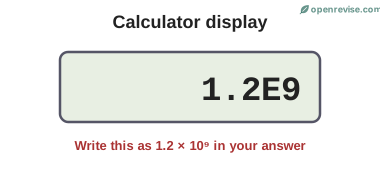
- Calculator display: how a calculator shows standard form, for example 1.2E9, which must be written as 1.2 \times 10^9.
Numbers in standard form are written as a number between 1 and 10 multiplied by a power of 10. To calculate with them, treat the number parts and the powers of 10 separately. Many questions are set on a non-calculator paper, and others expect you to use a calculator efficiently.
Multiplying
Multiply the number parts, add the powers of 10, and then check that the answer is in standard form.
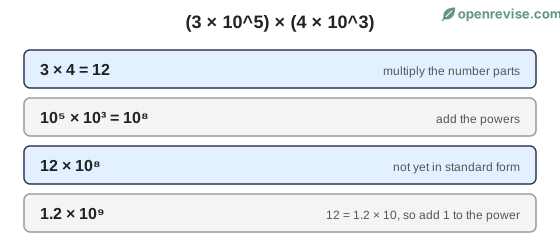
Worked example. Work out (3 \times 10^5) \times (4 \times 10^3).
3 \times 4 = 12 and 10^5 \times 10^3 = 10^8, so the product is 12 \times 10^8. This is not in standard form because 12 is bigger than 10. Write 12 = 1.2 \times 10: the answer is 1.2 \times 10^9.
Worked example. Work out (8 \times 10^{-3}) \times (5 \times 10^{-2}).
8 \times 5 = 40 and 10^{-3} \times 10^{-2} = 10^{-5}, giving 40 \times 10^{-5} = 4 \times 10^1 \times 10^{-5} = 4 \times 10^{-4}.
Dividing
Divide the number parts and subtract the powers of 10.
Worked example. Work out (6 \times 10^7) \div (2 \times 10^2).
6 \div 2 = 3 and 10^7 \div 10^2 = 10^5, so the answer is 3 \times 10^5.
Worked example. Work out (9.6 \times 10^8) \div (3.2 \times 10^{-3}).
9.6 \div 3.2 = 3 and 10^8 \div 10^{-3} = 10^{8-(-3)} = 10^{11}. The answer is 3 \times 10^{11}.
Adding and subtracting
You cannot add the powers. Instead, rewrite both numbers with the same power of 10, then add or subtract the number parts, and give the answer in standard form.
Worked example. Work out 4.2 \times 10^5 + 3.5 \times 10^4.
Write 3.5 \times 10^4 = 0.35 \times 10^5. Then 4.2 \times 10^5 + 0.35 \times 10^5 = 4.55 \times 10^5.
Worked example. Work out 6.1 \times 10^{-3} - 2.4 \times 10^{-4}.
Write 6.1 \times 10^{-3} = 61 \times 10^{-4}. Then 61 \times 10^{-4} - 2.4 \times 10^{-4} = 58.6 \times 10^{-4} = 5.86 \times 10^{-3}.
Using a calculator
Use the EXP or \times 10^x key to enter standard form. To enter 3.2 \times 10^{8}, press 3.2, then EXP, then 8. The display may show 3.2E8 or 3.2 \times 10^8. Calculators can do calculations with standard form directly, but you should still estimate to check. Remember to write the answer as A \times 10^n, not in calculator form, and round to the number of significant figures asked for.
Real problems
Worked example. The Earth is 1.5 \times 10^{11} m from the Sun. Light travels at 3 \times 10^8 m/s. How long does sunlight take to reach the Earth?
\text{time} = \dfrac{\text{distance}}{\text{speed}} = \dfrac{1.5 \times 10^{11}}{3 \times 10^8} = 0.5 \times 10^3 = 5 \times 10^2 = 500 seconds, which is about 8 minutes 20 seconds.
Worked example. A virus is 1.2 \times 10^{-7} m long. How many viruses placed end to end would fit along a 3 cm line?
3 cm = 3 \times 10^{-2} m. The number is \dfrac{3 \times 10^{-2}}{1.2 \times 10^{-7}} = 2.5 \times 10^{5}, or 250 000 viruses.
Exam-style example
Question. The mass of the Earth is 5.97 \times 10^{24} kg and the mass of the Moon is 7.35 \times 10^{22} kg. How many times heavier is the Earth than the Moon? Give your answer to 3 significant figures.
Answer. Divide: \dfrac{5.97 \times 10^{24}}{7.35 \times 10^{22}} = \dfrac{5.97}{7.35} \times 10^2 = 0.8122\ldots \times 100 = 81.2 (3 s.f.). The Earth is about 81.2 times heavier.
Common mistakes
- Leaving the answer as 12 \times 10^8. Always check that the first part is between 1 and 10.
- Adding the powers when adding numbers: 10^5 + 10^4 is not 10^9.
- Making a mistake with negative powers in division: 10^8 \div 10^{-3} = 10^{11}, not 10^5.
- Writing a calculator display such as 1.2E9 in an exam answer.
A method you can follow every time
For multiplication and division:
- Write the question with the number parts and the powers of 10 grouped separately.
- Do the calculation on the number parts using a calculator or by hand.
- Use the index laws on the powers: add for multiplication, subtract for division.
- Check that the number part is between 1 and 10. If not, adjust: for each factor of 10 you move from the number part, add 1 to the power if the number part gets smaller, or subtract 1 if it gets bigger.
For addition and subtraction:
- Choose the larger power of 10 (or the smaller one, whichever is easier).
- Rewrite the other number so that it uses that same power.
- Add or subtract the number parts, keeping the power of 10 the same.
- Convert the result to standard form if necessary.
Estimating to check your answer
Round the number parts to 1 significant figure and do a quick calculation. For (4.9 \times 10^6) \times (5.1 \times 10^3), estimate 5 \times 5 = 25 and 10^6 \times 10^3 = 10^9, so the answer should be about 25 \times 10^9 = 2.5 \times 10^{10}. If your exact answer is close to this, the power of 10 is correct. A very common error is to be one power of 10 out because of the conversion in step 4, and an estimate catches this.
Why you cannot add the powers when adding
Compare 10^5 + 10^4 = 100\,000 + 10\,000 = 110\,000 = 1.1 \times 10^5 with 10^9 = 1\,000\,000\,000. The sum is only slightly bigger than the bigger number, so the power is not 9. When you add numbers, the powers must match first, because 10^4 is ten times smaller than 10^5, and you need the same unit to add. This is the same reason you cannot add 3 metres and 4 centimetres without converting to the same unit.
Context: science and everyday numbers
Standard form calculations are important in physics (the speed of light, the mass of the Earth, the size of atoms), in chemistry (the number of particles in a mole, about 6.02 \times 10^{23}), and in everyday data such as the population of a country, the national debt, or the size of a computer file. In exam questions you may be given the numbers in a context and asked to work out a rate or a ratio. In every case, your working should show the numbers in standard form, the calculation, and a final answer with its units.
Summary
- Multiply: multiply the numbers, add the powers.
- Divide: divide the numbers, subtract the powers.
- Add and subtract: make the powers the same, then add or subtract the numbers.
- Always give the answer in standard form, adjusting if the first part is not between 1 and 10.
Test yourself on this lesson
9 exam questions · 19 marks · with mark schemes and model answers
Found a mistake?