1.13 Exact calculations with fractions and π
Calculating exactly with fractions rather than rounded decimals, and leaving answers as multiples of π, for circles, semicircles, cylinders and rings; when to give an exact answer and when to round.
What is an exact answer?
Key terms
- Exact value: an answer that has not been rounded, such as \frac{1}{3} or 12\pi.
- Pi (π): the number you get when you divide the circumference of any circle by its diameter. It is about 3.14159, and its decimal never ends or repeats.
- In terms of π: an answer with the symbol π left in it, such as 25\pi.
- Irrational number: a number that cannot be written as a fraction of two whole numbers. π is irrational.
When you use a calculator, the answer on the display is often rounded. The fraction \frac{1}{3} is 0.3333... forever, and π is 3.14159265... forever, so a calculator can only show an approximation. If you round early and carry on calculating, the small errors can build up. An exact answer avoids this. An exam question may tell you to give your answer 'as a fraction' or 'in terms of π', and then a decimal answer will not earn full marks.
Exact calculations with fractions
Fractions are exact. Use fraction methods (from the next lessons) and keep the answer as a fraction or mixed number, and only use decimals if you are asked to.
Worked example. Work out \frac{2}{3} + \frac{1}{4} exactly.
\frac{2}{3} + \frac{1}{4} = \frac{8}{12} + \frac{3}{12} = \frac{11}{12}. The decimal 0.9166... would be a rounded version.
Worked example. Work out \frac{3}{7} \times 28. 28 \div 7 = 4 and 4 \times 3 = 12. The answer is exactly 12.
Most scientific calculators have a fraction key and an S⇔D key that converts between a fraction and a decimal. Use these so that the calculator stays exact.
Calculating with π
The number π appears in every calculation about circles:
Instead of using the π key and rounding, leave π in the answer. Treat π like a letter in algebra: 5\pi + 3\pi = 8\pi, and \pi \times \pi = \pi^2.
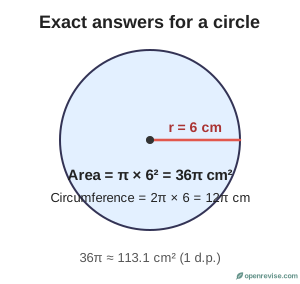
Worked example. A circle has radius 6 cm. Find its area and circumference in terms of π.
Area = \pi r^2 = \pi \times 6^2 = 36\pi cm². Circumference = 2\pi r = 2 \times \pi \times 6 = 12\pi cm. If you are asked for a decimal, use the calculator on the exact answer: 36\pi = 113.097... \approx 113.1 cm² to 1 decimal place.
Worked example (semicircle). A semicircle has diameter 10 cm. Find its area in terms of π.
The radius is 5 cm. The area of the full circle would be \pi \times 5^2 = 25\pi, so the semicircle has area \frac{1}{2} \times 25\pi = \frac{25\pi}{2} = 12.5\pi cm².
Worked example (cylinder). A cylinder has radius 3 cm and height 10 cm. Find its volume in terms of π.
Volume = \pi r^2 h = \pi \times 3^2 \times 10 = 90\pi cm³.
Worked example (cone and sphere). The formulae for a cone and sphere are given in the exam. For a cone with radius 3 cm and height 4 cm, V = \frac{1}{3}\pi r^2 h = \frac{1}{3} \times \pi \times 9 \times 4 = 12\pi cm³. For a sphere of radius 3 cm, V = \frac{4}{3}\pi r^3 = \frac{4}{3} \times \pi \times 27 = 36\pi cm³.
Worked example (a ring). A circular path has outer radius 7 m and inner radius 4 m. Find its area in terms of π.
Area = \pi \times 7^2 - \pi \times 4^2 = 49\pi - 16\pi = 33\pi m². Taking out the common factor π saved a step.
Working backwards from an exact answer
If an exact answer is given in terms of π, divide by π to get the other values.
Worked example. A circle has area 49\pi cm². Find the radius. \pi r^2 = 49\pi, so r^2 = 49 and r = 7 cm.
Worked example. A circle has circumference 20\pi cm. 2\pi r = 20\pi, so 2r = 20 and r = 10 cm (the diameter is 20 cm).
Exact answers with surds (Higher tier)
Some exact answers include square roots that do not simplify, such as \sqrt{2} or 3\sqrt{5}. These are called surds. The diagonal of a square with side 1 is exactly \sqrt{2}, not 1.414.... Surds are covered in the next two lessons.
Exam-style example
Question. The diagram shows a circle of diameter 10 cm drawn inside a square of side 10 cm. Work out the shaded area (the part of the square outside the circle). Give your answer in terms of π, and then as a decimal to 1 decimal place.
Working. Area of the square: 10 \times 10 = 100 cm². The circle has radius 5 cm, so its area is \pi \times 5^2 = 25\pi cm². Shaded area = 100 - 25\pi cm². As a decimal, 25\pi = 78.539..., so 100 - 78.54 = 21.46 \approx 21.5 cm².
Notice that the exact answer 100 - 25\pi is not simplified to 75\pi. You cannot combine 100 and 25\pi, because one has a π and the other does not.
Common mistakes
- Using 3.14 for π when the answer should be 'in terms of π'.
- Rounding too early in a multi-step calculation. Keep the full calculator value (or the exact form) until the last step.
- Writing 36 \times \pi = 113.04 as the exact answer.
- Combining terms that are not alike: 100 - 25\pi \ne 75\pi.
- Forgetting to square the radius: the area is \pi r^2, not \pi \times r \times 2.
Summary
- Exact answers are not rounded. Leave them as fractions or in terms of π.
- Circumference = 2\pi r and area = \pi r^2.
- Treat π like a letter: 5\pi + 3\pi = 8\pi.
- Round only at the end, and use the calculator's value of π, not 3.14.
Test yourself on this lesson
9 exam questions · 22 marks · with mark schemes and model answers
Found a mistake?