1.9 Laws of indices
The laws of indices for multiplying, dividing and raising a power to a power, and the meaning of zero and negative indices, with numbers and with algebraic terms.
Index notation
Key terms
- Index (plural: indices): the small raised number in a power such as 5^3. It is also called a power or an exponent.
- Base: the number that is being multiplied by itself, such as the 5 in 5^3.
- Index laws: the rules for simplifying expressions with powers of the same base.
- Reciprocal: \frac{1}{a} is the reciprocal of a.
In 5^3, the base is 5 and the index is 3, and it means 5 \times 5 \times 5 = 125. The index laws let you simplify calculations and expressions that have the same base without writing them out in full.
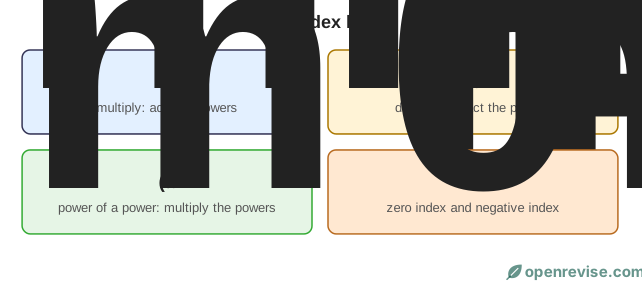
The three main laws
Law 1: multiplying (add the indices). a^m \times a^n = a^{m+n}.
3^4 \times 3^2 = 3^6 because (3 \times 3 \times 3 \times 3) \times (3 \times 3) has six 3s. So 3^4 \times 3^2 = 3^6 = 729.
Law 2: dividing (subtract the indices). a^m \div a^n = a^{m-n}.
5^7 \div 5^4 = 5^3 = 125, because four of the 5s cancel.
Law 3: a power of a power (multiply the indices). (a^m)^n = a^{m \times n}.
(2^3)^2 = 2^6 = 64, because 2^3 \times 2^3 = 2^{3+3}.
Algebraic terms
The same laws work with letters. When there are numbers in front (coefficients), deal with those separately by multiplying or dividing them, and use the index laws on each letter.
Worked example. Simplify 3x^2 \times 4x^3.
Multiply the numbers: 3 \times 4 = 12. Add the powers of x: x^2 \times x^3 = x^5. The answer is 12x^5.
Worked example. Simplify 15y^8 \div 3y^2.
15 \div 3 = 5 and y^8 \div y^2 = y^6, so the answer is 5y^6.
Worked example. Simplify (2x^3)^4.
Both the 2 and the x^3 are raised to the power 4: 2^4 \times (x^3)^4 = 16x^{12}.
Worked example. Simplify (a^2b)^3 \times 2ab^4.
(a^2b)^3 = a^6b^3. Then a^6b^3 \times 2ab^4 = 2a^{6+1}b^{3+4} = 2a^7b^7. Remember that a means a^1.
Zero and negative indices
Zero index. Any number (except 0) to the power 0 is 1: a^0 = 1. For example 7^0 = 1, (-3)^0 = 1 and 1\,000\,000^0 = 1. This follows from law 2: 5^3 \div 5^3 = 5^0, and any number divided by itself is 1.
Negative index. A negative power means a reciprocal: a^{-n} = \dfrac{1}{a^n}. Look at the pattern in the powers of 2: each step to the left halves the number.
| n | -3 | -2 | -1 | 0 | 1 | 2 | 3 | 4 |
|---|---|---|---|---|---|---|---|---|
| 2^n | \frac{1}{8} | \frac{1}{4} | \frac{1}{2} | 1 | 2 | 4 | 8 | 16 |
- 2^{-3} = \dfrac{1}{2^3} = \dfrac{1}{8}
- 10^{-2} = \dfrac{1}{100} = 0.01
- 5^{-1} = \dfrac{1}{5}
- \left(\dfrac{3}{4}\right)^{-2} = \left(\dfrac{4}{3}\right)^{2} = \dfrac{16}{9}, because a negative power of a fraction turns the fraction upside down.
A negative index does not make the answer negative: 2^{-3} = \frac{1}{8}, not -8.
Solving simple equations with indices
Write both sides with the same base. If 2^n = 64 then 2^n = 2^6 so n = 6. If 5^n = \frac{1}{25} then 5^n = 5^{-2}, so n = -2.
Exam-style example
Question. Show that \dfrac{2^5 \times 2^{-2}}{2^4} = \dfrac{1}{2}.
Answer. Add the indices on the top: 2^5 \times 2^{-2} = 2^{5 + (-2)} = 2^3. Then divide by 2^4: 2^3 \div 2^4 = 2^{3-4} = 2^{-1} = \dfrac{1}{2}.
Common mistakes
- Multiplying the bases: 2^3 \times 2^4 \ne 4^7. Keep the base and add the indices: 2^7.
- Adding the indices when raising a power to a power: (x^3)^2 = x^6, not x^5.
- Writing 3x^2 \times 4x^3 = 12x^6: the powers are added (to give x^5), not multiplied.
- Writing (2x)^3 = 2x^3. The 2 is cubed as well: (2x)^3 = 8x^3.
Why do the index laws work?
The laws are not magic: they follow from what a power means. a^4 means a \times a \times a \times a, and a^2 means a \times a. When you multiply them you write out all the a's together: a^4 \times a^2 = (a \times a \times a \times a) \times (a \times a) = a^6. That is six a's, which is 4 + 2. When you divide, the same number of a's on the top and the bottom cancel: a^5 \div a^2 = \dfrac{a \times a \times a \times a \times a}{a \times a} = a^3, so 5 - 2 = 3 a's are left. When you take a power of a power, you are repeating a whole group several times: (a^3)^2 = a^3 \times a^3 = a^6, and 3 \times 2 = 6.
The zero and negative laws come from carrying on the pattern. Divide a^3 by a^3: the answer is 1 because anything divided by itself is 1, but the law also says a^{3-3} = a^0, so a^0 must be 1. Divide a^2 by a^3: cancelling leaves \dfrac{1}{a}, and the law says a^{2-3} = a^{-1}, so a^{-1} = \dfrac{1}{a}.
A method for simplifying expressions
- Numbers first. Multiply or divide the numerical coefficients.
- One letter at a time. Group each letter and apply the right law to its powers.
- Brackets. Apply any power outside a bracket to every factor inside, numbers included, using the power-of-a-power law.
- Write the answer neatly, with no brackets left and no negative indices unless they are asked for.
For example, to simplify \dfrac{12a^5b^2}{3a^2b^6}: the numbers give 12 \div 3 = 4, the a's give a^{5-2} = a^3 and the b's give b^{2-6} = b^{-4}. The answer is 4a^3b^{-4}, or \dfrac{4a^3}{b^4}.
Linking to other topics
The index laws are used when you work with standard form (the powers of 10 are added or subtracted), in algebra when you simplify and expand, in roots (a square root is the same as a power of \frac{1}{2}) and in compound interest and growth problems with repeated multiplication. They are one of the most useful sets of rules in the whole GCSE course, so make sure you can state each law and use it quickly without a calculator.
Summary
- a^m \times a^n = a^{m+n} a^m \div a^n = a^{m-n} (a^m)^n = a^{mn}
- a^0 = 1 and a^1 = a
- a^{-n} = \dfrac{1}{a^n}: a negative index means a reciprocal, not a negative number.
- Deal with the numbers and each letter separately.
Test yourself on this lesson
9 exam questions · 21 marks · with mark schemes and model answers
Found a mistake?