1.8 Squares, cubes and roots
Square numbers up to 15 × 15, cube numbers, powers of 2, 3, 4 and 5, square roots, cube roots and higher roots, estimating a root between two integers, and knowing that 1000 = 10³ and 1 million = 10⁶.
Squares and cubes
Key terms
- Square number: the result of multiplying a whole number by itself, such as 7 \times 7 = 49.
- Cube number: the result of multiplying a whole number by itself twice, such as 4 \times 4 \times 4 = 64.
- Square root: a number that gives the original number when multiplied by itself. The square root of 49 is 7.
- Cube root: a number that gives the original number when multiplied by itself twice. The cube root of 64 is 4.
- Power (index): a small raised number that tells you how many times to multiply a number by itself.
Squaring a number means multiplying it by itself. We write 7^2 (said '7 squared'), which means 7 \times 7 = 49. It is called a square number because it is the area of a square with sides of that length. A cube number such as 4^3 = 4 \times 4 \times 4 = 64 is the volume of a cube.
You are expected to recall the square numbers up to 15 \times 15 without a calculator.
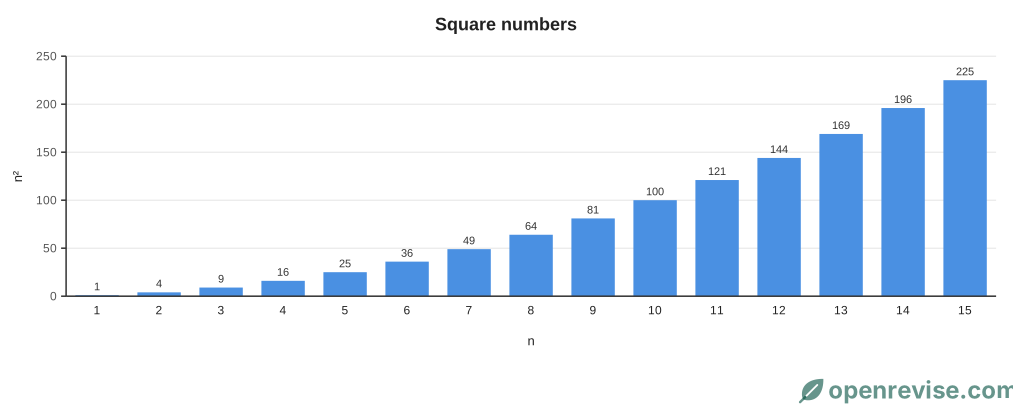
| n | 1 | 2 | 3 | 4 | 5 | 6 | 7 | 8 | 9 | 10 |
|---|---|---|---|---|---|---|---|---|---|---|
| n^2 | 1 | 4 | 9 | 16 | 25 | 36 | 49 | 64 | 81 | 100 |
| n^3 | 1 | 8 | 27 | 64 | 125 | 216 | 343 | 512 | 729 | 1000 |
The remaining squares are 11^2 = 121, 12^2 = 144, 13^2 = 169, 14^2 = 196 and 15^2 = 225. Notice that 64 is both a square number and a cube number: 8^2 = 64 and 4^3 = 64.
Other powers
A power shows repeated multiplication. 2^5 = 2 \times 2 \times 2 \times 2 \times 2 = 32. You should recognise the powers of 2, 3, 4 and 5.
| Base | Powers |
|---|---|
| 2 | 2, 4, 8, 16, 32, 64, 128, 256, 512, 1024 |
| 3 | 3, 9, 27, 81, 243 |
| 4 | 4, 16, 64, 256 |
| 5 | 5, 25, 125, 625 |
Powers of 10. 10^2 = 100, 10^3 = 1000, 10^4 = 10\,000, and so on. You should know that 1000 = 10^3 and 1 million = 10^6. The power tells you how many zeros follow the 1.
Roots
A root is the inverse of a power. The square root of 49 is written \sqrt{49} = 7 because 7^2 = 49. The cube root of 64 is written \sqrt[3]{64} = 4 because 4^3 = 64. Higher roots work in the same way: \sqrt[4]{81} = 3 because 3^4 = 81.
Square roots have two values. Because (-7) \times (-7) = 49 as well, the equation x^2 = 49 has two solutions: x = 7 or x = -7, written x = \pm 7. The symbol \sqrt{\ } on its own means the positive root.
Worked example. Work out \sqrt{144} + \sqrt[3]{27}.
\sqrt{144} = 12 and \sqrt[3]{27} = 3, so the answer is 12 + 3 = 15.
Worked example. Work out 5^3 - 4^2.
5^3 = 125 and 4^2 = 16, so 125 - 16 = 109.
Worked example. A square has area 169 cm². What is the length of its side?
The side is \sqrt{169} = 13 cm. A cube has volume 216 cm³; its edge is \sqrt[3]{216} = 6 cm.
Estimating roots
If a number is not a perfect square, its root lies between two integers. Find the nearest square numbers on each side.
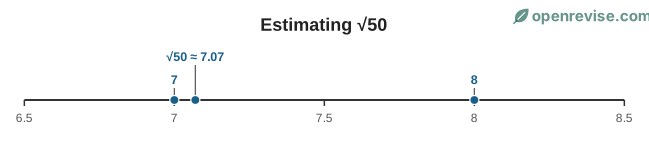
Worked example. Estimate \sqrt{50}.
49 < 50 < 64, so 7 < \sqrt{50} < 8. Since 50 is much closer to 49 than to 64, \sqrt{50} is just above 7: about 7.1. A calculator gives 7.07 (to 2 d.p.).
Worked example. Between which two integers does \sqrt[3]{30} lie?
27 < 30 < 64, so 3 < \sqrt[3]{30} < 4. It is close to 3, about 3.1.
Using a calculator
Use the x^2, x^3 and x^{\square} keys for powers and the \sqrt{\ }, \sqrt[3]{\ } and \sqrt[\square]{\ } keys for roots. Check that you can reproduce these answers: 2^{10} = 1024, \sqrt{2025} = 45 and \sqrt[3]{1728} = 12.
Common mistakes
- Writing 4^3 = 4 \times 3 = 12. The power means 4 \times 4 \times 4 = 64.
- Thinking the square root of 100 is 50. Halving is not the same as taking a root.
- Forgetting that (-5)^2 = 25 is positive, because a negative times a negative is positive.
- Mixing up 2^3 = 8 and 3^2 = 9.
Exam-style example
Question. (a) Write down the value of 3^4. (b) Write down a number that is both a square number and a cube number, and is greater than 1. (c) Show that \sqrt{90} is between 9 and 10.
Answer. (a) 3^4 = 3 \times 3 \times 3 \times 3 = 81. (b) 64, because 8^2 = 64 and 4^3 = 64. (c) 9^2 = 81 and 10^2 = 100, and 81 < 90 < 100, so 9 < \sqrt{90} < 10.
Why are they called squares and cubes?
A square number gets its name from geometry. If you arrange counters in a square grid, the number of counters is a square number: a 3 by 3 grid has 9 counters and a 4 by 4 grid has 16. The side length of the square is the number you squared. In the same way, a cube number counts the small unit cubes in a larger cube: a cube with edges of 3 units is made of 27 unit cubes, because 3 \times 3 \times 3 = 27. This is why finding a square root or cube root is the same as finding the side length of a square with a given area or the edge length of a cube with a given volume.
Patterns in the square numbers
Look at the differences between neighbouring square numbers: 1, 4, 9, 16, 25, 36 have gaps of 3, 5, 7, 9, 11. These gaps are the odd numbers, so you can build each square number from the one before it. For example 8^2 = 7^2 + 15 = 49 + 15 = 64. This also shows that adding the first n odd numbers always gives n^2: 1 + 3 + 5 + 7 = 16 = 4^2.
The last digit of a square number can only be 0, 1, 4, 5, 6 or 9. So a number such as 2 347 cannot be a perfect square because it ends in 7. This is a quick way to rule out answers in a question about square numbers.
A step-by-step method for estimating roots
- Write down the square numbers (or cube numbers) either side of the number you are given.
- State the two integers that the root lies between.
- Decide which of the two the number is closer to, and give an estimate.
- Check by squaring your estimate: 7.1^2 = 50.41, which is close to 50.
Where these facts are used
Square numbers and square roots are used throughout GCSE mathematics: finding the side of a square from its area, Pythagoras' theorem, the quadratic formula, the equation of a circle and the laws of indices. Cube numbers appear in volume calculations and in questions about the volume of a cube. If you know the squares up to 15 and the cubes up to 10 instantly, many of these questions become much quicker.
Summary
- Know the squares up to 15^2, the cubes up to 10^3, and the powers of 2, 3, 4 and 5 in the tables.
- 1000 = 10^3 and 1 million = 10^6.
- Roots are the inverse of powers: \sqrt{49} = 7, \sqrt[3]{64} = 4.
- The equation x^2 = k has two solutions, x = \pm \sqrt{k}.
- To estimate a root, find the two perfect powers on either side.
Test yourself on this lesson
9 exam questions · 19 marks · with mark schemes and model answers
Found a mistake?