1.7 Systematic listing and the product rule for counting
Counting outcomes with systematic lists, tables and diagrams so that none is missed or repeated, and (Higher tier) the product rule for counting: multiply the number of choices at each stage.
Listing outcomes
Key terms
- Outcome: one possible result of an event or choice.
- Systematic list: a list written in an organised order so that no outcome is missed or repeated.
- Product rule for counting: if there are m ways to make one choice and n ways to make another independent choice, there are m \times n ways to make both.
- Repetition: using the same item more than once, for example the digit 3 appearing twice in 33.
Many problems ask how many different ways something can happen, or ask you to list all the possibilities. If you list them at random it is easy to miss some or to write the same one twice. A systematic method fixes this: keep one item fixed while the others change, and work in a logical order (alphabetical or numerical).
Systematic lists
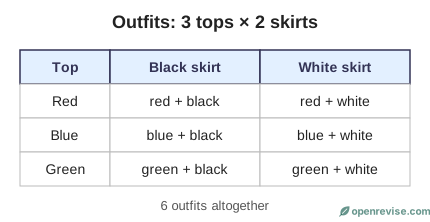
Worked example. Ellie has three tops (red, blue, green) and two skirts (black, white). List all the possible outfits.
Fix the top and run through the skirts: red with black, red with white; then blue with black, blue with white; then green with black, green with white. That is 6 outfits.
Worked example. How many two-digit numbers can be made using the digits 3, 5 and 7?
If a digit can be repeated: 33, 35, 37, 53, 55, 57, 73, 75, 77, which is 9 numbers. If a digit cannot be repeated: 35, 37, 53, 57, 73, 75, which is 6 numbers. Always read the question to see whether repetition is allowed.
Worked example. A coin is tossed three times. List all the outcomes.
Keep the first toss fixed and vary the others: HHH, HHT, HTH, HTT, then THH, THT, TTH, TTT. There are 8 outcomes. Each extra toss doubles the number of outcomes.
Using a table
When two events happen together, a two-way table (or grid) shows every combination without any chance of missing one. For two spinners, with one numbered 1 to 3 and one numbered 1 to 4, a table with 3 rows and 4 columns shows 12 outcomes. To find how many outcomes give a sum of 5, look along the diagonal: (1,4), (2,3), (3,2) gives 3 outcomes. The same idea is used for sample spaces in probability.
The product rule for counting (Higher tier)
Listing every outcome is slow when there are many. The product rule gives the total by multiplying the number of choices at each stage.
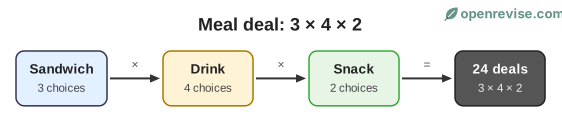
Worked example. A meal deal has a choice of 3 sandwiches, 4 drinks and 2 snacks. How many different meal deals are there?
3 \times 4 \times 2 = 24 different meal deals.
Worked example. A PIN has 4 digits, each chosen from 0 to 9, and digits can repeat. How many PINs are there?
There are 10 choices for each of the 4 digits, so 10 \times 10 \times 10 \times 10 = 10^4 = 10\,000.
Worked example. A code has 2 letters, each chosen from the 26 letters of the alphabet, followed by 3 digits. How many codes are possible?
26 \times 26 \times 10 \times 10 \times 10 = 676\,000.
Worked example (no repetition). Five friends run a race. In how many ways can 1st, 2nd and 3rd places be given?
There are 5 choices for 1st place. Once someone has won, there are 4 left for 2nd, and then 3 left for 3rd place. So 5 \times 4 \times 3 = 60 ways. When items cannot be repeated, the number of choices decreases at each stage.
Exam-style example
Question. A café sells 3 types of sandwich (cheese, ham or egg), 4 drinks and 2 cakes. A lunch deal is one sandwich, one drink and one cake. (a) How many different lunch deals are there? (b) Sam does not eat egg. How many lunch deals can Sam choose from? (c) Write down three different lunch deals with a ham sandwich.
Answer. (a) 3 \times 4 \times 2 = 24. (b) Sam has only 2 sandwiches to pick from, so 2 \times 4 \times 2 = 16. (c) For example: ham, tea, flapjack; ham, juice, flapjack; ham, tea, brownie (any three different combinations).
Common mistakes
- Adding the numbers of choices instead of multiplying: a meal deal with 3 sandwiches and 4 drinks has 3 \times 4 = 12 combinations, not 7.
- Repeating an outcome that is the same in a different order, for example counting 'red, black' and 'black, red' as different outfits.
- Forgetting to check whether repetition is allowed.
- Missing outcomes because the list is not organised.
Summary
- Make lists systematically: keep one item fixed while the others change, in order.
- Use a table for two events, which also helps with probability.
- Higher tier: the number of ways of doing several things in a row is found by multiplying the number of choices at each stage.
- If something cannot be repeated, reduce the number of choices each time.
Test yourself on this lesson
9 exam questions · 21 marks · with mark schemes and model answers
Found a mistake?