4.1 The structure of the atom and isotopes
The structure of the atom, the size of atoms and nuclei, atomic number, mass number, isotopes and ions, and how electrons move between energy levels when they absorb or emit radiation.
Inside the atom
Key terms
- Atom: the smallest part of an element that can exist. Atoms are the building blocks of all matter.
- Nucleus: the tiny, dense, positively charged centre of an atom. It contains the protons and neutrons.
- Proton: a positively charged particle found in the nucleus.
- Neutron: a particle with no charge found in the nucleus.
- Electron: a very small, negatively charged particle that moves around the nucleus in energy levels.
- Element: a substance made of only one type of atom, with all its atoms having the same number of protons.
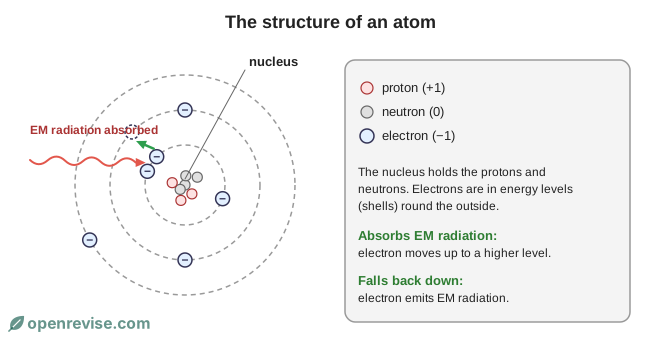
Everything around you is made of atoms. Each atom has a nucleus at its centre, which is made of protons and neutrons. The electrons are found in regions around the nucleus called energy levels (or shells).
How big is an atom?
Atoms are extremely small. An atom has a radius of about 1 \times 10^{-10} \text{ m}, which is 0.1 nanometres. You could line up about ten million atoms across a full stop.
The nucleus is even smaller. Its radius is less than \frac{1}{10\,000} of the radius of the whole atom, typically about 1 \times 10^{-15} \text{ m}. Almost all of the mass of the atom is in the nucleus, but the nucleus takes up only a tiny fraction of its volume. If an atom were the size of a football stadium, the nucleus would be about the size of a pea at the centre. The rest of the atom is mostly empty space.
Relative charge and mass
The three sub-atomic particles have different properties. Relative values are used because the real masses and charges are incredibly small.
| Particle | Relative charge | Relative mass | Where it is found |
|---|---|---|---|
| Proton | +1 | 1 | In the nucleus |
| Neutron | 0 | 1 | In the nucleus |
| Electron | −1 | Very small (about 1/2000) | In energy levels around the nucleus |
An atom has no overall charge: the number of electrons equals the number of protons, so the positive and negative charges cancel out. This is why atoms are described as neutral.
Atomic number and mass number
Every atom can be described by two numbers.
- The atomic number is the number of protons in the nucleus. It decides which element the atom is. All carbon atoms have 6 protons.
- The mass number is the total number of protons and neutrons in the nucleus.
You can work out the number of neutrons:
\text{number of neutrons} = \text{mass number} - \text{atomic number}
An atom is written in nuclear notation, with the mass number at the top and the atomic number at the bottom. For sodium:
^{23}_{11}\text{Na}
Worked example. How many protons, neutrons and electrons are in an atom of ^{23}_{11}\text{Na}?
- Protons = atomic number = 11
- Neutrons = 23 − 11 = 12
- Electrons = the same as protons = 11
Isotopes
Key terms
- Isotopes: atoms of the same element with the same number of protons but a different number of neutrons.
Isotopes of an element have the same atomic number but different mass numbers. Carbon has three isotopes. The two you see most often are carbon-12 and carbon-14.

| Isotope | Protons | Neutrons | Electrons |
|---|---|---|---|
| Carbon-12 | 6 | 6 | 6 |
| Carbon-14 | 6 | 8 | 6 |
Isotopes have the same chemical properties, because chemical reactions depend on the electrons, and isotopes have the same number of electrons. Their masses are different. Some isotopes, such as carbon-14, have unstable nuclei, which means they are radioactive.
Ions
Key terms
- Ion: an atom that has lost or gained one or more electrons, so it has an overall charge.
An atom becomes an ion when its number of electrons changes. The number of protons never changes.
- If an atom loses electrons, there are more protons than electrons, so it becomes a positive ion. A sodium atom that loses one electron becomes Na⁺, with 11 protons and 10 electrons.
- If an atom gains electrons, it becomes a negative ion.
Electrons and energy levels
Electrons can only be at certain distances from the nucleus, in energy levels. The levels closest to the nucleus have the lowest energy.
- If an electron absorbs electromagnetic radiation of the right frequency, it gains energy and moves to a higher energy level, further from the nucleus.
- When the electron falls back down to a lower energy level, it emits electromagnetic radiation.
- If an electron absorbs enough energy, it can leave the atom altogether. The atom becomes a positive ion.
Test yourself on this lesson
8 exam questions · 19 marks · with mark schemes and model answers
Found a mistake?