3.8 Gas pressure, volume and doing work on a gas
Gas pressure acting at right angles to surfaces, the relationship pV = constant at constant temperature, and how doing work on a gas raises its temperature. For Separate Science.
Pressure in a gas
Key terms
- Pressure: the force acting per unit area on a surface. It is measured in pascals (Pa).
- Constant temperature: the temperature stays the same while other quantities change.
- Work done: energy transferred by a force moving through a distance.
The pressure of a gas produces a force on any surface it touches. The force always acts at right angles (perpendicular) to the surface.
Pressure and volume
If the temperature of a fixed mass of gas stays the same, then decreasing the volume increases the pressure.
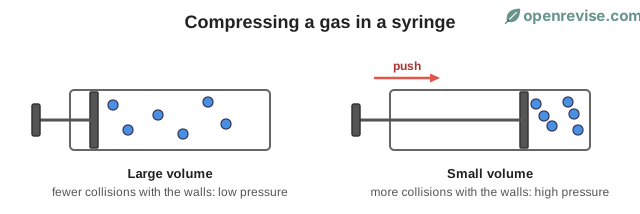
When the volume decreases, the same number of particles are in a smaller space. They hit the walls more often, so the force on each unit area is bigger and the pressure increases.
For a fixed mass of gas at constant temperature, pressure × volume is constant:
p V = \text{constant}
so for a change from one state to another:
p_1 V_1 = p_2 V_2
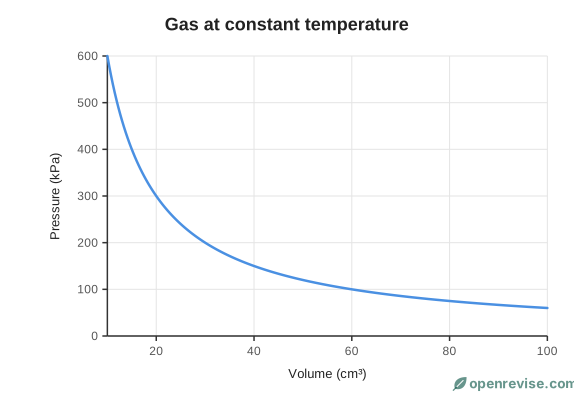
The graph is a curve: doubling the volume halves the pressure. This is an example of inverse proportion.
Worked example. A gas has a pressure of 100 kPa and a volume of 60 cm³. It is compressed to 20 cm³ at the same temperature. Calculate the new pressure.
p_2 = \frac{p_1 V_1}{V_2} = \frac{100 \times 60}{20} = 300 \text{ kPa}
Doing work on a gas (Higher tier)
When you compress a gas by pushing the piston in, you do work on the gas. The energy is transferred to the internal energy of the gas: the particles gain kinetic energy and move faster. The temperature of the gas rises.
This is why the barrel of a bicycle pump gets warm when you pump quickly: work is done compressing the air, and it increases the air's internal energy and temperature.
More calculations with p₁V₁ = p₂V₂
Example 1: a syringe. A syringe contains 50 cm³ of air at a pressure of 100 kPa. The end is sealed and the plunger is pushed in until the volume is 20 cm³. The temperature is constant.
p_2 = \frac{p_1 V_1}{V_2} = \frac{100 \times 50}{20} = 250 \text{ kPa}
Example 2: a bicycle pump. A pump holds 800 cm³ of air at atmospheric pressure (100 kPa). All of this air is pushed into a tyre of volume 200 cm³. Assuming the temperature stays the same:
p_2 = \frac{100 \times 800}{200} = 400 \text{ kPa}
Example 3: a bubble. A bubble of volume 2.0 cm³ rises from the bottom of a lake, where the pressure is 300 kPa, to the surface, where it is 100 kPa.
V_2 = \frac{p_1 V_1}{p_2} = \frac{300 \times 2.0}{100} = 6.0 \text{ cm}^3
The bubble gets three times bigger. The units of pressure and volume can be anything, as long as they are the same on both sides.
Why is pV constant?
Imagine that you halve the volume of a gas. The same number of particles are now in half the space, so each part of the wall is hit twice as often. The pressure doubles, so p \times V stays the same. This applies only if the temperature and the mass of gas do not change.
Investigating the relationship
Trap a fixed mass of air in a syringe connected to a pressure gauge. Change the volume by pushing the plunger in, and wait for the temperature to settle. Record the volume and pressure each time. A graph of pressure against volume is a curve, and a graph of pressure against 1 ÷ volume is a straight line through the origin, which shows that pressure is inversely proportional to volume.
Work done on a gas, and cooling (Higher tier)
When a gas is compressed, work is done on it. The energy transferred increases the internal energy, so the gas warms. This is why the barrel of a bicycle pump becomes warm. When a gas expands and pushes something out of the way, it does work on its surroundings, and its internal energy decreases, so it cools. This is why an aerosol can feels cold when you use it for a long time: the gas that comes out expands quickly and cools.
Test yourself on this lesson
9 exam questions · 22 marks · with mark schemes and model answers
Found a mistake?