4.4 Background radiation and detecting radiation
Natural and man-made sources of background radiation, radiation dose in sieverts, detecting radiation with a Geiger-Müller tube and photographic film, and correcting a count for background.
Background radiation
Key terms
- Background radiation: low-level ionising radiation that is around us all the time, from natural and man-made sources.
- Radiation dose: a measure of the risk of harm from exposure to radiation. It is measured in sieverts (Sv).
- Geiger-Müller tube: a detector that records the ionising radiation that enters it, as clicks or counts.
- Corrected count rate: the count rate from a source after the background count rate has been subtracted.
You are being exposed to radiation right now. A small amount of ionising radiation is always around us. It is called background radiation, and in most places it is too small to be harmful.
Sources of background radiation
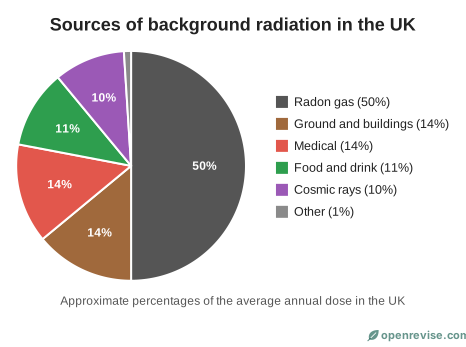
Most background radiation is natural.
- Radon gas. Radon is a radioactive gas given off by rocks such as granite. It is the biggest source in the UK and can build up in houses.
- The ground and buildings. Rocks, soil, bricks and concrete contain small amounts of radioactive substances.
- Food and drink. Plants and animals take in radioactive isotopes such as potassium-40 and carbon-14.
- Cosmic rays. High-energy particles from the Sun and other stars that hit the atmosphere.
Some background radiation is man-made.
- Medical sources, such as X-rays and gamma-ray scans. This is the biggest man-made source.
- Nuclear weapons testing and nuclear accidents, which released radioactive substances into the environment. This is now a very small amount.
- Nuclear power stations and industry, which cause a tiny dose for most people.
Why the amount of background radiation varies
The background radiation depends on where you live and what job you do.
- In some places, such as Cornwall, the rocks contain more granite and so give off more radon.
- Higher up, there are fewer atoms of air above you to absorb cosmic rays. Airline pilots and cabin crew get a higher dose.
- Uranium miners, radiographers and workers in nuclear power stations may also receive a higher dose from their work.
Radiation dose
The risk of harm from radiation depends on the type of radiation and the amount absorbed by the body. Radiation dose takes both of these into account and is measured in sieverts (Sv). Because the sievert is a large unit, doses are usually quoted in millisieverts (mSv), where 1 mSv = 0.001 Sv. The average person in the UK receives about 2.7 mSv each year from all sources.
Detecting radiation
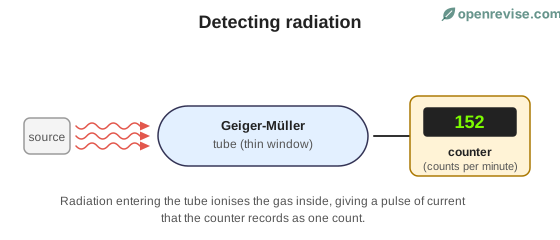
- Geiger-Müller (GM) tube. Radiation enters through a thin window and ionises the gas inside the tube. This causes a brief pulse of electric current, which is counted. The counter records the count rate (counts per second or per minute) and may click.
- Photographic film. Radiation darkens photographic film in the same way as light. People who work with radiation wear film badges. The film is developed later, and the amount of darkening shows how much radiation they have been exposed to.
Correcting for background radiation
When you measure the radiation from a source, the detector also counts background radiation. So the reading is too high. You need to:
- Measure the background count rate with no source present.
- Measure the count rate with the source.
- Subtract: \text{corrected count rate} = \text{measured count rate} - \text{background count rate}
Worked example. The background count rate is 20 counts per minute. With the source in place, the count rate is 260 counts per minute.
Corrected count rate = 260 − 20 = 240 counts per minute.
For the most reliable values, measure the background for a long time (for example 10 minutes) and take a mean, because the counts are random.
Test yourself on this lesson
9 exam questions · 16 marks · with mark schemes and model answers
Found a mistake?