4.5 Nuclear equations
How to write and balance nuclear equations for alpha decay, beta decay, gamma emission and (for Edexcel) positron emission.
Writing nuclear equations
Key terms
- Nuclear equation: an equation showing the nuclei and particles before and after a nuclear change. The mass numbers and atomic numbers must balance.
- Daughter nucleus: the nucleus that is left after the original (parent) nucleus has decayed.
- Mass number: the total number of protons and neutrons in a nucleus (the top number).
- Atomic number: the number of protons in a nucleus (the bottom number).
When an unstable nucleus decays, it turns into the nucleus of a different element (or the same element with a different mass). We show this with a nuclear equation. Each particle is written using nuclear notation:
^{A}_{Z}\text{X}
where A is the mass number, Z is the atomic number, and X is the symbol.
The rule for every nuclear equation is that both the mass numbers and the atomic numbers must balance. The total on the left must equal the total on the right.
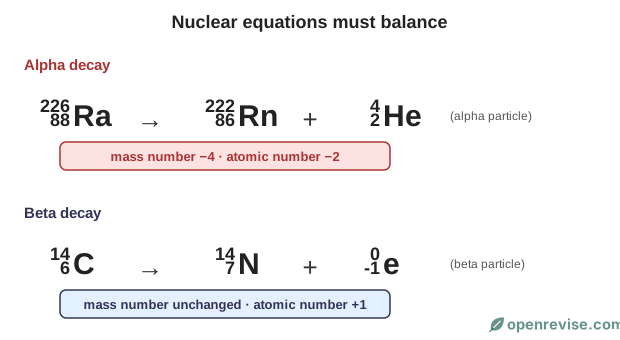
Alpha decay
An alpha particle is a helium nucleus, ^{4}_{2}\text{He}. When a nucleus emits an alpha particle:
- the mass number goes down by 4;
- the atomic number goes down by 2.
Worked example. Radium-226 (atomic number 88) decays by emitting an alpha particle to form radon.
^{226}_{88}\text{Ra} \rightarrow\; ^{222}_{86}\text{Rn} + ^{4}_{2}\text{He}
Check: mass numbers 226 = 222 + 4 ✓ and atomic numbers 88 = 86 + 2 ✓.
Beta decay
In beta decay, a neutron in the nucleus changes into a proton and an electron. The electron is emitted at high speed as the beta particle. It is written ^{0}_{-1}\text{e}.
- the mass number stays the same (the electron has almost no mass);
- the atomic number goes up by 1 (one more proton).
Worked example. Carbon-14 (atomic number 6) decays by beta emission into nitrogen.
^{14}_{6}\text{C} \rightarrow\; ^{14}_{7}\text{N} + ^{0}_{-1}\text{e}
Check: mass numbers 14 = 14 + 0 ✓ and atomic numbers 6 = 7 + (−1) ✓.
Gamma emission
When a nucleus has extra energy, it can lose it by emitting a gamma ray. Gamma rays have no mass and no charge, so neither the mass number nor the atomic number changes. Gamma emission usually follows alpha or beta decay. For example, the daughter nucleus produced by a beta decay may be in an excited state and release a gamma ray to reach a more stable state.
Positron emission (Edexcel)
When a nucleus has too many protons, a proton can change into a neutron and a positron, ^{0}_{+1}\text{e}.
- the mass number stays the same;
- the atomic number goes down by 1.
^{22}_{11}\text{Na} \rightarrow\; ^{22}_{10}\text{Ne} + ^{0}_{+1}\text{e}
More worked examples
Example 1: finding the daughter nucleus. Thorium-232 (atomic number 90) emits an alpha particle.
- Mass number: 232 − 4 = 228
- Atomic number: 90 − 2 = 88, which is radium
^{232}_{90}\text{Th} \rightarrow\; ^{228}_{88}\text{Ra} + ^{4}_{2}\text{He}
Example 2: finding the emitted particle. The equation ^{90}_{38}\text{Sr} \rightarrow\; ^{90}_{39}\text{Y} + \text{?} has the same mass number on both sides but one extra proton. So the missing particle must have a mass number of 0 and a charge of −1. It is a beta particle, ^{0}_{-1}\text{e}.
Example 3: a decay series. Radioactive substances often decay in a series. After each decay the daughter nucleus may still be unstable, so it decays again, and this carries on until a stable nucleus is made. For example, uranium-238 decays to thorium-234 by alpha emission, then thorium-234 decays to protactinium-234 by beta emission. The mass number goes 238 → 234 → 234 and the atomic number goes 92 → 90 → 91.
Summary of the changes
| Type of decay | Particle emitted | Change in mass number | Change in atomic number |
|---|---|---|---|
| Alpha | Helium nucleus ^{4}_{2}\text{He} | −4 | −2 |
| Beta (β⁻) | Electron ^{0}_{-1}\text{e} | 0 | +1 |
| Gamma | Electromagnetic wave | 0 | 0 |
| Positron (β⁺) | Positron ^{0}_{+1}\text{e} | 0 | −1 |
How to balance an equation
- Write down the mass number and atomic number of the parent nucleus.
- Write the emitted particle's numbers.
- Find the unknown by subtracting: daughter mass number = parent − emitted; daughter atomic number = parent − emitted.
- Use the new atomic number to identify the element, using the periodic table or the information in the question.
Example. Uranium-238 (atomic number 92) emits an alpha particle. The daughter mass number is 238 − 4 = 234. The atomic number is 92 − 2 = 90, which is thorium.
^{238}_{92}\text{U} \rightarrow\; ^{234}_{90}\text{Th} + ^{4}_{2}\text{He}
Test yourself on this lesson
9 exam questions · 18 marks · with mark schemes and model answers
Found a mistake?