4.6 Half-life
Half-life as the time for the activity or number of nuclei to halve, reading it from a decay curve, calculating activity after a number of half-lives, and the net decline as a ratio.
What is half-life?
Key terms
- Half-life: the time it takes for the number of unstable nuclei in a sample of an isotope to halve. It is also the time it takes for the activity (or the count rate) of the sample to fall to half its starting value.
- Activity: the number of nuclei that decay each second, measured in becquerels (Bq).
- Count rate: the number of decays detected by a counter in a given time.
- Random: unpredictable. You cannot say when any one nucleus will decay.
Radioactive decay is a random process. If you look at a single unstable nucleus, you cannot tell when it will decay: it could be in the next second or in a million years. But when there is a very large number of nuclei, the pattern of decay becomes very predictable. For every isotope there is a fixed time, called the half-life, in which half of the unstable nuclei in a sample will have decayed.
For example, if a sample of an isotope contains 800 unstable nuclei, and its half-life is 3 hours, then:
- after 3 hours, 400 unstable nuclei are left;
- after 6 hours, 200 are left;
- after 9 hours, 100 are left.
Because the activity is proportional to the number of unstable nuclei that are left, the activity halves in the same way. Half-lives vary hugely: from a fraction of a second for some isotopes to billions of years for others. Technetium-99m, which is used in hospitals, has a half-life of 6 hours. Uranium-238 has a half-life of 4.5 billion years.
The decay curve
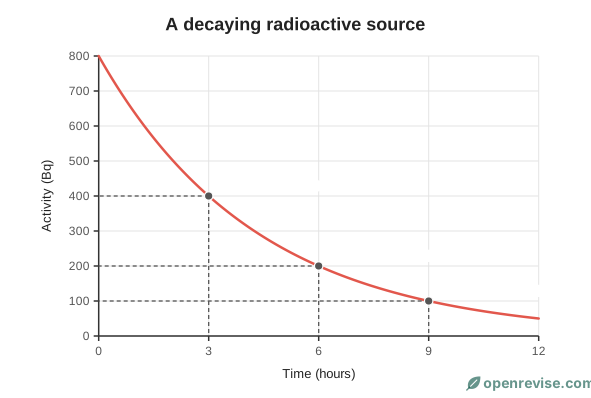
The graph shows how the activity falls with time. The curve gets less steep because there are fewer nuclei left to decay. To find the half-life from a graph:
- Read the starting activity (800 Bq).
- Find half of that value (400 Bq) on the vertical axis.
- Go across to the curve, then down to the time axis. This is the half-life (3 hours).
- Check with another half: from 400 Bq to 200 Bq should take the same time.
Calculating after a number of half-lives
Each half-life halves the amount again, so the fraction left after n half-lives is \left(\frac{1}{2}\right)^n.

| Number of half-lives | Fraction remaining | Percentage remaining |
|---|---|---|
| 0 | 1 | 100% |
| 1 | 1/2 | 50% |
| 2 | 1/4 | 25% |
| 3 | 1/8 | 12.5% |
| 4 | 1/16 | 6.25% |
Worked example 1. A sample has an activity of 640 Bq. The half-life is 5 minutes. What is its activity after 20 minutes?
- Number of half-lives = 20 ÷ 5 = 4
- 640 → 320 → 160 → 80 → 40 Bq
Worked example 2. A source has a half-life of 12 hours. What fraction of the unstable nuclei is left after 36 hours?
36 ÷ 12 = 3 half-lives, so the fraction left is \frac{1}{2} \times \frac{1}{2} \times \frac{1}{2} = \frac{1}{8}.
Half-life with background radiation
When you find a half-life from experimental data, you must subtract the background count rate from every reading first. For example, if the background is 20 counts per minute and the readings are 260, 140 and 80 counts per minute, the corrected readings are 240, 120 and 60 counts per minute. This halves every time, so the half-life is the time between each reading.
Net decline as a ratio (Higher tier)
The net decline compares the starting activity with the activity after a number of half-lives. After 3 half-lives the activity falls to \frac{1}{8} of its starting value, so the ratio of final to initial activity is 1 : 8. After 4 half-lives it is 1 : 16. Always say which way round your ratio is, for example "initial : final = 16 : 1".
Worked example. A source has a half-life of 2 days. Calculate the ratio of the activity after 8 days to the starting activity.
8 ÷ 2 = 4 half-lives, so the activity falls to \frac{1}{16} of its initial value: final : initial = 1 : 16.
Why half-life matters
The half-life of an isotope tells you how long it stays dangerous. An isotope with a short half-life loses its activity quickly, so it is safe after a short time, but it is very active at the start. An isotope with a long half-life stays radioactive for a very long time, so it must be stored safely for many years, although its activity at any moment is low.
Test yourself on this lesson
9 exam questions · 22 marks · with mark schemes and model answers
Found a mistake?