4.10 Nuclear fusion
How light nuclei join in nuclear fusion, why fusion needs extremely high temperature and pressure, fusion in stars and the difficulties of fusion power. For Separate Science.
Nuclear fusion
Key terms
- Nuclear fusion: the joining of two light nuclei to form a heavier nucleus, with the release of energy.
- Plasma: a very hot gas in which the atoms have lost their electrons, leaving charged ions and free electrons.
- Isotopes of hydrogen: deuterium (hydrogen-2) and tritium (hydrogen-3), which are used as fuel for fusion.
Nuclear fusion is the opposite of fission. Instead of a large nucleus splitting, two small nuclei join together to make a larger nucleus. This is how the Sun, and the other stars, produce their energy.
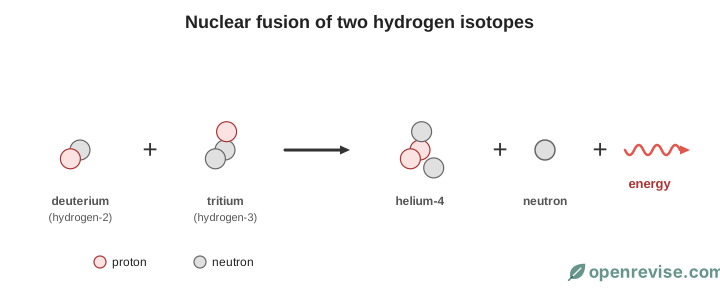
In the reaction shown, a nucleus of deuterium (hydrogen-2) and a nucleus of tritium (hydrogen-3) join together to form a nucleus of helium-4 and a neutron, and energy is released:
^{2}_{1}\text{H} + ^{3}_{1}\text{H} \rightarrow\; ^{4}_{2}\text{He} + ^{1}_{0}\text{n} + \text{energy}
Check the balance: mass numbers 2 + 3 = 5 and 4 + 1 = 5 ✓. Atomic numbers 1 + 1 = 2 and 2 + 0 = 2 ✓.
Where does the energy come from?
The nucleus formed in fusion has slightly less mass than the two nuclei that joined together. This small amount of mass is converted into energy. Because the amount of energy released is so large compared with the mass that disappears, fusion releases much more energy for each kilogram of fuel than any chemical reaction, and more than fission.
Why is fusion so difficult?
All nuclei have a positive charge, so two nuclei repel each other. They can only fuse if they are forced very close together, against the electrostatic repulsion. To do this, the nuclei have to be moving extremely fast, so they need:
- an extremely high temperature, about 100 million °C on Earth, which gives the particles enough kinetic energy;
- a very high pressure (or density), so that collisions happen often enough.
At these temperatures the fuel is a plasma. No solid material can hold something at 100 million °C, because it would melt, so a plasma is held in place using very strong magnetic fields. This is the idea behind tokamak reactors, such as those used in experiments. Another approach is to heat a tiny pellet of fuel with powerful lasers.
Fusion in stars
In the Sun and other stars, the temperature in the core is very high (about 15 million °C), and the huge gravitational force pulls so much matter inwards that the pressure and density are enormous. Hydrogen nuclei fuse into helium and this releases energy, which keeps the star hot and prevents it from collapsing. Larger stars can go on to make heavier elements.
Fusion power on Earth
Scientists have been trying to build a fusion power station for many years. If it can be done, it would have many benefits:
- the fuel (hydrogen from sea water) is almost unlimited;
- there is no carbon dioxide released;
- there is no long-lived radioactive waste, and no chain reaction that could get out of control, because if anything goes wrong the plasma cools and fusion stops.
But there are big problems:
- it takes a huge amount of energy to heat and contain the plasma, and scientists have so far not been able to get more energy out than they put in over a long period;
- the technology is very expensive to develop;
- no fusion reactor currently supplies electricity to the National Grid.
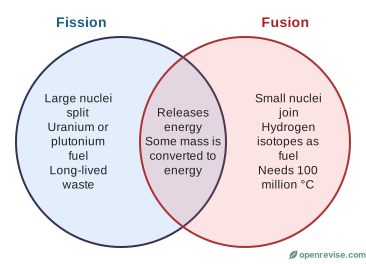
Fission and fusion compared
| Feature | Fission | Fusion |
|---|---|---|
| What happens to the nuclei? | A large nucleus splits into smaller ones | Small nuclei join to make a larger one |
| Fuel | Uranium-235 or plutonium-239 | Hydrogen isotopes (deuterium and tritium) |
| Conditions needed | Neutrons to start it | Extremely high temperature and pressure |
| Waste | Radioactive waste for thousands of years | Very little, mostly short-lived |
| Used now? | Yes: nuclear power stations | Only in experiments (and in stars) |
Test yourself on this lesson
9 exam questions · 22 marks · with mark schemes and model answers
Found a mistake?