4.9 Nuclear fission
How nuclear fission releases energy, how a chain reaction is started and controlled in a nuclear reactor, and the advantages and disadvantages of nuclear power. For Separate Science.
Nuclear fission
Key terms
- Nuclear fission: the splitting of a large, unstable nucleus into two smaller nuclei, releasing energy.
- Chain reaction: a reaction in which the neutrons released by one fission go on to cause further fissions.
- Control rods: rods that absorb neutrons, used to control the rate of a chain reaction in a reactor.
- Moderator: a material that slows down neutrons, so that they are more likely to be absorbed by uranium-235 nuclei.
- Coolant: a fluid that carries thermal energy away from the reactor core.
Some very large nuclei, such as uranium-235 and plutonium-239, can be made to split into two smaller nuclei. This is called nuclear fission. These are the fuels used in nuclear power stations.
How fission happens
- A slow-moving neutron is absorbed by a nucleus of uranium-235.
- The nucleus becomes unstable and splits into two smaller nuclei (the daughter nuclei), which are radioactive.
- Two or three neutrons are also released, as well as gamma rays.
- The products have a lot of kinetic energy. When they collide with surrounding atoms, this is transferred to the thermal store of the material.
A typical fission reaction is:
^{1}_{0}\text{n} + ^{235}_{92}\text{U} \rightarrow\; ^{141}_{56}\text{Ba} + ^{92}_{36}\text{Kr} + 3\; ^{1}_{0}\text{n} + \text{energy}
Check the balance: mass numbers 1 + 235 = 236 and 141 + 92 + 3 = 236 ✓. Atomic numbers 0 + 92 = 92 and 56 + 36 = 92 ✓.
The chain reaction
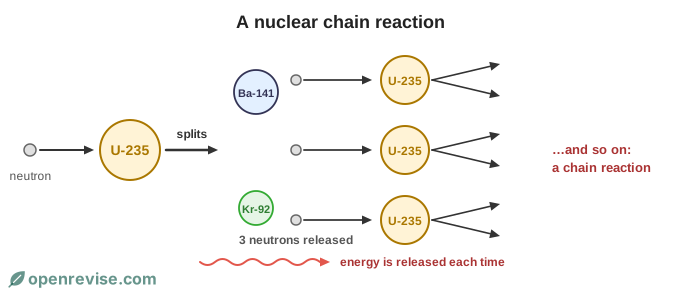
The neutrons released by the first fission can be absorbed by other uranium-235 nuclei, and these split, releasing more neutrons, and so on. This is a chain reaction.
- In a nuclear weapon, the chain reaction is uncontrolled, so a huge amount of energy is released in a fraction of a second.
- In a nuclear reactor, the chain reaction is controlled, so that on average only one neutron from each fission causes another fission. This releases energy at a steady rate.
Very little fuel is needed: the fission of 1 kg of uranium-235 releases millions of times more energy than burning 1 kg of coal.
Inside a nuclear reactor
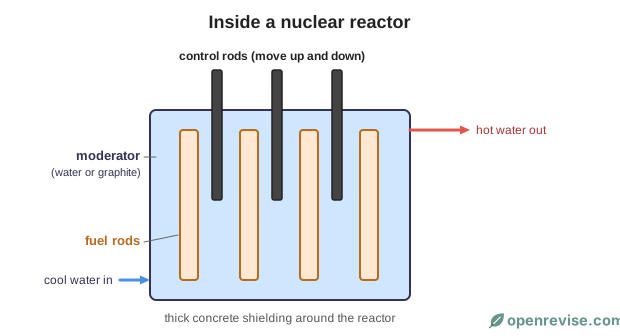
- Fuel rods contain the uranium-235 or plutonium-239, where the fission takes place.
- The moderator (water or graphite) surrounds the fuel. Neutrons from fission are fast-moving, and are more likely to be absorbed when they are slowed down by collisions with the moderator.
- Control rods, made of materials such as boron or cadmium, absorb neutrons. They are lowered into the core to slow down the reaction, or raised to make it faster. If they are fully lowered, the reaction stops.
- A coolant (water or carbon dioxide) is pumped through the core, and carries the thermal energy away.
- Thick concrete shielding absorbs the radiation, so that people outside are safe.
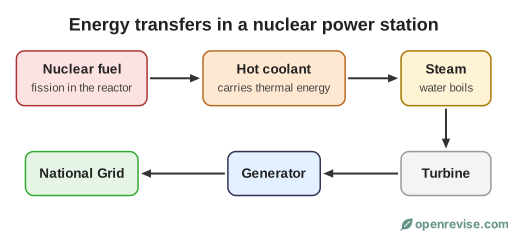
The hot coolant is used to boil water to make steam, which turns a turbine, which drives a generator. A nuclear power station is therefore just like a fossil fuel power station, except that the energy comes from fission rather than burning.
For and against nuclear power
| Advantages | Disadvantages |
|---|---|
| No carbon dioxide is made when it is running, so it does not add to global warming | Produces radioactive waste, which has to be stored safely for thousands of years |
| Very large amounts of energy from a small amount of fuel | Accidents, such as at Chernobyl and Fukushima, can release radioactive material over a large area |
| Reliable: it can run day and night, whatever the weather | Very expensive and slow to build, and expensive to decommission at the end |
| Large power output from one station | Uranium is a limited resource and mining it is harmful to the environment |
Many people disagree about whether nuclear power is a good choice. Some support it as a low-carbon energy source, and others worry about safety, waste and cost. A good answer weighs up both sides.
Test yourself on this lesson
9 exam questions · 24 marks · with mark schemes and model answers
Found a mistake?