2.2 Charge and current
Electric current as the rate of flow of charge, the equation Q = It, conventional current, and why the current is the same everywhere in a series loop.
What is an electric current?
Key terms
- Electric current: the rate of flow of electric charge. It is measured in amperes (A).
- Charge: a property of matter that causes electrical effects. It is measured in coulombs (C).
- Conventional current: the direction a positive charge would move, from the positive terminal of a cell to the negative terminal.
An electric current is a flow of charge. A current only flows in a complete circuit that has a source of potential difference, such as a cell or battery.
In a metal wire the charge is carried by electrons. Metals contain free (delocalised) electrons that can move through the wire. When a cell is connected, the electrons are pushed round the circuit from the negative terminal towards the positive terminal.
Electrons have a negative charge, so they move in the opposite direction to conventional current. On circuit diagrams, arrows for current are drawn in the conventional direction, from + to −.
Charge, current and time
The bigger the current, the more charge passes each point every second. A current of 1 ampere means that 1 coulomb of charge passes a point each second.
Q = I t
- Q is charge flow in coulombs (C)
- I is current in amperes (A)
- t is time in seconds (s)
Worked example. A current of 3 A flows through a lamp for 20 s. Calculate the charge that flows.
Q = I t = 3 \times 20 = 60 \text{ C}
You can rearrange the equation to find the current or the time:
I = \frac{Q}{t} \qquad t = \frac{Q}{I}
Current in a series circuit
In a single loop with no branches, the current is the same everywhere. Charge is not used up as it passes through the components, so the same amount flows through every part of the loop each second. It does not matter where an ammeter is placed in the loop, the reading will be the same.
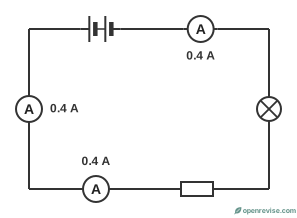
An ammeter is always connected in series so that all the current goes through it. It has a very low resistance, so it does not change the current it is measuring.
Why does a lamp light as soon as you close the switch?
The free electrons in a wire only drift slowly, at roughly a millimetre per second. Yet a lamp lights almost the instant that you close the switch. This is because the wire is already full of free electrons. When the circuit is complete, an electric field is set up in the whole circuit almost instantly, and all of the electrons start to move together. It is like a pipe full of water: if you push more water in at one end, water comes out of the other end at once.
More calculations with Q = It
Example 1: lightning. A flash of lightning transfers 20 C of charge in 0.002 s.
I = \frac{Q}{t} = \frac{20}{0.002} = 10\,000 \text{ A}
Example 2: a phone charger. A charger gives a current of 1.5 A for 2.0 hours. First change the time to seconds: 2.0 \times 3600 = 7200 s.
Q = I t = 1.5 \times 7200 = 10\,800 \text{ C}
Example 3: finding the time. A charge of 45 C flows round a circuit with a current of 0.25 A.
t = \frac{Q}{I} = \frac{45}{0.25} = 180 \text{ s} (3 minutes)
Typical currents
| Device | Current |
|---|---|
| LED indicator | 0.02 A (20 mA) |
| Torch bulb | 0.3 A |
| Phone charger | 1 A to 2 A |
| Electric kettle | about 10 A |
| Lightning | about 10 000 A or more |
A current of only a few tens of milliamperes through the body can be fatal, which is why mains electricity is so dangerous.
Measuring current
An ammeter measures the current. It is connected in series, in the loop of the circuit, so all of the current passes through it. A good ammeter has a very low resistance, so adding it to the circuit does not change the current that it is measuring. Take care with units: the ammeter may read in milliamperes (mA), and 1000 mA = 1 A.
Test yourself on this lesson
9 exam questions · 19 marks · with mark schemes and model answers
Found a mistake?