2.4 I-V characteristics
The current-potential difference graphs of a resistor, a filament lamp and a diode, why their shapes differ, and how to find resistance from a graph.
Current-potential difference graphs
Key terms
- I-V characteristic: a graph of current (I) against potential difference (V) for a component.
- Ohmic conductor: a conductor whose current is directly proportional to the potential difference across it, as long as its temperature stays the same.
- Filament lamp: a lamp with a thin metal wire that glows white-hot when a current passes through it.
- Diode: a component that lets current pass in one direction only.
An I-V characteristic shows how the current through a component changes as the potential difference across it changes. The shape of the graph tells you how its resistance behaves. Remember that R = \frac{V}{I}, so the resistance at any point is the potential difference divided by the current at that point.
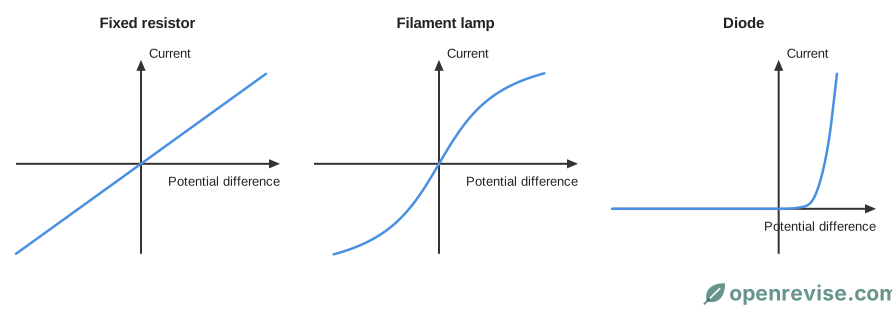
Fixed resistor (ohmic conductor)
The graph is a straight line through the origin. The current is directly proportional to the potential difference, so the resistance is constant. This is only true if the temperature stays constant.
Filament lamp
The graph is a curve that gets flatter as the potential difference increases. The current rises more slowly than the potential difference, which means the resistance increases as the current increases.
The reason is that the current heats the filament. The metal ions in the filament vibrate more, so the electrons collide with them more often. It is harder for the charge to flow, so the resistance goes up.
The graph is the same shape in both directions, so the lamp behaves the same way if the potential difference is reversed.
Diode
A diode lets current through in one direction only. In the forward direction the graph is flat at first and then the current rises steeply once the potential difference is high enough. In the reverse direction the resistance is very high and the current is almost zero.
| Component | Shape of graph | Resistance |
|---|---|---|
| Fixed resistor | Straight line through the origin | Constant (at constant temperature) |
| Filament lamp | Curve that flattens out | Increases as the current and temperature increase |
| Diode | Zero current in reverse, steep rise forwards | Very high in reverse, low in forward direction |
Finding resistance from a graph
To find the resistance at a point on the graph, read off the current and potential difference and use R = \frac{V}{I}.
For a lamp, a point at 6.0 V and 1.5 A gives R = \frac{6.0}{1.5} = 4.0 \text{ Ω}. Do not use the gradient of a curved graph: the resistance is the ratio of V to I at that point.
Finding the resistance from a table of results
You can use any pair of values of V and I to find the resistance at that point, using R = \frac{V}{I}. The table shows results for a filament lamp.
| Potential difference V (V) | Current I (A) | Resistance R = V ÷ I (Ω) |
|---|---|---|
| 1.0 | 0.50 | 2.0 |
| 2.0 | 0.90 | 2.2 |
| 3.0 | 1.20 | 2.5 |
| 4.0 | 1.40 | 2.9 |
| 5.0 | 1.55 | 3.2 |
| 6.0 | 1.65 | 3.6 |
As the potential difference goes up, the resistance increases, as the filament gets hotter. For a fixed resistor the resistance column would have the same value all the way down.
A warning about gradients
For a fixed resistor, the I-V graph is a straight line through the origin, and its gradient is \frac{I}{V} = \frac{1}{R}. A steeper line therefore means a smaller resistance. For a curve, you cannot use the gradient to find the resistance. Use R = \frac{V}{I} at the point you are interested in.
More about diodes
A diode only conducts when the potential difference is large enough in the forward direction. For a silicon diode, this is about 0.6 V to 0.7 V, and for an LED about 1.5 V to 3 V. Below this, the current is almost zero. In the reverse direction, the resistance is very high, and almost no current flows.
Diodes are used:
- to protect a circuit from being damaged if a battery is connected the wrong way round;
- to change a.c. into d.c. (rectification), since the diode only lets through the current in one direction;
- as LEDs, which are used for indicators, displays and lighting, because they are efficient and last a long time.
Describing a graph
When you describe an I-V graph in an exam, give the shape and then say what that shows about the resistance. For example: "The graph is a curve that gets less steep, so the resistance increases as the potential difference increases, because the filament gets hotter."
Test yourself on this lesson
9 exam questions · 18 marks · with mark schemes and model answers
Found a mistake?