2.6 LDRs and thermistors
How the resistance of an LDR changes with light intensity and of an NTC thermistor with temperature, and how they are used in automatic lights, thermostats and alarms.
Sensing components
Key terms
- LDR (light-dependent resistor): a resistor whose resistance decreases as the light intensity increases.
- Thermistor: a resistor whose resistance changes with temperature. In the thermistors you need to know, the resistance decreases as the temperature increases.
- Sensor: a component that responds to a change in the surroundings, such as light or temperature.
Some components change their resistance when their surroundings change. They are used as sensors in circuits that switch things on and off automatically.
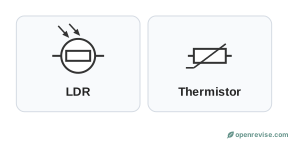
Light-dependent resistors (LDRs)
- In bright light the resistance of an LDR is low.
- In the dark the resistance of an LDR is very high.
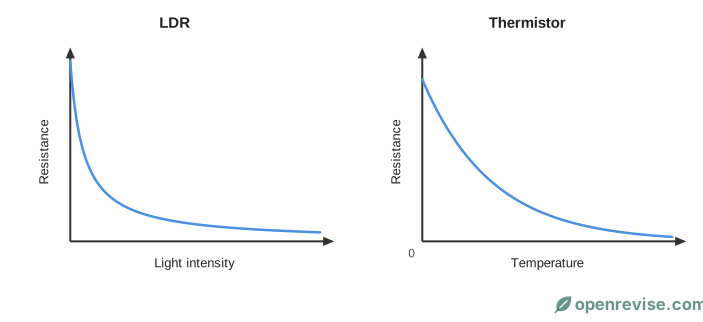
So as the light intensity increases, the resistance of an LDR decreases.
Thermistors
- When the temperature is low, the resistance of the thermistor is high.
- When the temperature is high, the resistance of the thermistor is low.
So as the temperature increases, the resistance of this type of thermistor decreases.
Why the current changes
The potential difference of the supply is fixed. Using I = \frac{V}{R}:
- When the resistance of a component falls, the current through it rises.
- When the resistance rises, the current falls.
Worked example. A thermistor is connected to a 6.0 V supply. At 20 °C the current is 0.0030 A, so its resistance is R = \frac{6.0}{0.0030} = 2000 \text{ Ω}. At 60 °C the current is 0.012 A, so R = \frac{6.0}{0.012} = 500 \text{ Ω}. The resistance fell as the temperature rose.
Uses
| Component | Uses |
|---|---|
| LDR | Automatic street lights and night lights (switch on when it gets dark), light meters in cameras |
| Thermistor | Thermostats in heating systems and ovens, fire alarms, digital thermometers, car engine temperature sensors |
For example, in an automatic night light the LDR's resistance becomes high in the dark. This changes the current in the circuit so that the lamp switches on.
Why does the resistance change?
LDRs and thermistors are made of semiconductor materials. In the dark, or when cold, very few electrons are free to move, so the resistance is high. When light falls on an LDR, or when a thermistor is heated, more electrons gain enough energy to become free, so more charge carriers are available and the resistance falls. The type of thermistor that you need to know about is called an NTC thermistor (negative temperature coefficient), because its resistance decreases as its temperature increases.
Calculations with R = V/I
You can find the resistance of an LDR or a thermistor by measuring the current and the potential difference.
| Temperature (°C) | Current | Resistance R = V ÷ I |
|---|---|---|
| 25 | 4.5 mA | 2000 Ω |
| 50 | 15 mA | 600 Ω |
| 75 | 36 mA | 250 Ω |
Example. An LDR is connected to a 9.0 V supply. In the dark, the current is 0.10 mA, so R = \frac{9.0}{0.000\,10} = 90\,000 Ω (90 kΩ). In bright light the current is 5.0 mA, so R = \frac{9.0}{0.0050} = 1800 Ω.
Everyday uses of LDRs and thermistors
| Component | Use | How it works |
|---|---|---|
| LDR | Automatic night light | In the dark, the resistance rises and the circuit switches on the lamp |
| LDR | Burglar alarm with a light beam | When the beam is broken, the light on the LDR drops, and the alarm sounds |
| LDR | Camera light meter | The resistance shows how bright the scene is |
| Thermistor | Thermostat in a heating system | The resistance changes as the room warms, and the circuit switches the heating on and off |
| Thermistor | Car engine temperature gauge | The resistance falls as the engine gets hotter, and the gauge shows the temperature |
| Thermistor | Fire alarm | A high temperature lowers the resistance and sets off the alarm |
Reading the graphs
For a thermistor, the graph of resistance against temperature is a curve that falls, steeply at first and then more gradually. It never reaches zero. The graph for an LDR is a similar curve against the light intensity. In an exam, read values from the graph and use them with R = \frac{V}{I} to work out the current or the potential difference.
Test yourself on this lesson
9 exam questions · 19 marks · with mark schemes and model answers
Found a mistake?