2.10 Mains electricity and plugs
Direct and alternating potential difference, UK mains electricity, the wires in a three-pin plug, and how fuses, earthing and circuit breakers keep users safe.
Direct and alternating potential difference
Key terms
- Direct current (d.c.): a current that flows in one direction only. Cells and batteries supply a direct potential difference.
- Alternating current (a.c.): a current that repeatedly reverses direction. Mains electricity is a.c.
- Frequency: the number of complete cycles every second. It is measured in hertz (Hz).
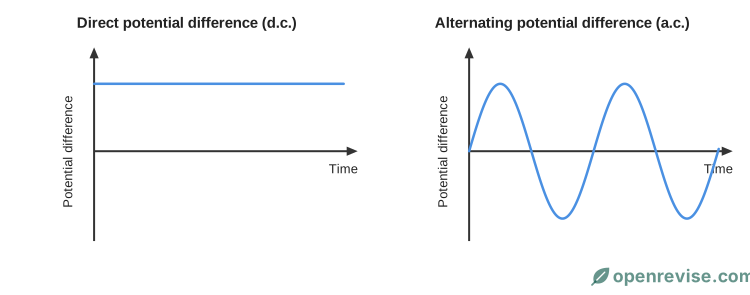
In the UK, the mains supply is an alternating potential difference of 230 V with a frequency of 50 Hz. This means the direction of the current changes 50 times every second.
The three-pin plug
Mains appliances are connected through a three-core cable to a three-pin plug. Each wire has a different colour, so it is connected to the right pin.
| Wire | Colour of insulation | Job |
|---|---|---|
| Live | Brown | Carries the alternating potential difference (230 V) from the supply to the appliance |
| Neutral | Blue | Completes the circuit; it is close to 0 V |
| Earth | Green and yellow stripes | A safety wire; it is at 0 V and does not normally carry a current |
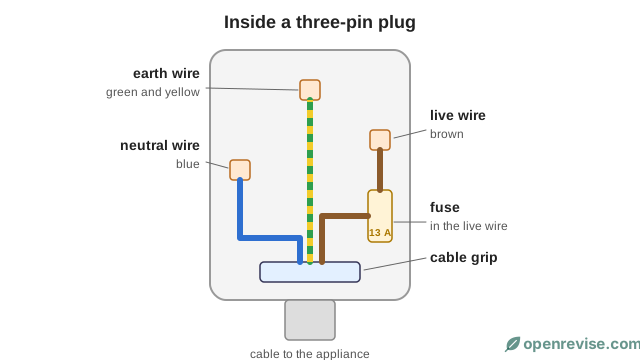
The plug case is made of plastic, which is a good insulator, and the pins are brass, which is a good conductor. The cable is held by a cable grip so that the wires cannot be pulled out.
Why the live wire is dangerous
The live wire is at a potential difference of about 230 V compared with the earth (and with a person standing on the ground). If you touch it, a current can flow through your body to the earth, giving you an electric shock, which can be fatal. This is why switches and fuses are put in the live wire: when the switch is off, the appliance is not connected to the live wire.
Fuses, earthing and circuit breakers
- A fuse is a thin wire that melts if the current gets too large. This breaks the circuit and stops the current. It is in the live wire.
- The earth wire is connected to the metal case of an appliance. If the live wire comes loose and touches the case, a large current flows to earth through the earth wire. This melts the fuse, which disconnects the appliance from the live wire so that the case is no longer dangerous.
- A circuit breaker is an electromagnetic switch that opens when the current is too large. Unlike a fuse, it can be reset and it works faster.
Choosing the correct fuse
A fuse should have a rating that is just above the normal current of the appliance. Then it will not melt in normal use but it will melt if there is a fault. The fuses that are used in plugs are 3 A, 5 A and 13 A. To choose the right one, work out the current from the power and the potential difference, using I = \frac{P}{V} with V = 230 V, and then choose the nearest fuse above that current.
| Appliance | Power | Current | Fuse |
|---|---|---|---|
| Table lamp | 60 W | \frac{60}{230} = 0.26 A | 3 A |
| Television | 150 W | \frac{150}{230} = 0.65 A | 3 A |
| Electric heater | 1500 W | \frac{1500}{230} = 6.5 A | 13 A |
Double insulation
Some appliances, such as hairdryers and many power tools, have a plastic case and are double insulated. The live parts are separated from the user by two layers of insulation, so the case cannot become live, even if a wire comes loose. These appliances have only two wires (live and neutral) and no earth wire. They are marked with a symbol of one square inside another.
Other protection
A circuit breaker is a switch that opens automatically if the current is too high, and it can be reset. A residual current device (RCD) compares the current in the live and neutral wires and switches off the supply in a fraction of a second if they are different, which means that current is flowing through somebody or something it should not be. Circuit breakers and RCDs are usually found in the consumer unit (fuse box) of a house.
Staying safe with mains electricity
| Danger | Precaution |
|---|---|
| Water conducts electricity | Keep appliances away from water and never touch switches with wet hands |
| Damaged cables | Check for frayed wires and replace damaged cables |
| Overloaded sockets | Do not plug too many appliances into one socket |
| Metal objects in a socket | Use socket covers and never push objects into sockets |
| Overhead power lines | Never fly kites or climb pylons near power lines |
Why can a bird sit on a power line?
A bird sitting on a bare power line is safe because both of its feet are at the same potential. There is no potential difference across the bird, so no current flows through it. If the bird touched a different wire, or the pylon and a wire at the same time, there would be a potential difference across its body, and it would be killed.
Test yourself on this lesson
9 exam questions · 21 marks · with mark schemes and model answers
Found a mistake?