2.12 The National Grid
How the National Grid transfers electrical energy from power stations to homes, and why step-up and step-down transformers reduce energy wasted in the cables.
The National Grid
Key terms
- National Grid: a network of cables and transformers that links power stations to homes, schools and factories across the country.
- Step-up transformer: a transformer that increases the potential difference.
- Step-down transformer: a transformer that decreases the potential difference.
- Transmission: the transfer of electrical energy over long distances at high potential difference.
The National Grid is the system that carries electrical energy from power stations to consumers. It uses transformers to change the potential difference of the alternating current at different stages.
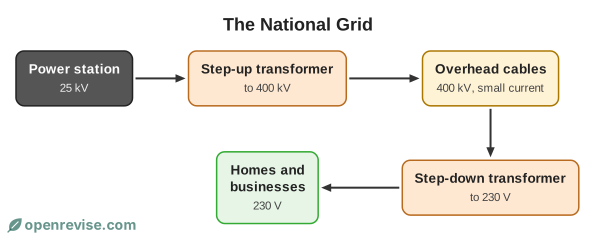
- A power station generates electricity at about 25 000 V (25 kV).
- A step-up transformer increases the potential difference to as much as 400 000 V (400 kV).
- The electricity is transmitted through overhead cables supported by pylons.
- Step-down transformers reduce the potential difference in stages, down to the 230 V used in homes.
Why use a high potential difference?
The power transferred by the cables is P = V I. For a given power, a higher potential difference means a smaller current.
The cables have a small resistance, so they heat up when a current passes through them, and energy is wasted as heat. The power wasted is:
P_{\text{wasted}} = I^2 R
Because the wasted power depends on the square of the current, halving the current reduces the wasted power to a quarter. So transmitting at a high potential difference (and a small current) means much less energy is wasted, which makes the National Grid efficient.
Worked example. A cable has a resistance of 10 Ω.
- At 100 A, P = I^2 R = 100^2 \times 10 = 100\,000 \text{ W}
- At 50 A, P = I^2 R = 50^2 \times 10 = 25\,000 \text{ W}
Halving the current cuts the power wasted from 100 kW to 25 kW.
Transformers
Transformers only work with alternating current. For a transformer that is 100% efficient, the power input equals the power output:
V_p \times I_p = V_s \times I_s
where V_p and I_p are the potential difference and current in the primary coil, and V_s and I_s are the values in the secondary coil. If the potential difference is stepped up, the current is stepped down. (This equation is needed for the Separate Science course. How transformers work is covered in a later lesson.)
Comparing the current at different potential differences
Example. A power station sends 200 MW (2.0 \times 10^8 W) into cables that have a total resistance of 0.50 Ω.
| Quantity | At 25 kV | At 400 kV |
|---|---|---|
| Current I = P \div V | \frac{2.0 \times 10^8}{25\,000} = 8000 A | \frac{2.0 \times 10^8}{400\,000} = 500 A |
| Power wasted P = I^2 R | 8000^2 \times 0.50 = 32 MW | 500^2 \times 0.50 = 0.125 MW |
| Percentage of the power wasted | 16% | 0.06% |
The potential difference was increased by a factor of 16, so the current fell by a factor of 16. Because the power wasted depends on the square of the current, the power wasted fell by 16^2 = 256 times (from 32 MW to 0.125 MW). This is why the National Grid transmits electricity at such a high potential difference.
Overhead cables or underground cables?
| Overhead cables on pylons | Underground cables |
|---|---|
| Cheaper to install and to repair | Much more expensive to install (about ten times as much) |
| Easy to reach if there is a fault | Harder to find and repair faults |
| Spoil the view and may affect wildlife | Hidden from view |
| Cooled by the air | Need to be insulated and get hot |
Stepping down in stages
The potential difference is reduced in several steps, for example from 400 kV to 132 kV, then to 33 kV, then to 11 kV and finally to 230 V for homes. Large factories may use a higher potential difference directly.
Why does the National Grid use a.c.?
A transformer only works with an alternating current. Since the Grid needs transformers, the whole system uses a.c. It is also easy to generate a.c. in power stations with alternators.
Supply and demand
The demand for electricity changes during the day and the year. It is greatest on winter evenings, when people are cooking, heating and using lights. The Grid has to match the supply to the demand at every moment. Gas power stations and pumped storage can start quickly, so they are used to meet sudden rises in demand, while the nuclear power stations run steadily all the time.
Test yourself on this lesson
9 exam questions · 23 marks · with mark schemes and model answers
Found a mistake?