2.13 Static charge
How insulators become charged by friction through the transfer of electrons, the forces between charges, sparks and earthing, and the uses and dangers of static electricity.
Static charge
Key terms
- Static electricity: electric charge that builds up on the surface of an insulator and stays there instead of flowing.
- Insulator: a material that does not let charge flow through it easily, such as plastic or rubber.
- Earthing: connecting an object to the ground with a conductor so that any charge can flow safely away.
- Spark: a sudden flow of charge through the air between two objects with a large potential difference between them.
Everything is made of atoms, which have a positive nucleus and negative electrons. Normally an object has equal amounts of positive and negative charge, so it has no overall charge.
Charging by friction
When two insulators are rubbed together, electrons are transferred from the surface of one to the surface of the other. The positive charges, in the nuclei, cannot move.
- The material that gains electrons becomes negatively charged.
- The material that loses electrons becomes positively charged.
For example, rubbing a polythene rod with a cloth transfers electrons from the cloth to the rod. The rod becomes negative and the cloth becomes positive. Both objects end up with the same amount of charge, but with opposite signs.
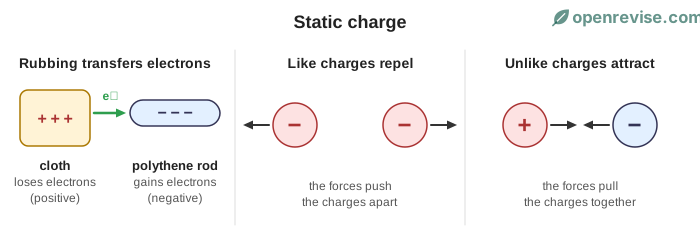
Forces between charges
- Like charges repel (positive and positive, or negative and negative).
- Unlike charges attract (positive and negative).
These are non-contact forces: the objects do not need to touch each other. A charged object also attracts a neutral insulator, such as a balloon sticking to a wall. The charge on the balloon pushes the electrons in the wall away and leaves the surface nearest the balloon with an opposite charge, so the balloon is attracted.
Sparks and earthing
If an object holds a lot of charge, the potential difference between it and a nearby conductor can become large. The air between them then lets the charge jump across as a spark. Touching a charged object can also give you a small shock.
Earthing is a way to make static charge safe. A conducting wire joins the charged object to the ground. Electrons flow through the wire, so the charge cannot build up.
Uses and dangers
| Uses | Dangers |
|---|---|
| Photocopiers and laser printers | Sparks when refuelling aircraft or cars, which could ignite fuel vapour |
| Paint sprayers (charged paint drops spread evenly) | Electric shocks from clothing or from walking on a carpet |
| Removing dust in chimneys (electrostatic precipitators) | Lightning, which is a huge spark |
Aircraft and fuel tankers are earthed when refuelling, so any charge that builds up as the fuel flows through the pipe is safely led away.
Hair standing on end
A Van de Graaff generator builds up a large charge on a metal dome. If a student touches the dome, the charge spreads over her body, including onto each of her hairs. Each hair has the same type of charge, so the hairs repel one another and stand out from her head.
Lightning
Lightning is a huge static spark. In a thundercloud, ice crystals and water drops collide, and electrons are transferred, so that the bottom of the cloud becomes negatively charged and the ground below becomes positively charged. The potential difference can be as high as hundreds of millions of volts, and when it is big enough, the air ionises and the charge flows between the cloud and the ground in a bright flash.
A lightning conductor on a tall building is a pointed metal rod connected to the ground by a thick copper strip. It lets charge flow safely to the ground, instead of through the building.
Conductors and insulators
Charge stays where it is put on an insulator, but flows away through a conductor. So you cannot charge a metal rod by rubbing it while you hold it, because the charge flows away through your body to the Earth. A metal rod can be charged if it is held with an insulating handle. This is why the objects in a static electricity demonstration are made of plastic or are held on insulating threads.
More uses of static electricity
- Electrostatic precipitators remove ash and smoke from the chimneys of power stations. The particles pick up a charge as they pass through a charged grid, and are attracted to plates of the opposite charge, from which they can be removed.
- Spray painting: the droplets of paint are given the same charge, so they repel one another and form a fine spray. The object is earthed so the droplets are attracted to it, and cover it evenly, even at the back.
- Photocopiers use charged drums to attract powdered ink in the pattern of the original.
More dangers, and how they are reduced
- Fuel and grain dust: a spark can ignite fuel vapour or the dust in a grain store and cause an explosion. Fuel tankers are earthed, and workers wear antistatic shoes.
- Hospitals: sparks could ignite the oxygen used in operating theatres, so special floors and clothes that let charge leak away are used.
- Clothes and carpets: charge on synthetic clothing can cause crackles and small shocks. Antistatic sprays and natural fibres help.
Test yourself on this lesson
9 exam questions · 21 marks · with mark schemes and model answers
Found a mistake?