2.8 Parallel circuits
The rules for current, potential difference and resistance in a parallel circuit, why total resistance falls when a branch is added, and why homes are wired in parallel.
Components in parallel
Key terms
- Parallel circuit: a circuit in which the components are connected on separate branches, so the current can take more than one path.
- Branch: one of the separate paths in a parallel circuit.
- Junction: a point where the current splits or joins.
In a parallel circuit each component is connected to the supply on its own branch. The current from the cell splits at a junction, goes through the branches, and then joins together again.
The rules for parallel circuits
1. The potential difference is the same across each branch, and it equals the potential difference of the supply.
V_{\text{total}} = V_1 = V_2
2. The currents in the branches add up to the total current from the supply.
I_{\text{total}} = I_1 + I_2
The branch with the smaller resistance has the larger current, because I = \frac{V}{R}.
3. The total resistance is less than the smallest resistance in any branch. Adding another branch gives the charge another path to flow along, so more current flows from the supply. The potential difference is the same, so the total resistance is lower.
Worked example
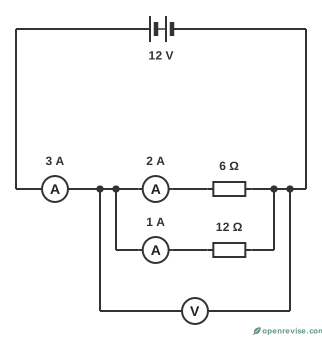
A 12 V battery is connected across a 6 Ω resistor and a 12 Ω resistor in parallel.
- Current in the 6 Ω branch: I = \frac{V}{R} = \frac{12}{6} = 2 \text{ A}
- Current in the 12 Ω branch: I = \frac{12}{12} = 1 \text{ A}
- Total current: 2 + 1 = 3 \text{ A}
- Total resistance: R = \frac{V}{I} = \frac{12}{3} = 4 \text{ Ω}
The total resistance (4 Ω) is smaller than the 6 Ω resistor, as expected.
Why homes use parallel circuits
Household appliances are connected in parallel because:
- each appliance gets the full mains potential difference, so it works properly;
- each can be switched on and off independently;
- if one appliance breaks, the others keep working.
Total resistance in a parallel circuit
You do not need a formula to find the total resistance of a parallel circuit. You can use the current to find the resistance of the whole circuit.
Example 1: two identical resistors. Two 4.0 Ω resistors are connected in parallel across a 12 V battery.
- Current in each = \frac{12}{4.0} = 3.0 A
- Total current = 3.0 + 3.0 = 6.0 A
- Total resistance = \frac{V}{I} = \frac{12}{6.0} = 2.0 Ω
So two identical resistors in parallel have a total resistance of half the resistance of one. Three identical resistors would have a third. For two different resistors, you can check with the rule that the total is always less than the smaller resistance.
A mixed example
Example 2. A 6.0 V battery is connected to three branches. Branch 1 is a lamp with a current of 0.30 A, branch 2 is another lamp with a current of 0.50 A, and branch 3 is a resistor R with a current of 0.20 A.
- Current from the battery = 0.30 + 0.50 + 0.20 = 1.0 A
- The p.d. across each branch is 6.0 V, so R = \frac{6.0}{0.20} = 30 Ω
Where to put the switches
A switch in the main wire (the part where the current is not split) controls all the branches. A switch in one branch controls only the components in that branch. This is why a house has a switch for each light: it is a parallel circuit, so each light can be turned on and off separately.
The danger of overloading a socket
In a house, each new appliance that is plugged into an extension lead is a new branch, so the total current from the supply increases. A lot of high-power appliances, such as heaters and kettles, on one socket might need more current than the cable can handle. The heating effect of the current makes the cable hot, which is a fire risk. This is why extension leads have a fuse and a maximum current rating, and why you should never plug too many appliances into one socket.
Checking your answers
There are two quick checks for a parallel circuit.
- The currents in the branches must add up to the current from the battery (or the current in the main wire).
- The total resistance must be smaller than the resistance of any one branch. If your answer is bigger, you have probably added the resistances, which is the rule for a series circuit.
Also remember that the branch with the smaller resistance has the bigger current, because every branch has the same potential difference across it, and I = \frac{V}{R}.
Test yourself on this lesson
9 exam questions · 22 marks · with mark schemes and model answers
Found a mistake?