1.1 SI units, prefixes and converting units
The SI units used in GCSE Physics, the prefixes from nano to giga, standard form and significant figures, and how to convert units before a calculation.
Why units matter
Every measurement in physics has a number and a unit. A mass of "5" means nothing, but 5 kg does. Equations only work when the quantities are in the right units, so converting units is a skill you will use in almost every calculation in this course.
Key terms
- SI unit: a unit from the international system of units, agreed by scientists all over the world.
- Prefix: a short word or letter put in front of a unit to show it is multiplied or divided by a power of ten.
- Standard form: a way of writing very large or very small numbers as a number between 1 and 10 multiplied by a power of ten.
SI units
| Quantity | Unit | Symbol |
|---|---|---|
| Length | metre | m |
| Mass | kilogram | kg |
| Time | second | s |
| Temperature | kelvin (or degree Celsius) | K (°C) |
| Force | newton | N |
| Energy | joule | J |
| Power | watt | W |
| Current | ampere | A |
| Potential difference | volt | V |
| Frequency | hertz | Hz |
Notice that the SI unit of mass is the kilogram, not the gram. That catches people out when they use Ek = ½mv² or Ep = mgh with a mass in grams.
Prefixes
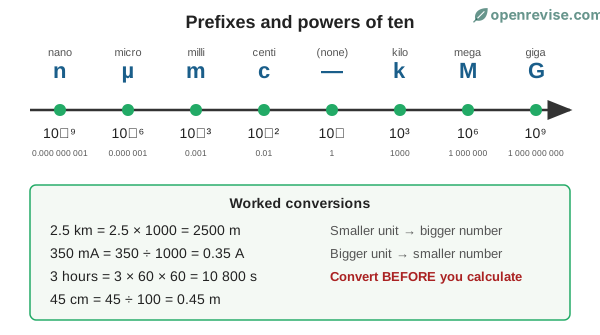
| Prefix | Symbol | Multiply the unit by | Standard form |
|---|---|---|---|
| nano | n | 0.000 000 001 | 1 × 10⁻⁹ |
| micro | µ | 0.000 001 | 1 × 10⁻⁶ |
| milli | m | 0.001 | 1 × 10⁻³ |
| centi | c | 0.01 | 1 × 10⁻² |
| kilo | k | 1000 | 1 × 10³ |
| mega | M | 1 000 000 | 1 × 10⁶ |
| giga | G | 1 000 000 000 | 1 × 10⁹ |
So 1 km = 1000 m, 1 mA = 0.001 A and 1 MJ = 1 000 000 J.
Converting units
- Write down the number and its unit.
- Decide whether you need a bigger or smaller unit.
- Multiply or divide by the right power of ten (or by 60 for minutes and hours).
Example 1. Convert 2.5 kJ to J. 1 kJ = 1000 J, so 2.5 × 1000 = 2500 J.
Example 2. Convert 350 mA to A. 1 mA = 0.001 A, so 350 × 0.001 = 0.35 A.
Example 3. Convert 3 hours to seconds. 3 × 60 = 180 minutes, and 180 × 60 = 10 800 s.
Example 4. Convert 45 cm to m. 45 ÷ 100 = 0.45 m.
Standard form and significant figures
Standard form is written as A \times 10^n, where A is between 1 and 10. The speed of light is 300 000 000 m/s, which is 3 × 10⁸ m/s. A small number such as 0.000 004 5 s is 4.5 × 10⁻⁶ s.
A significant figure is a digit that tells you something about the size of the number. Count from the first non-zero digit. 0.0472 has three significant figures, and so does 4.72. In a calculation, give your answer to the same number of significant figures as the least precise value you were given, or to two or three significant figures if you are not told.
Converting areas and volumes
Be careful when you convert squares and cubes. A square of side 1 m is 100 cm by 100 cm, so its area is 100 × 100 = 10 000 cm². The same idea applies to volumes.
| To convert | Multiply or divide by |
|---|---|
| m² to cm² | × 10 000 |
| cm² to m² | ÷ 10 000 |
| m³ to cm³ | × 1 000 000 |
| cm³ to m³ | ÷ 1 000 000 |
Example 5. Convert 250 cm² to m². 250 \div 10\,000 = 0.025 m².
Example 6. Convert 0.002 m³ to cm³. 0.002 \times 1\,000\,000 = 2000 cm³.
You will need this when you work with pressure (force ÷ area) and density (mass ÷ volume).
Units made from other units
Many quantities have units made by dividing one unit by another: speed is in metres per second (m/s), density is in kilograms per cubic metre (kg/m³) and acceleration is in metres per second squared (m/s²).
- To change a speed from km/h to m/s, divide by 3.6. For example, 72 km/h ÷ 3.6 = 20 m/s. To go from m/s to km/h, multiply by 3.6.
- To change a density from g/cm³ to kg/m³, multiply by 1000. For example, water has a density of 1.0 g/cm³, which is 1000 kg/m³.
Using standard form on a calculator
Most calculators have a button marked EXP or ×10ˣ for standard form. To enter 4.5 \times 10^{-6}, press 4.5, then the button, then the power (6 with a minus sign). Do not type "× 10" and then the power as a separate step, because the calculator will not treat it as one number. The display should show something like 4.5E-6.
Checking that an equation makes sense
You can use units as a check. For work done, W = F s, the unit of force is the newton and the unit of distance is the metre, so the unit of work is the newton metre (N m). One newton metre is one joule, which shows that the equation gives an energy. If the units of your answer are not the ones you expect, you may have used the wrong equation or a wrong value.
Estimating
Some questions ask you to estimate. It helps to know some typical values: the mass of an adult is about 70 kg, a walking speed is about 1.5 m/s, a mobile phone has a mass of about 0.15 kg, and the width of a human hair is about 1 \times 10^{-4} m. After you have calculated an answer, always ask yourself whether it is sensible.
Test yourself on this lesson
9 exam questions · 14 marks · with mark schemes and model answers
Found a mistake?