1.2 Energy stores and systems
The eight energy stores, the four ways energy is transferred, and how to describe energy changes in a system.
Energy and systems
Energy is not a substance you can see. It is a quantity that tells you how much "work" can be done. The unit of energy is the joule (J).
Key terms
- System: an object or group of objects that you choose to study.
- Energy store: a way in which energy is held in a system.
- Energy transfer: energy moving from one store to another, or from one object to another.
- Closed system: a system where neither matter nor energy can enter or leave, so the total energy never changes.
When you describe an energy change, you pick a system (for example, a ball and the Earth) and say which stores gain energy and which stores lose energy.
The energy stores
| Store | Example |
|---|---|
| Kinetic | A moving car, a falling ball |
| Gravitational potential | A book on a high shelf, water behind a dam |
| Elastic potential | A stretched spring or elastic band, a squashed rubber ball |
| Thermal | A hot cup of tea, the particles of any warm object |
| Chemical | Food, fuel, the chemicals in a battery |
| Magnetic | Two magnets that are pushed together or pulled apart |
| Electrostatic | Two charges that attract or repel each other |
| Nuclear | The nucleus of an atom, such as uranium |
Ways energy is transferred
Energy moves from one store to another in four ways:
- Mechanically: a force moves an object (a push, a pull, friction or air resistance);
- Electrically: a current flows through a circuit and does work;
- By heating: energy moves from a hotter object to a cooler one because of a temperature difference;
- By radiation: energy carried by waves such as light, infrared or sound.
Describing energy changes
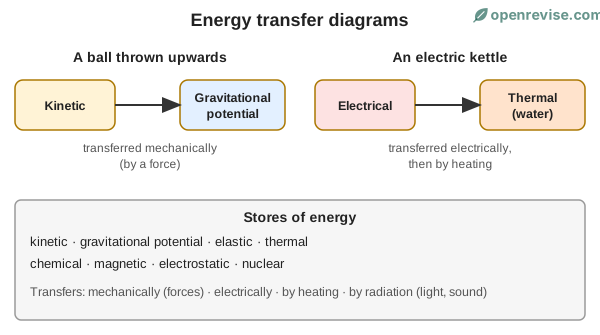
A ball thrown upwards. The ball starts with energy in its kinetic store. As it rises, a force (gravity) acts over a distance and energy is transferred mechanically to the gravitational potential store. Some energy is also transferred to the thermal store of the air by friction, so the total energy is shared out differently.
An electric kettle. Energy is transferred electrically to the heating element. The element heats the water, so energy is transferred by heating to the thermal store of the water.
A car braking. The kinetic store of the car decreases. Friction between the brakes and the wheels transfers energy mechanically and then by heating to the thermal stores of the brakes and the surroundings.
Energy in a closed system
In a closed system there is no net change in the total energy. Energy may move between stores, but the total stays the same. This idea is called the conservation of energy, and you will use it in the next lessons.
More examples of energy changes
A battery-powered toy car. Energy is transferred electrically from the chemical store of the battery to the motor. The motor transfers energy mechanically to the kinetic store of the car. Some energy is also transferred to the thermal store of the motor and the surroundings, and to the surroundings by sound.
A person climbing a ladder. The chemical store in the person's muscles decreases. Energy is transferred mechanically to the gravitational potential store as the person is lifted. Some is also transferred to the thermal store, which is why you get hot.
A hairdryer. Energy is transferred electrically to the heating element and to the motor of the fan. The element transfers energy by heating to the air, and the fan transfers energy to the kinetic store of the moving air.
A catapult. When you pull back the elastic, energy is transferred mechanically to its elastic potential store. When you let go, the energy is transferred to the kinetic store of the stone.
Energy in food and fuels
Food and fuels hold energy in a chemical store. When a fuel is burned, or food is digested, a chemical reaction takes place and energy is transferred to other stores. For a fuel, most of it goes to the thermal store of the surroundings. For food, some goes to the kinetic store of your muscles and some to the thermal store that keeps your body at about 37 °C. The energy values on food packets are usually given in kilojoules (kJ), where 1 kJ = 1000 J.
Energy store and temperature are not the same
Do not confuse the thermal store of an object with its temperature. The thermal store is the total energy of all the moving particles in the object. Temperature tells you how hot the object is. A bath of warm water at 40 °C has much more energy in its thermal store than a cup of tea at 80 °C, because the bath contains far more water, even though the tea has the higher temperature.
A method for describing an energy change
You can describe any energy change in three steps.
- Choose the system (for example, the ball and the Earth).
- Name the store that decreases and the store (or stores) that increase.
- Say how the energy is transferred: mechanically, electrically, by heating or by radiation.
Example. A diver stands on a diving board and jumps. The system is the diver and the Earth. The gravitational potential store of the diver decreases and the kinetic store increases, because gravity does work on the diver as she falls (a mechanical transfer). When she hits the water, the kinetic store decreases and the energy is transferred mechanically to the kinetic store of the water, the thermal stores of the water and the air, and, as sound, to the surroundings.
Test yourself on this lesson
9 exam questions · 17 marks · with mark schemes and model answers
Found a mistake?