5.7 Required practical: force and extension
Required practical: investigate the relationship between force and extension for a spring, and use the results to find the spring constant and the energy stored.
Aim
To investigate the relationship between the force applied to a spring and its extension, to find out if it obeys Hooke's law, and to use the results to calculate the spring constant.
Key terms
- Independent variable: the variable you change. Here it is the force (the weight of the masses added).
- Dependent variable: the variable you measure. Here it is the extension of the spring.
- Control variables: the variables you keep the same, such as the spring and the ruler.
- Parallax error: an error made when a scale is read from the wrong angle, so the pointer looks to be at the wrong place.
Apparatus
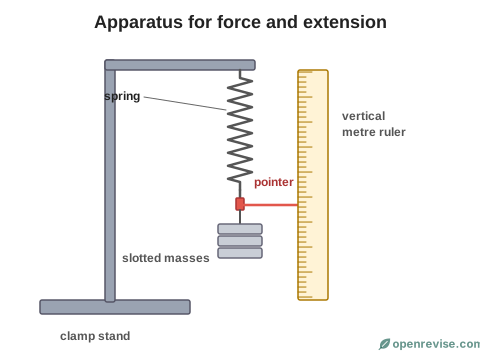
- a spring, clamp stand, boss and clamp
- a set of slotted masses (for example 100 g) and a mass hanger
- a metre ruler (or a half-metre ruler) and a pointer (a piece of tape or a thin wire at the bottom of the spring)
- a set square, to help read the ruler without parallax
- a tray, and goggles
Method
- Set up the apparatus as shown. The metre ruler should be vertical, held in a clamp, with its zero end at the top and next to the pointer.
- Measure the natural length of the spring (the length with the hanger attached but with no extra masses). Record it.
- Add a 100 g mass to the hanger. This provides a force of W = m g = 0.1 \times 9.8 \approx 1.0 \text{ N}. Wait for the spring to stop moving, then record the new length from the ruler.
- Add more masses one at a time, and record the length each time, until you have at least six readings, taking care not to go beyond the elastic limit of the spring.
- Remove the masses one at a time and record the length again, to check that the spring returns to the same lengths.
- Calculate the extension for each reading: extension = length − natural length.
- Repeat the experiment and calculate the mean extension for each force.
Results
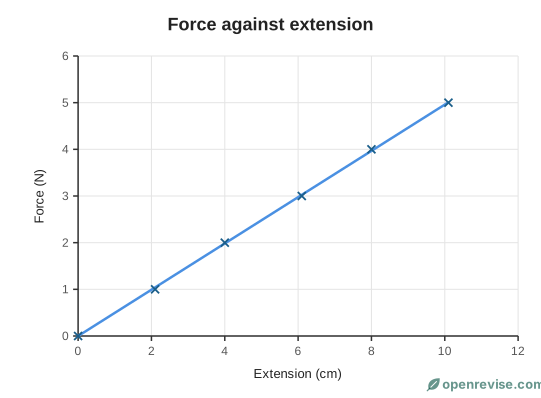
| Mass (kg) | Force (N) | Length (cm) | Extension (cm) |
|---|---|---|---|
| 0.0 | 0.0 | 10.0 | 0.0 |
| 0.1 | 1.0 | 12.1 | 2.1 |
| 0.2 | 2.0 | 14.0 | 4.0 |
| 0.3 | 3.0 | 16.1 | 6.1 |
| 0.4 | 4.0 | 18.0 | 8.0 |
| 0.5 | 5.0 | 20.1 | 10.1 |
Plot force (y-axis) against extension (x-axis) and draw a line of best fit. If the line is a straight line through the origin, then force is directly proportional to extension, so the spring obeys Hooke's law.
Calculating the spring constant
The gradient of the line is the spring constant. Using two points on the line: for an extension of 10.0 cm (0.100 m), the force is 5.0 N:
k = \frac{F}{e} = \frac{5.0}{0.100} = 50 \text{ N/m}
The area under the graph is the work done (energy stored) in stretching the spring: from the graph, \frac{1}{2} \times 0.100 \times 5.0 = 0.25 \text{ J}.
Errors and precautions
- Parallax error: read the pointer from the same level, using a set square or eye-level, and always read at the same position.
- Wait until the spring has stopped moving before taking the reading.
- Do not exceed the limit of proportionality, or the spring may be permanently stretched.
- Zero error: measure from the natural length, not from the bottom of the clamp, so the extension is correct.
- Repeat the readings and calculate a mean to reduce the effect of random errors.
- Safety: wear goggles in case the spring breaks or a mass drops, and put a tray or a soft mat below the masses.
Test yourself on this lesson
8 exam questions · 19 marks · with mark schemes and model answers
Found a mistake?