5.6 Stretching springs: Hooke's law
Elastic and inelastic deformation, extension, Hooke's law F = ke, the limit of proportionality, linear and non-linear force-extension graphs, and energy stored in a stretched spring.
Changing the shape of an object
Key terms
- Elastic deformation: a change in shape that is reversed when the forces are removed. The object returns to its original shape.
- Inelastic (plastic) deformation: a change in shape that is permanent. The object does not return to its original shape.
- Extension: the increase in length of a spring, found by subtracting its natural length from its stretched length.
- Spring constant: the force needed to produce 1 metre of extension of a spring, measured in newtons per metre (N/m). A stiff spring has a high spring constant.
- Limit of proportionality: the point beyond which the extension of a spring stops being proportional to the force.
To stretch, compress or bend an object, you need more than one force. A spring that is stretched, for example, has a force pulling at each end. If the object goes back to its original shape when the forces are removed, it has been elastically deformed. A spring, a rubber band and a trampoline are elastic. If it stays stretched or bent, it has been inelastically deformed. A paper clip that is bent too far, or a lump of plasticine, are examples.
Extension and Hooke's law
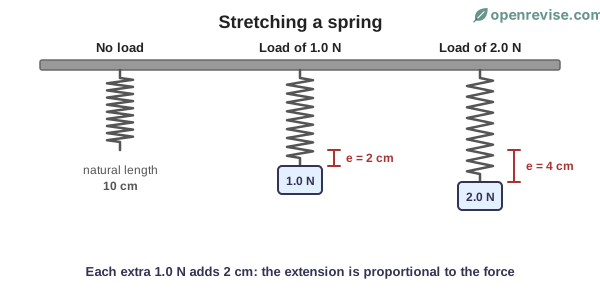
Every spring has a natural length, which is the length when there is no force on it. When a force stretches the spring, its extension is:
\text{extension} = \text{stretched length} - \text{natural length}
In the diagram, a spring of natural length 10 cm has a length of 12 cm with a load of 1.0 N, so the extension is 2 cm. When the load doubles to 2.0 N, the extension also doubles, to 4 cm. This is direct proportion, and it is known as Hooke's law:
F = k e
- F is the force in newtons (N)
- k is the spring constant in newtons per metre (N/m)
- e is the extension in metres (m)
The equation also works for compression of a spring, where e is the amount the spring is squashed.
Worked example 1. A force of 10 N stretches a spring by 5.0 cm. Calculate the spring constant.
Change the extension to metres: 5.0 cm = 0.050 m.
k = \frac{F}{e} = \frac{10}{0.050} = 200 \text{ N/m}
Worked example 2. A spring with a spring constant of 40 N/m is stretched by 0.15 m. Calculate the force.
F = k e = 40 \times 0.15 = 6.0 \text{ N}
The force-extension graph
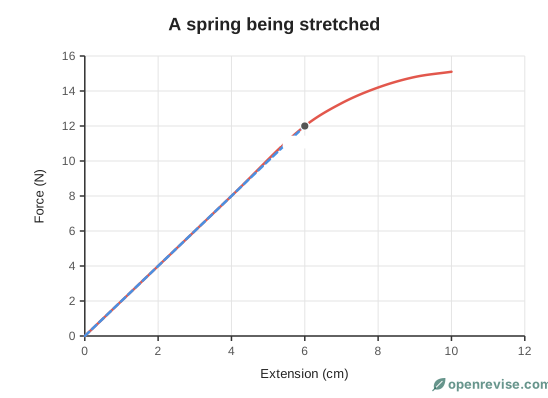
For a spring:
- up to the limit of proportionality, the graph is a straight line through the origin: the force is directly proportional to the extension. The gradient of the line is the spring constant, k;
- beyond this limit, the line curves. The spring is now easier to stretch, and the relationship is non-linear. If it is stretched too far, it may be permanently deformed, and when the forces are removed it will not go back to its original length.
A rubber band is an example of a non-linear material: its force-extension graph is a curve from the start.
Energy stored in a spring
When you stretch or compress an object, you do work on it. If the deformation is elastic, all of this energy is stored in the elastic potential store of the object. When the object is released, the energy is transferred to other stores (for example, to kinetic energy when a catapult is released).
For a spring that obeys Hooke's law, the energy stored is:
E_e = \frac{1}{2} k e^2
Worked example 3. A spring with a spring constant of 200 N/m is stretched by 0.050 m. Calculate the energy stored.
E_e = \frac{1}{2} \times 200 \times 0.050^2 = 0.25 \text{ J}
The work done is also equal to the area under the force-extension graph. For the straight-line part of the graph, this area is a triangle, with area \frac{1}{2} \times \text{base} \times \text{height} = \frac{1}{2} \times e \times F = \frac{1}{2} k e^2.
Test yourself on this lesson
10 exam questions · 25 marks · with mark schemes and model answers
Found a mistake?