5.2 Contact and non-contact forces
Forces as interactions between pairs of objects, the difference between contact forces (friction, air resistance, tension, normal contact) and non-contact forces (gravity, magnetic, electrostatic).
What is a force?
Key terms
- Force: a push or a pull that acts on an object as a result of its interaction with another object. It is a vector, measured in newtons (N).
- Contact force: a force that acts only when two objects are touching.
- Non-contact force: a force that acts between objects that are not touching.
- Interaction: a pair of objects exerting forces on each other.
A force is a push or a pull. Forces always happen in interactions between two objects. When you push on a wall, you exert a force on the wall and the wall exerts a force on you. A force can only be described by saying which object is exerting it, and which object it is acting on.
Forces are measured in newtons (N) with a newtonmeter (a calibrated spring balance). A force can change the speed, the direction or the shape of an object.
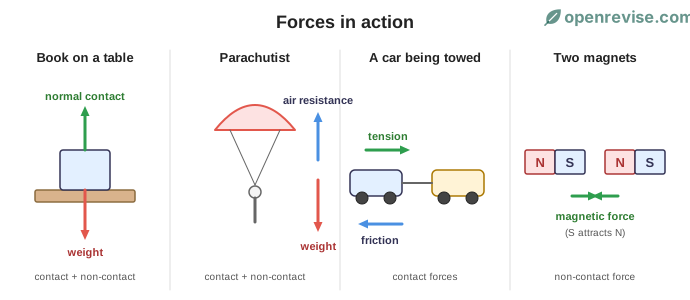
Contact forces
| Force | What it does | Example |
|---|---|---|
| Friction | Opposes motion (or attempted motion) between two surfaces that are touching | Brakes slowing a bicycle wheel; shoes gripping the ground |
| Air resistance (drag) | Opposes the motion of an object through air (or any fluid); gets bigger as the speed increases | A cyclist, a parachutist |
| Tension | A pulling force in a rope, string or cable when it is stretched | A rope pulling a bucket up from a well |
| Normal contact force | A push from a surface at right angles to the surface, which stops an object sinking into it | A table pushing up on a book |
Friction and air resistance both transfer energy to the thermal store, which is why your hands warm up when you rub them together, and why a spacecraft gets hot on re-entry. Friction can be useful (grip) or a problem (wasted energy in machines, which is reduced with lubricants such as oil).
Non-contact forces
| Force | Acts between | Example |
|---|---|---|
| Gravitational force | Any two objects with mass; always attractive | Weight; the Moon orbiting the Earth |
| Magnetic force | Magnets, and magnetic materials | A fridge magnet; a compass needle |
| Electrostatic force | Charged objects; like charges repel and unlike attract | A charged balloon sticking to a wall |
These forces act through a field, which is the region in which an object feels the force. Because the field extends across space, the objects do not need to touch.
Forces come in pairs
Every force is one half of an interaction pair. When the Earth pulls down on you with a gravitational force (your weight), you pull up on the Earth with a force that is exactly the same size. When a book rests on a table, the book pushes down on the table and the table pushes up on the book. You will study this more in the lesson on Newton's third law.
Examples
A book on a table. There are two forces on the book: its weight (gravity, non-contact, acting downwards) and the normal contact force from the table (contact, acting upwards). They are equal in size, so the book stays at rest.
A parachutist. There are two forces on the parachutist: weight (downwards) and air resistance (upwards). When the parachute opens, the area increases and so does the air resistance.
A towed car. The tension in the tow rope pulls the car forwards. Friction between the tyres and the road and air resistance act backwards.
Free body diagrams
To show the forces on one object, scientists draw a free body diagram. The object is drawn on its own, and each force on it is shown as an arrow pointing in the direction of the force, from the object. The length of each arrow shows the size of the force. You will practise this in the next lessons.
Test yourself on this lesson
9 exam questions · 21 marks · with mark schemes and model answers
Found a mistake?