5.3 Weight, mass and gravity
The difference between mass and weight, gravitational field strength, the equation W = mg, measuring weight with a newtonmeter, and the centre of mass.
Mass and weight
Key terms
- Mass: the amount of matter in an object. It is a scalar, measured in kilograms (kg), and it does not change from place to place.
- Weight: the force acting on an object because of gravity. It is a vector, measured in newtons (N).
- Gravitational field strength: the force on each kilogram of mass in a gravitational field. It is measured in newtons per kilogram (N/kg).
- Centre of mass: the point at which the weight of an object appears to act.
People often use the words "mass" and "weight" as if they mean the same. In physics they are different.
- Mass is how much matter there is in an object. It is measured in kilograms with a balance. An astronaut has the same mass on Earth, on the Moon or in space.
- Weight is the force of gravity on the object. It is measured in newtons with a newtonmeter. It depends on the gravitational field strength where the object is, so it changes from one place to another.
Gravitational field strength
A gravitational field is the region around an object where it exerts a gravitational force on another mass. The gravitational field strength, g, tells you the weight of each kilogram. On the surface of the Earth, g is about 9.8 N/kg (often rounded to 10 N/kg). This means that every kilogram of mass has a weight of 9.8 N.
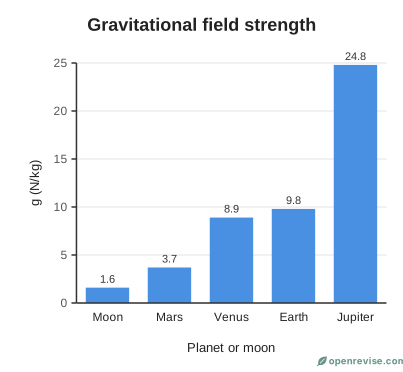
The force of gravity gets weaker with distance from the Earth's surface. In space, far from any planet, the gravitational field strength is almost zero, so an object there is almost weightless, although it still has the same mass.
The weight equation
Weight is directly proportional to mass:
W = m g
- W is weight in newtons (N)
- m is mass in kilograms (kg)
- g is the gravitational field strength in newtons per kilogram (N/kg)
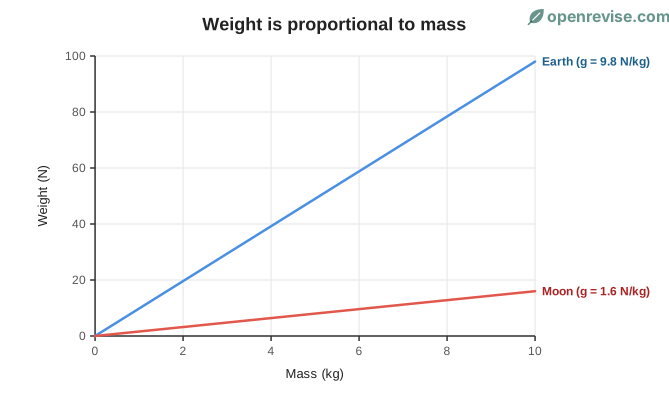
On a graph of weight against mass, the result is a straight line through the origin. The gradient of the line is the gravitational field strength. The line for the Moon is shallower than for the Earth, because g is smaller there.
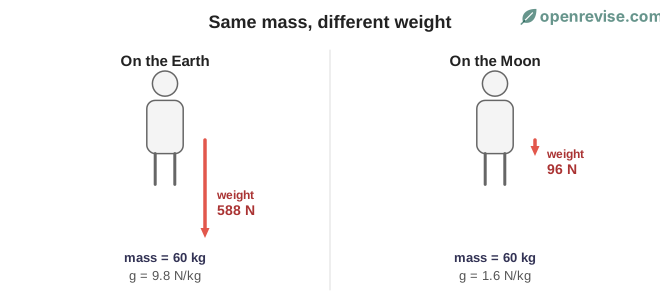
Worked example 1. Calculate the weight of a 60 kg student on the Earth (g = 9.8 \text{ N/kg}).
W = m g = 60 \times 9.8 = 588 \text{ N}
Worked example 2. On the Moon, g = 1.6 \text{ N/kg}. What is the weight of the same student?
W = 60 \times 1.6 = 96 \text{ N}
Worked example 3. A rock has a weight of 49 N on the Earth. Calculate its mass.
m = \frac{W}{g} = \frac{49}{9.8} = 5.0 \text{ kg}
Worked example 4. An astronaut has a mass of 80 kg and a weight of 296 N on Mars. Calculate g on Mars.
g = \frac{W}{m} = \frac{296}{80} = 3.7 \text{ N/kg}
Measuring weight
A newtonmeter contains a spring. When an object hangs from the hook, the spring stretches in proportion to the force, and a pointer shows the weight on a scale. To find the mass of the object from the reading, divide by g. A balance compares the object with standard masses, so it measures mass and gives the same reading anywhere.
Centre of mass
Although every part of an object is pulled by gravity, we can treat the whole weight as acting at one point, the centre of mass. For a symmetrical object with the same density throughout, such as a metre ruler or a sphere, the centre of mass is at its geometric centre. If an object is hung freely from a point, it always settles so that the centre of mass is directly below the point of suspension. You can use this to find the centre of mass of an irregular shape: hang it from two different points and draw a vertical line with a plumb line from each. The centre of mass is where the lines cross.
Test yourself on this lesson
9 exam questions · 25 marks · with mark schemes and model answers
Found a mistake?