5.5 Resolving forces and vector diagrams
Higher tier: using scale drawings to find the resultant of two forces at an angle, resolving a force into two components at right angles, and closed vector triangles for forces in equilibrium.
Forces at an angle (Higher tier)
Key terms
- Resultant: the single vector that has the same effect as two or more vectors added together.
- Component: one of two vectors, usually at right angles, that together have the same effect as a single vector.
- Resolving a force: splitting a force into two components at right angles to each other.
- Equilibrium: when the resultant force on an object is zero.
Not all forces act in a straight line. For example, a boat can be pulled by two tugs at the same time, at an angle to each other. To find the overall effect, you need to add the vectors using diagrams (or, for right angles, mathematics).
Adding two forces at an angle: the scale drawing
To find the resultant of two forces by drawing:
- Choose a scale, for example 1 cm for 1 N.
- Draw the first force as an arrow, with its length to scale and the direction correct.
- At the head of the first arrow, draw the second force (head-to-tail).
- Draw the resultant from the start of the first arrow to the end of the second.
- Measure the length of the resultant and convert it with the scale. Measure the angle with a protractor.
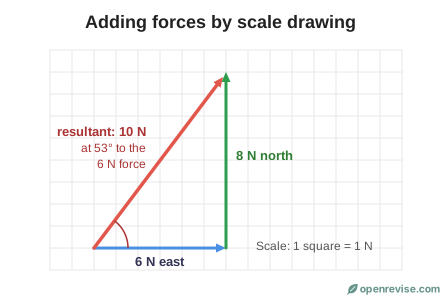
This method is the triangle method. Another is the parallelogram method, where both forces are drawn from the same point and the resultant is the diagonal.
For two forces at right angles, you can check your drawing with Pythagoras' theorem:
\text{resultant} = \sqrt{6^2 + 8^2} = \sqrt{100} = 10 \text{ N}
and find the angle with trigonometry:
\tan \theta = \frac{8}{6} \quad \Rightarrow \quad \theta = 53°
Resolving a force into components
Sometimes it helps to do the opposite and split one force into two components at right angles, usually horizontal and vertical. This is called resolving the force.
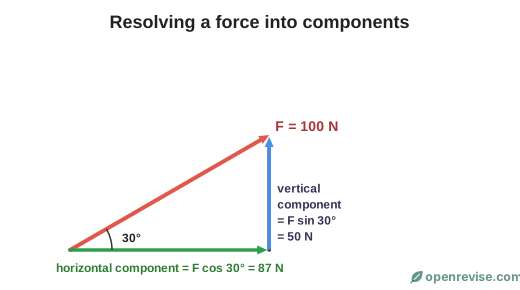
For a force F at an angle \theta to the horizontal:
\text{horizontal component} = F \cos \theta
\text{vertical component} = F \sin \theta
Worked example. A child pulls a sledge with a rope using a force of 100 N, at 30° above the horizontal.
- Horizontal component = 100 \times \cos 30° = 87 \text{ N}: this part pulls the sledge forwards.
- Vertical component = 100 \times \sin 30° = 50 \text{ N}: this part lifts the sledge slightly.
You can also resolve by scale drawing: draw the 100 N force to scale at 30°, then draw lines to make a right-angled triangle and measure the two sides.
Equilibrium and closed vector triangles
If an object is in equilibrium, the resultant force is zero: the object stays at rest or moves at constant velocity. If three forces act on the object, then when their arrows are drawn head-to-tail they make a closed triangle, because the last arrow finishes where the first one started.
For example, forces of 3 N, 4 N and 5 N can be in equilibrium if they are at the correct angles, since they can form a closed 3-4-5 triangle.
Worked example. A 50 N force pulls a trolley to the east and a 30 N force pulls it north. What third force would keep the trolley in equilibrium?
Draw the 50 N and 30 N forces head-to-tail. The resultant is \sqrt{50^2 + 30^2} = 58 \text{ N} at an angle of \tan^{-1}\left(\frac{30}{50}\right) = 31° north of east. The third force must be equal in size and opposite in direction: 58 N at 31° south of west.
Choosing a method
- For two forces at right angles: use Pythagoras and trigonometry.
- For forces at other angles: use a scale drawing, and measure.
- To find the effect of a force in a certain direction: resolve it.
Test yourself on this lesson
8 exam questions · 24 marks · with mark schemes and model answers
Found a mistake?