5.9 Pressure
Pressure as force per unit area, the equation p = F/A, and how the size of the contact area changes the pressure in everyday situations. For Separate Science.
What is pressure?
Key terms
- Pressure: the force acting per unit area on a surface. It is measured in pascals (Pa).
- Pascal (Pa): the unit of pressure, equal to a force of 1 newton on an area of 1 square metre (1 N/m²).
- Area: the amount of surface covered, measured in square metres (m²).
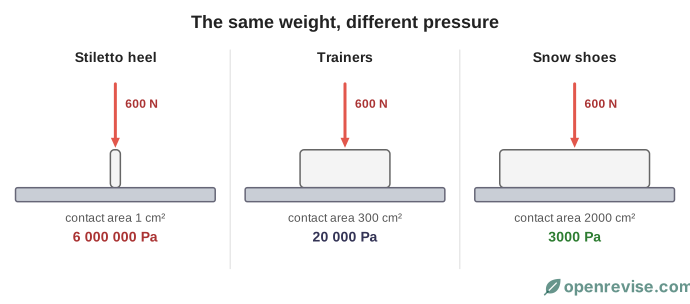
If you stand on a mattress, the mattress squashes. If you stand on the point of a pencil, it hurts, even though the force (your weight) is exactly the same. The difference is the area over which the force acts. When the force is concentrated into a small area, the pressure is high. When the same force is spread over a big area, the pressure is low.
Pressure is calculated using the equation:
p = \frac{F}{A}
- p is pressure in pascals (Pa)
- F is the force in newtons (N)
- A is the area in square metres (m²)
The force is the part that acts at right angles (normal) to the surface. A pressure of 1 Pa is very small, so large pressures are often given in kilopascals (kPa), where 1 kPa = 1000 Pa.
Worked examples
Worked example 1. A box exerts a force of 120 N on a table. The area of its base is 0.40 m². Calculate the pressure.
p = \frac{F}{A} = \frac{120}{0.40} = 300 \text{ Pa}
Worked example 2. A person has a weight of 600 N. Each shoe has a sole of area 150 cm². Calculate the pressure when the person stands on both feet.
- Total area = 2 × 150 = 300 cm². Convert to m²: 1 m² = 10 000 cm², so 300 cm² = 0.030 m².
- p = \frac{600}{0.030} = 20\,000 \text{ Pa} = 20 \text{ kPa}
Worked example 3. The pressure on a surface is 50 kPa and the area is 0.20 m². Calculate the force.
F = p A = 50\,000 \times 0.20 = 10\,000 \text{ N}
Rearranging: F = p A and A = \frac{F}{p}.
Worked example 4. A car has a mass of 1200 kg. Each of its four tyres has a contact area with the road of 0.015 m². Calculate the pressure of the tyres on the road. (g = 9.8 N/kg)
- Weight = m g = 1200 \times 9.8 = 11\,760 \text{ N}
- Total area = 4 × 0.015 = 0.060 m²
- p = \frac{F}{A} = \frac{11\,760}{0.060} = 196\,000 \text{ Pa} \approx 200 \text{ kPa}
This is roughly the pressure of the air inside a car tyre, which is not a coincidence: the tyre is in balance, so the air pressure inside matches the pressure between the tyre and the road.
Increasing and decreasing pressure
There are only two ways to change the pressure on a surface:
- change the force: a bigger force on the same area gives a bigger pressure;
- change the area: the same force on a smaller area gives a bigger pressure.
So to increase the pressure you can increase the force or reduce the area (sharpen a knife). To decrease the pressure you can reduce the force or increase the area (use a wider tyre). Camels have wide, flat feet for the same reason as snow shoes: they spread the weight to stop them sinking into soft sand.
Pressure in everyday life
High pressure is needed (small area):
- Knives, nails, drawing pins and needles have a very small area at the tip, so a small force gives a high pressure that can cut or pierce.
- Spikes on running shoes dig into the ground to give grip.
Low pressure is needed (large area):
- Snow shoes and skis spread the weight over a larger area, so the pressure on the snow is lower, and they do not sink in.
- Tractors and diggers have wide tyres or caterpillar tracks so they do not sink into soft ground.
- Bricks are laid with the largest face down, and wide foundations stop a house sinking into the ground.
Pressure in a fluid
A fluid is a liquid or a gas. The particles in a fluid move about and collide with any surface they touch. Each collision produces a tiny force on the surface. Altogether, the fluid exerts a force on the surface, and this gives a pressure. Because the particles bounce off the surface, the force on the surface is always at right angles to the surface. This explains why a balloon expands in all directions when you blow it up, and why the water in a bottle pushes outwards at its walls on all sides, not just at the bottom.
Test yourself on this lesson
9 exam questions · 25 marks · with mark schemes and model answers
Found a mistake?