5.10 Pressure in liquids and upthrust
Higher tier: how pressure in a liquid increases with depth and density, p = h rho g, and how the difference in pressure produces upthrust, floating and sinking. For Separate Science.
Pressure in a liquid
Key terms
- Upthrust: the upward force that a fluid exerts on an object that is partly or completely submerged in it.
- Density: the mass per unit volume of a substance, in kg/m³.
- Displaced: pushed out of the way. A floating or submerged object displaces some of the fluid.
The particles in a liquid are close together and they are continually colliding with each other and with the walls of their container. The pressure at a point in a liquid is caused by the weight of the liquid above that point. This has three main consequences:
- pressure increases with depth, because there is more liquid above;
- pressure increases with the density of the liquid, because a denser liquid has more mass (and so more weight) in the same volume;
- at any one depth, the pressure acts equally in all directions, and the force on a surface is at right angles to it.
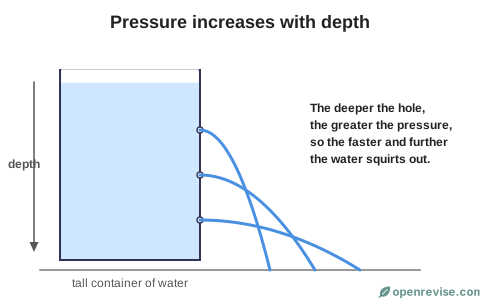
The equation for pressure in a liquid
p = h \rho g
- p is the pressure due to the liquid in pascals (Pa)
- h is the height of the column of liquid (the depth) in metres (m)
- \rho is the density of the liquid in kg/m³
- g is the gravitational field strength (9.8 N/kg)
Worked example 1. Calculate the pressure due to the water at the bottom of a swimming pool that is 3.0 m deep. The density of water is 1000 kg/m³.
p = h \rho g = 3.0 \times 1000 \times 9.8 = 29\,400 \text{ Pa}
Worked example 2. Calculate the pressure due to the sea water at a depth of 20 m. The density of sea water is 1030 kg/m³.
p = 20 \times 1030 \times 9.8 = 201\,880 \text{ Pa} \approx 2.0 \times 10^5 \text{ Pa}
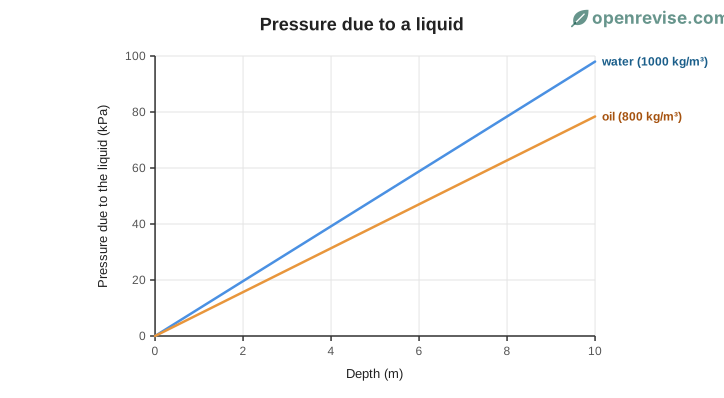
The graph is a straight line through the origin: the pressure is directly proportional to the depth. The line for a less dense liquid such as oil is less steep. This is why divers and submarines must be built to withstand much greater pressures at depth.
Upthrust
An object in a fluid feels an upward force called upthrust. It is caused by the difference in pressure between the bottom and the top of the object. The bottom surface is deeper, so the pressure on it is bigger, so the upward force on the bottom is bigger than the downward force on the top. The resultant of these forces is upwards: the upthrust.
The upthrust is equal to the weight of the fluid that the object displaces. This was discovered by Archimedes.
Worked example 3. An object of volume 0.0040 m³ is fully submerged in water. Calculate the upthrust.
- Mass of water displaced = density × volume = 1000 × 0.0040 = 4.0 kg
- Weight of this water = 4.0 × 9.8 = 39 N, so the upthrust is 39 N.
Floating and sinking
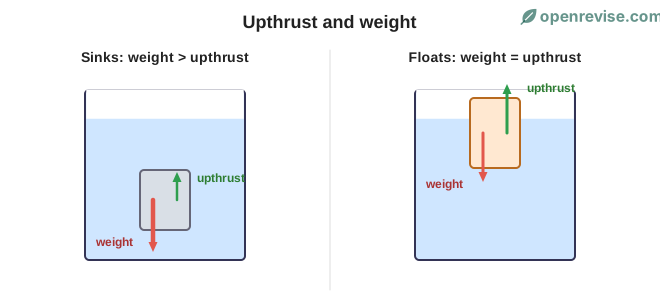
Whether an object floats or sinks depends on the balance between its weight and the upthrust.
- If the weight is greater than the maximum upthrust, the resultant force is downwards and the object sinks.
- If the upthrust is greater than the weight, the object rises, until it floats partly out of the water.
- A floating object is in equilibrium: the upthrust equals its weight. It displaces a weight of water that is exactly equal to its own weight.
An object floats if it is less dense than the fluid and sinks if it is more dense. A steel ship floats because its hull is shaped to hold a huge volume of air, so its average density (including the air) is less than that of water, and it displaces a lot of water.
Test yourself on this lesson
9 exam questions · 24 marks · with mark schemes and model answers
Found a mistake?