5.15 Newton's first law and terminal velocity
Newton's first law, inertia, and how falling objects reach terminal velocity when air resistance balances weight, including the velocity-time graph for a skydiver.
Newton's first law
Key terms
- Newton's first law: if the resultant force on an object is zero, a stationary object stays at rest and a moving object continues to move at a constant speed in a straight line.
- Inertia: the tendency of an object to stay at rest or to keep moving at constant velocity.
- Terminal velocity: the constant velocity reached by a falling object when the air resistance equals its weight.
Newton's first law says that:
- if the resultant force on a stationary object is zero, the object stays stationary;
- if the resultant force on a moving object is zero, it continues to move at the same speed in the same direction (at constant velocity).
In other words, an object only changes its velocity if there is a resultant force on it. A force is not needed to keep something moving. It only seems that way in everyday life because friction and air resistance are nearly always present, slowing things down. A puck on ice slides a long way, as there is almost no friction. A spacecraft far from any planet keeps going at the same speed with its engines switched off.
Inertia
The tendency of objects to keep their state of motion is called inertia. You feel it in everyday situations:
- When a car brakes suddenly, you keep moving forwards at the same velocity, and the seat belt provides the force that slows you down.
- When you pull a tablecloth quickly from under dishes, the dishes tend to stay where they are.
- A heavy object is harder to start moving and harder to stop than a light one, since a larger mass has a larger inertia.
Falling objects and terminal velocity
When an object falls through the air, two forces act on it:
- its weight, acting downwards. This is constant.
- air resistance (drag), acting upwards. It depends on the speed, the shape and the area of the object. Air resistance increases as the speed increases.
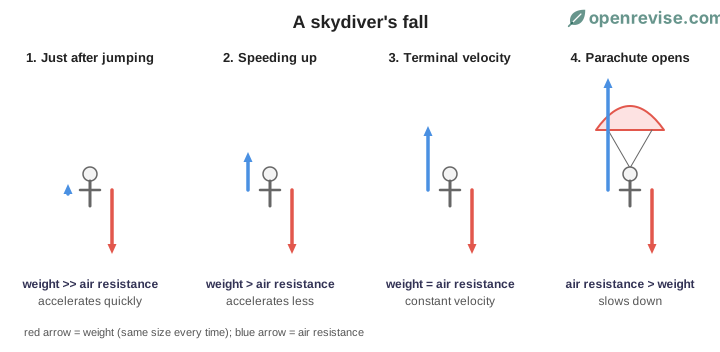
Consider a skydiver:
- Just after jumping, the skydiver is slow, so the air resistance is very small. The weight is much bigger. The resultant force is downwards, so the skydiver accelerates (at about 9.8 m/s²).
- As the speed increases, the air resistance increases. The resultant force gets smaller, so the acceleration decreases. The skydiver still speeds up but not as quickly.
- Eventually the air resistance equals the weight. The resultant force is zero, so there is no acceleration. The skydiver falls at a constant velocity called the terminal velocity (about 55 m/s for a skydiver falling spread-eagled).
- When the parachute opens, the area is much larger so the air resistance suddenly becomes much bigger than the weight. The resultant force is upwards, so the skydiver decelerates. As the speed falls, the air resistance falls, until it again equals the weight. The skydiver now falls at a much lower terminal velocity (about 5 m/s), which is slow enough to land safely.
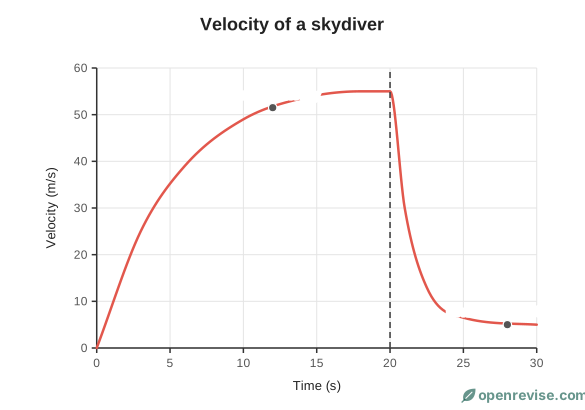
Why the terminal velocity depends on the shape
A larger area or a less streamlined shape means more air resistance at the same speed, so the terminal velocity is lower. This is why a parachute slows you down and why a skydiver who tucks in falls faster. The terminal velocity of a raindrop is lower than that of a hailstone.
Falling in a vacuum
Without air, there is no air resistance, so objects of different masses fall with the same acceleration. On the Moon, which has no atmosphere, an astronaut dropped a hammer and a feather at the same time, and they hit the ground together.
Test yourself on this lesson
9 exam questions · 22 marks · with mark schemes and model answers
Found a mistake?