5.16 Newton's second law
Newton's second law F = ma, how acceleration depends on resultant force and mass, and inertial mass (Higher tier).
Newton's second law
Key terms
- Newton's second law: the acceleration of an object is proportional to the resultant force acting on it, and inversely proportional to its mass.
- Newton (N): the force that gives a mass of 1 kg an acceleration of 1 m/s².
- Inertial mass: a measure of how difficult it is to change the velocity of an object. It is the ratio of force over acceleration. (Higher tier)
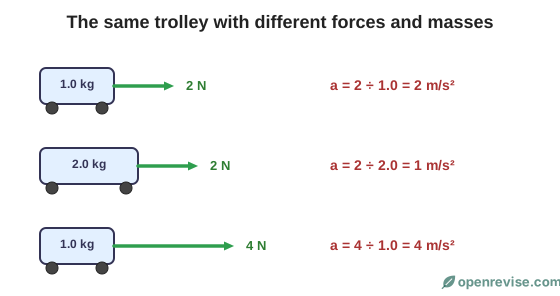
Newton's first law tells you that no resultant force means no change in velocity. Newton's second law tells you how much the velocity changes when there is a resultant force. It states that:
- the acceleration of an object is directly proportional to the resultant force on it: a bigger force gives a bigger acceleration;
- the acceleration is inversely proportional to the mass of the object: a bigger mass gives a smaller acceleration.
F = m a
- F is the resultant force in newtons (N)
- m is the mass in kilograms (kg)
- a is the acceleration in metres per second squared (m/s²)
One newton is the force needed to give a mass of 1 kg an acceleration of 1 m/s².
Using the equation
Worked example 1. A force of 1500 N acts on a car of mass 1000 kg. Calculate its acceleration.
a = \frac{F}{m} = \frac{1500}{1000} = 1.5 \text{ m/s}^2
Worked example 2. A runner of mass 60 kg accelerates at 3.0 m/s². Calculate the resultant force.
F = m a = 60 \times 3.0 = 180 \text{ N}
Worked example 3. A resultant force of 24 N accelerates an object at 6.0 m/s². Calculate its mass.
m = \frac{F}{a} = \frac{24}{6.0} = 4.0 \text{ kg}
Worked example 4: using resultant force. A car of mass 900 kg has a driving force of 3000 N. The air resistance and friction total 1200 N.
- Resultant force = 3000 − 1200 = 1800 N
- a = \frac{F}{m} = \frac{1800}{900} = 2.0 \text{ m/s}^2
Always use the resultant force in F = m a, not just one of the forces.
Worked example 5: a braking car. A car of mass 1000 kg slows from 20 m/s to rest in 5.0 s. Calculate the braking force.
- Acceleration: a = \frac{v - u}{t} = \frac{0 - 20}{5.0} = -4.0 \text{ m/s}^2
- Force: F = m a = 1000 \times (-4.0) = -4000 \text{ N}
The negative sign shows that the resultant force acts in the opposite direction to the motion, so the braking force is 4000 N. A heavier vehicle needs a bigger force to stop in the same time: a lorry of mass 10 000 kg would need 40 000 N.
Force, mass and acceleration graphs
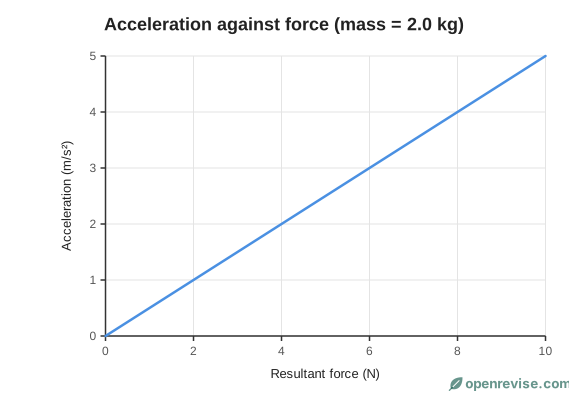
- For a constant mass, a graph of acceleration against resultant force is a straight line through the origin. Doubling the force doubles the acceleration. The gradient is \frac{1}{m}.
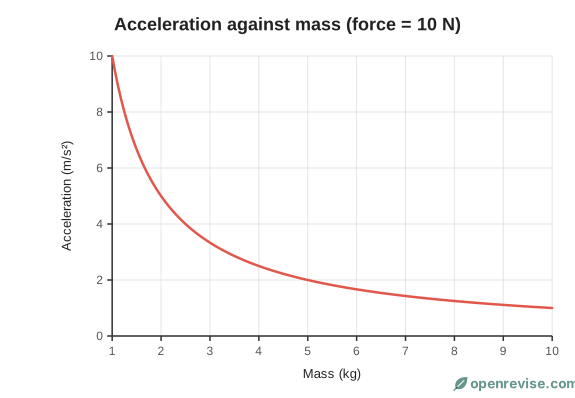
- For a constant force, a graph of acceleration against mass is a curve (inverse proportion). Doubling the mass halves the acceleration.
Weight and acceleration of free fall
All objects in free fall have the same acceleration, g. The only force is weight, W = m g. Using F = m a:
a = \frac{W}{m} = \frac{m g}{m} = g
The mass cancels, so a heavy and a light object accelerate at the same rate, when there is no air resistance.
Inertia and inertial mass (Higher tier)
An object's inertia is its tendency to continue in its state of rest or constant velocity. The inertial mass of an object measures how hard it is to change its velocity. It is defined by the ratio of force to acceleration:
m = \frac{F}{a}
An object with a large inertial mass needs a large force to give it a given acceleration. For example, a loaded lorry takes a much larger force to accelerate than an empty one at the same rate.
Test yourself on this lesson
9 exam questions · 23 marks · with mark schemes and model answers
Found a mistake?