5.18 Newton's third law
Newton's third law: pairs of equal and opposite forces that act on different objects, how to identify them, and why they do not cancel out.
Newton's third law
Key terms
- Newton's third law: whenever two objects interact, the forces they exert on each other are equal in size and opposite in direction.
- Interaction pair (third-law pair): the two forces that two objects exert on each other. They are always the same type of force.
You already know that a force is always part of an interaction between two objects. Newton's third law says that:
> Whenever two objects interact, the forces they exert on each other are equal and opposite.
If object A pushes on object B with a force of 10 N to the right, then object B pushes on object A with a force of 10 N to the left. These two forces make up an interaction pair.
For a pair of forces to be a Newton's third law pair, four things are true:
- They are equal in size.
- They act in opposite directions.
- They are the same type of force (both contact or both gravitational, for example).
- They act on different objects.
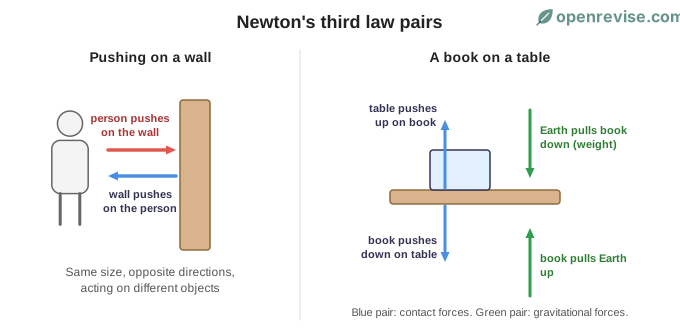
Examples
Pushing on a wall. When you push on a wall with 50 N, the wall pushes back on you with 50 N. Both forces are contact forces. This is why you move backwards if you push on a wall while standing on roller skates.
The Earth and the Moon. The Earth pulls on the Moon with a gravitational force. The Moon pulls on the Earth with a force of exactly the same size, in the opposite direction.
Walking. Your foot pushes backwards on the ground (friction). The ground pushes forwards on your foot. It is this second force that makes you move.
Rockets. The rocket engine pushes burning gases downwards. By the third law, the gases push the rocket upwards with an equal force. A rocket does not need air to push against.
A swimmer. The swimmer pushes backwards on the water. The water pushes forwards on the swimmer.
A gun recoiling. The gun pushes the bullet forwards. The bullet pushes the gun backwards with an equal force, so the gun recoils. The gun's acceleration is smaller than the bullet's, since the gun has a much larger mass (a = \frac{F}{m}).
Why don't the forces cancel out?
If the forces in an interaction pair are equal and opposite, why isn't the resultant force always zero? Because they act on different objects. To find the resultant force on one object, you only add up the forces that act on that object. The force that the object exerts on something else is not included.
For example, when a car tows a trailer, the car pulls the trailer forwards and the trailer pulls the car backwards, with equal forces. But the force on the car from the engine (through the ground) is bigger than the pull of the trailer, so the car-and-trailer system accelerates forwards.
A common trap: weight and the normal contact force
A book rests on a table. The weight of the book acts downwards, and the table's normal contact force acts upwards. They are equal and opposite, and both act on the book. But they are not a Newton's third law pair, because:
- they act on the same object (the book);
- they are different types of force (gravitational and contact).
The actual pairs are:
| Force on the book | Its pair (the other half of the interaction) |
|---|---|
| Weight: the Earth pulls the book down (gravity) | The book pulls the Earth up (gravity) |
| The table pushes the book up (contact) | The book pushes the table down (contact) |
The weight and the normal contact force are equal because the book is in equilibrium, which follows from Newton's first law (zero resultant force), not from the third law.
Using the third law in problems
When you are asked for a force pair, say: "A exerts a force on B" and then "B exerts an equal and opposite force on A". Always name both objects and the type of force.
Test yourself on this lesson
9 exam questions · 22 marks · with mark schemes and model answers
Found a mistake?