5.17 Required practical: acceleration
Required practical: investigate the effect of force and of mass on the acceleration of a trolley using a falling mass, light gates and a data logger.
Aim
To investigate how the acceleration of an object depends on (a) the resultant force acting on it and (b) its mass.
Key terms
- Independent variable: the variable you change deliberately. Here it is the force (for part A) or the mass (for part B).
- Dependent variable: the variable you measure. Here it is the acceleration.
- Control variable: a variable that you keep the same so the test is fair. Here it is the total mass (part A), or the force (part B).
- Light gate: a sensor that records the time for which a beam of light is blocked.
Apparatus
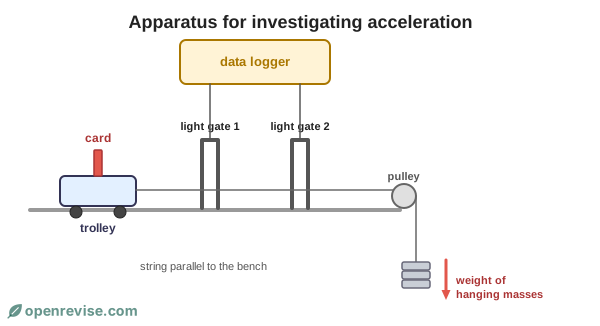
- a trolley, and a flat runway or bench
- a pulley at the end of the runway, a string, and a mass hanger with slotted masses
- two light gates and a data logger (or one light gate and a double card)
- a card of known length fixed to the trolley, a metre ruler and a balance
- a cushion or a tray of sand to stop the trolley, and goggles
How it works
The weight of the hanging masses pulls the trolley along the bench through the string. This weight is the force that makes the trolley accelerate. The light gates measure the velocity of the card at two points, and the data logger uses the time between them to calculate the acceleration:
a = \frac{v - u}{t}
Part A: the effect of force (mass constant)
For this part, the total mass of the whole system (trolley, masses on the trolley and the hanging masses) must stay the same. Otherwise, the mass changes with the force.
- Put 10 slotted masses of 10 g each on the trolley (and hanging mass hanger of 10 g), and record the total mass.
- Release the trolley from rest. The data logger records the acceleration.
- Move one 10 g mass from the trolley to the hanger. The total mass stays the same, but the force increases.
- Repeat for at least five different forces.
- Calculate the force F = m g from the hanging mass for each.
Part B: the effect of mass (force constant)
- Keep the hanging mass the same, for example 50 g, so the force is the same (0.49 N).
- Add extra masses to the trolley, one at a time, and record the acceleration each time.
- Plot a graph of acceleration against mass (or against \frac{1}{\text{mass}}).
Results
| Hanging mass (kg) | Force (N) | Acceleration (m/s²) |
|---|---|---|
| 0.02 | 0.20 | 0.20 |
| 0.04 | 0.39 | 0.41 |
| 0.06 | 0.59 | 0.58 |
| 0.08 | 0.78 | 0.80 |
| 0.10 | 0.98 | 0.97 |
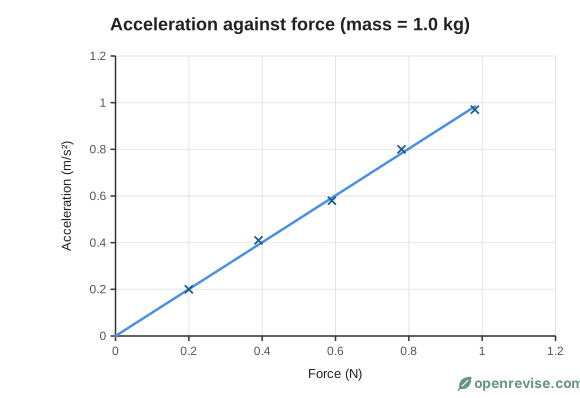
The graph is a straight line through the origin, so the acceleration is directly proportional to the force. The gradient is \frac{1}{m} = \frac{1}{1.0} = 1.0 \text{ per kg}, as predicted by a = \frac{F}{m}. In Part B, a graph of a against m is a curve, and a graph of a against \frac{1}{m} is a straight line through the origin: acceleration is inversely proportional to mass.
Errors and precautions
- Friction in the wheels and the pulley opposes the motion. Slightly raising the end of the runway where the trolley starts can compensate for the friction.
- The string must be parallel to the bench, so the whole weight acts to pull the trolley forwards.
- Always keep the total mass constant in Part A. Moving the masses, rather than adding them, does this.
- Make sure the card is level and passes through the light gate beam cleanly.
- Repeat the measurements and calculate a mean.
- Safety: put a cushion at the end of the runway to stop the trolley, and keep feet clear of the hanging masses.
Test yourself on this lesson
9 exam questions · 25 marks · with mark schemes and model answers
Found a mistake?