5.20 Stopping distance and reaction time
Stopping distance as thinking distance plus braking distance, typical reaction times, factors that affect thinking distance, and how to measure reaction time with a ruler drop.
Stopping distance
Key terms
- Stopping distance: the total distance a vehicle travels from the moment the driver sees a hazard until the vehicle stops.
- Thinking distance: the distance the vehicle travels while the driver reacts, before the brakes are applied.
- Braking distance: the distance the vehicle travels once the brakes are applied, until it stops.
- Reaction time: the time between the driver seeing a hazard and applying the brakes.
When a driver sees a danger, such as a child running into the road, the car does not stop at once. There are two stages.
\text{stopping distance} = \text{thinking distance} + \text{braking distance}
- Thinking distance. During the driver's reaction time, the car keeps moving at its original speed.
- Braking distance. Once the brakes are applied, the braking force slows the car down until it stops.
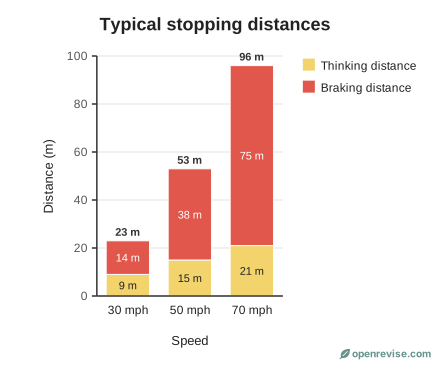
The bar chart shows the typical distances. At 30 mph, the thinking distance is 9 m and the braking distance is 14 m, giving a stopping distance of 23 m. At 70 mph, the thinking distance is 21 m, and the braking distance is 75 m, which gives a stopping distance of 96 m.
Typical stopping distances
| Speed (mph) | Thinking distance (m) | Braking distance (m) | Stopping distance (m) |
|---|---|---|---|
| 20 | 6 | 6 | 12 |
| 30 | 9 | 14 | 23 |
| 40 | 12 | 24 | 36 |
| 50 | 15 | 38 | 53 |
| 60 | 18 | 55 | 73 |
| 70 | 21 | 75 | 96 |
Look at how the two parts change. From 20 mph to 40 mph, the speed doubles, so the thinking distance doubles (6 m to 12 m), but the braking distance goes up four times (6 m to 24 m). This is why speed limits are so important near schools and in built-up areas: a car travelling at 20 mph has a stopping distance of 12 m, but at 40 mph it needs 36 m, three times as far. A pedestrian who is hit at the higher speed is much more likely to be killed.
Worked example 1. A car is travelling at 50 mph. Use the table to find the stopping distance, and the percentage of it that is thinking distance.
Stopping distance = 15 + 38 = 53 m. Thinking distance as a percentage = \frac{15}{53} \times 100 = 28\%.
Thinking distance and reaction time
The thinking distance is calculated using:
\text{thinking distance} = \text{speed} \times \text{reaction time}
Worked example 2. A driver has a reaction time of 0.8 s. Her car is travelling at 20 m/s. Calculate the thinking distance.
\text{thinking distance} = 20 \times 0.8 = 16 \text{ m}
The thinking distance is directly proportional to the speed: if the speed doubles, the thinking distance doubles, as long as the reaction time is the same.
A typical reaction time is between 0.2 s and 0.9 s. Reaction times are longer when:
- the driver is tired;
- the driver has taken alcohol or drugs (including some medicines);
- the driver is distracted, for example by a mobile phone, passengers or loud music;
- the driver is older, or inexperienced.
A longer reaction time means a longer thinking distance, and so a longer stopping distance. It does not change the braking distance.
Measuring reaction time: the ruler-drop test
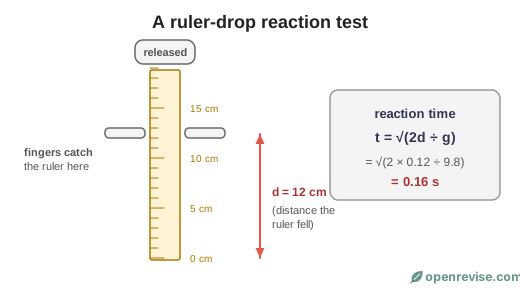
- A partner holds a 30 cm ruler vertically, with the zero mark level with your open thumb and finger. Do not look at the ruler's markings.
- Your partner drops the ruler without warning.
- Catch it as quickly as you can. Read the distance, d, that the ruler fell, from the zero mark to the top of your thumb.
- Repeat several times and calculate the mean.
- Work out the reaction time using the equation for free fall. The ruler starts from rest and accelerates at 9.8 m/s²:
t = \sqrt{\frac{2 d}{g}}
Worked example 3. The ruler falls 12 cm (0.12 m) before it is caught.
t = \sqrt{\frac{2 \times 0.12}{9.8}} = 0.16 \text{ s}
| Distance fallen (cm) | Reaction time (s) |
|---|---|
| 5 | 0.10 |
| 10 | 0.14 |
| 15 | 0.17 |
| 20 | 0.20 |
| 30 | 0.25 |
You can use the test to investigate how reaction time changes with distractions (such as a phone call), with tiredness, or between people. For a fair test, only the factor you are investigating should change. A computer-based test, where you press a key when a screen changes colour, can give a more precise measurement.
Other factors affecting stopping distance
The thinking distance depends on the driver and the speed. The braking distance depends on the vehicle, the road and the speed. These will be covered in the next lesson.
Test yourself on this lesson
9 exam questions · 20 marks · with mark schemes and model answers
Found a mistake?