5.21 Braking distance and large decelerations
Factors that affect braking distance, why braking distance rises with the square of speed, the energy transfers in braking, and the dangers of large decelerations.
Braking distance
Key terms
- Braking distance: the distance a vehicle travels from when the brakes are first applied until it stops.
- Braking force: the force applied by the brakes (and friction at the tyres) to slow the vehicle.
- Deceleration: the rate at which a vehicle slows down.
- Brake fade: the loss of braking power when brakes get too hot.
The braking distance of a vehicle depends on a number of things.
| Factor | Effect on braking distance |
|---|---|
| Speed of the vehicle | A higher speed gives a much longer braking distance |
| Mass of the vehicle | A heavier vehicle needs a larger force to stop, so it has a longer braking distance |
| Road surface | Wet, icy or loose surfaces reduce friction, so the braking distance is longer |
| Condition of the tyres | Worn tyres with less tread grip the road less well, so the distance is longer |
| Condition of the brakes | Worn or badly adjusted brakes give a smaller braking force, so the distance is longer |
Brakes and energy
When a driver applies the brakes, brake pads are pressed onto a brake disc (or drum) that turns with the wheel. Friction acts between the pads and the disc, and this provides the braking force.
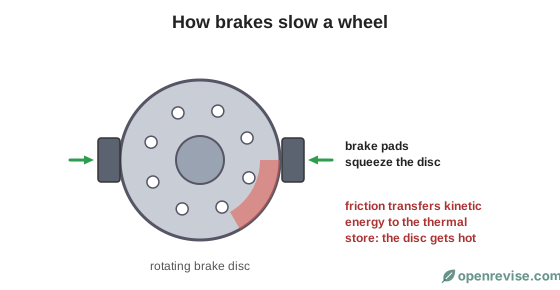
The brakes do work against the motion, which transfers the kinetic energy of the car to the thermal store of the brakes. The brakes get hot. This is why a brake disc can glow red after heavy braking. If the brakes overheat, they become less effective, which is called brake fade.
For the car to stop, all of its kinetic energy must be transferred:
\text{work done by the brakes} = \text{kinetic energy lost}
F d = \frac{1}{2} m v^2
Why speed matters so much
The kinetic energy depends on the square of the speed, so:
- if the speed is doubled, the kinetic energy is four times bigger;
- the brakes have to do four times the work, so for the same braking force the braking distance is four times longer.
Worked example 1. A car of mass 1000 kg has a braking force of 8000 N. Calculate the braking distance from 20 m/s.
- Kinetic energy = \frac{1}{2} m v^2 = 0.5 \times 1000 \times 20^2 = 200\,000 \text{ J}
- d = \frac{\text{work done}}{F} = \frac{200\,000}{8000} = 25 \text{ m}
Worked example 2. The same car brakes from 40 m/s. Kinetic energy = 0.5 \times 1000 \times 40^2 = 800\,000 \text{ J}, so d = \frac{800\,000}{8000} = 100 \text{ m}.
When the speed doubled from 20 to 40 m/s, the braking distance went up by a factor of four, from 25 m to 100 m.
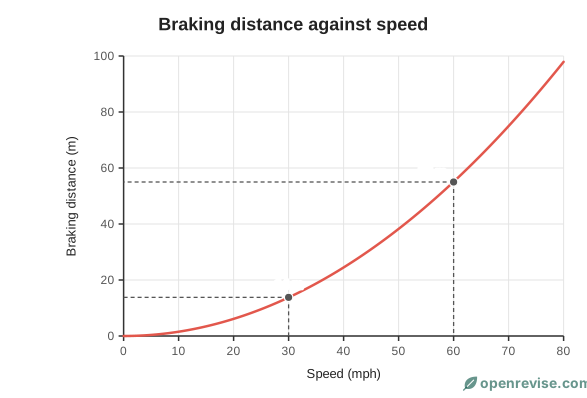
The graph is a curve that gets steeper, because braking distance is proportional to the square of the speed.
Large decelerations
A force is needed to decelerate a vehicle. A large deceleration needs a large force, because F = m a. If the brakes are applied too hard, the tyres can skid and the car may lose control.
In a collision, a vehicle may stop in a very short time, which means a very large deceleration, and so a very large force on the passengers. This can cause serious injury.
Worked example 3 (Higher tier: estimating forces). A car travelling at 30 m/s hits a wall and stops in 0.10 s. Estimate the force on a passenger of mass 70 kg.
- Deceleration: a = \frac{\Delta v}{t} = \frac{0 - 30}{0.10} = -300 \text{ m/s}^2
- Force: F = m a = 70 \times 300 = 21\,000 \text{ N}
This is 30 times the acceleration of gravity, and the force is about 30 times the weight of the passenger. For comparison, normal braking in a car is about 5-8 m/s², much gentler.
Test yourself on this lesson
9 exam questions · 25 marks · with mark schemes and model answers
Found a mistake?