7.5 Loudspeakers and microphones
Higher tier: how a loudspeaker uses the motor effect to turn an alternating current into sound, and how a moving-coil microphone uses electromagnetic induction to turn sound into an alternating potential difference. For Separate Science.
Using electromagnetism to handle sound
Key terms
- Loudspeaker: a device that converts an electrical signal into sound, using the motor effect.
- Microphone: a device that converts sound into an electrical signal, using electromagnetic induction.
- Diaphragm: a thin, flexible sheet that vibrates when sound waves hit it.
- Alternating current (a.c.): a current that repeatedly changes direction.
A loudspeaker and a microphone are two devices that do opposite jobs. Both have a coil of wire and a permanent magnet, but they use two different effects: the motor effect in the loudspeaker and electromagnetic induction in the microphone.
The loudspeaker
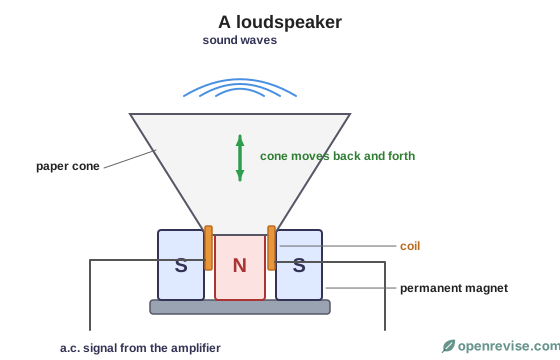
A loudspeaker is made of:
- a permanent magnet, one pole of which sits inside a coil;
- a coil of wire, which is free to move and is attached to a paper cone;
- the cone, which pushes on the air.
How it works
- The amplifier sends an alternating current (the electrical signal for the music or speech) to the coil.
- The coil is in the magnetic field of the permanent magnet, so a current in it means the coil experiences a force (the motor effect).
- Because the current is alternating, the direction of the force keeps changing, so the coil and the cone move backwards and forwards.
- The moving cone makes the air vibrate, producing compressions and rarefactions: a sound wave.

- The frequency of the sound is the same as the frequency of the a.c. A 440 Hz current makes the cone vibrate 440 times per second, and produces a sound of 440 Hz.
- A bigger current gives a bigger force, so the cone moves further, and the sound is louder (the amplitude is larger).
Worked example. An a.c. signal of frequency 440 Hz is sent to a loudspeaker. The speed of sound in air is 330 m/s.
- The cone vibrates at 440 Hz.
- The wavelength of the sound is \lambda = \frac{v}{f} = \frac{330}{440} = 0.75 \text{ m}.
Different speakers for different sounds
A real sound system usually has more than one loudspeaker. A large woofer produces low frequencies, because a big cone moves a lot of air with each slow vibration. A small tweeter produces high frequencies, because a small light cone can vibrate very quickly. A circuit sends the right range of frequencies to each. This shows that the design of a speaker has to suit the frequencies it makes. A good loudspeaker also needs a cone that is stiff but light, so it follows the signal closely and does not add any distortion of its own.
The moving-coil microphone
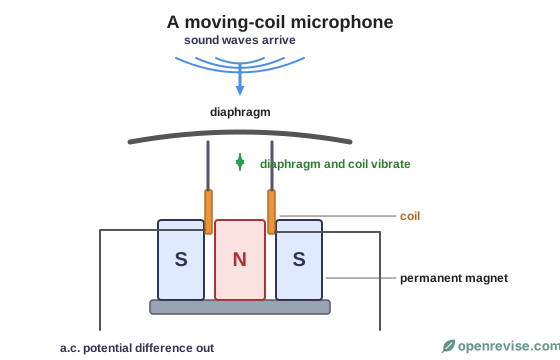
A moving-coil microphone works in the opposite way:
- Sound waves hit the diaphragm and make it vibrate, at the frequency of the sound.
- The diaphragm is attached to a coil that is in the field of a permanent magnet. The coil moves backwards and forwards with the diaphragm.
- As the coil moves, it cuts the magnetic field lines, so a potential difference is induced across the coil (electromagnetic induction).
- Because the coil moves one way and then the other, the induced p.d. is alternating, with the same frequency as the sound wave.
- A louder sound makes the diaphragm move further and faster, so a larger potential difference is induced.

The tiny signal from a microphone is then amplified, and can be recorded, or sent to a loudspeaker.
Comparing the two
| Feature | Loudspeaker | Moving-coil microphone |
|---|---|---|
| Energy change | Electrical to sound | Sound to electrical |
| Effect used | Motor effect | Electromagnetic induction |
| What moves | The coil and cone, because of a force | The coil and diaphragm, because of the sound wave |
| Frequency of output | Same as the a.c. input | Same as the sound |
| Louder means | Bigger current | Bigger induced p.d. |
Because the two are so similar, a small loudspeaker can be used as a microphone, as in some intercom systems: sound moves the cone, which moves the coil, and this induces a signal.
Test yourself on this lesson
9 exam questions · 22 marks · with mark schemes and model answers
Found a mistake?