7.4 Electric motors
How a simple d.c. motor works: a coil in a magnetic field, the forces on its two sides, the split-ring commutator and brushes, and how to make it turn faster.
Electric motors
Key terms
- Electric motor: a device that uses the motor effect to transfer electrical energy to kinetic energy, by making a coil turn.
- Commutator: a split ring that reverses the direction of the current in the coil every half turn.
- Brushes: carbon contacts that press against the commutator and carry the current to the coil.
- Armature: the coil of a motor, which turns in the magnetic field.
An electric motor uses the motor effect to make something spin. Motors are used in washing machines, fans, power drills, electric cars and trains, hard drives and many other devices.
A simple d.c. motor
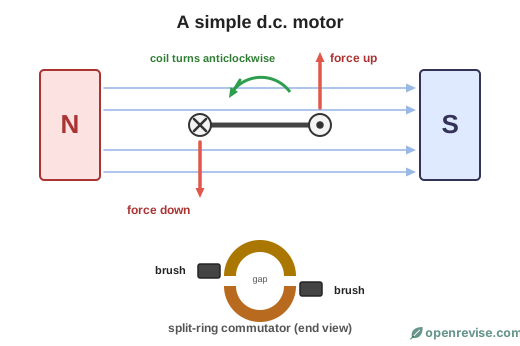
A simple motor has these parts:
- a rectangular coil of wire, which can turn on an axle;
- two permanent magnets, with a north and a south pole facing each other, that make a magnetic field;
- a split-ring commutator joined to the ends of the coil, which turns with it;
- two carbon brushes that press against the commutator, and are joined to a d.c. supply (a battery or a power supply).
How it works
- The current goes round the coil. On one side of the coil, the current flows one way, and on the opposite side it flows the other way.
- Both sides of the coil are in the magnetic field. By Fleming's left-hand rule, the force on one side of the coil is upwards and the force on the other side is downwards.
- These opposite forces have a turning effect (moment) on the coil, so it rotates.
- When the coil reaches the vertical position, the commutator breaks the contact with the brushes for an instant. The coil's momentum carries it past this position.
- After the vertical position, the halves of the commutator have swapped brushes, so the current in the coil is reversed. The side that was going up is now going down, and so on. The forces still turn the coil in the same direction.
So every half-turn, the commutator reverses the current, which keeps the coil rotating in one direction. Without the commutator, the coil would swing to the vertical position, and then stop and rock back and forth.
Energy transfers
A motor transfers electrical energy from the supply to the kinetic energy of the motor and its load. Some energy is also wasted as thermal energy (due to the resistance of the wires and friction in the bearings) and sound.
Making the motor turn faster or harder
| Change | Effect |
|---|---|
| Increase the current | Bigger force on the coil, so the motor turns faster |
| Use stronger magnets | Bigger force on the coil (the magnetic flux density is larger) |
| Use more turns of wire in the coil | More wire in the field, so each side has a bigger total force |
| Use a larger coil | The forces act further from the axle, so the turning effect is bigger |
Worked example. One side of a coil has a length of 0.050 m in a magnetic field of 0.40 T, and the current is 2.0 A.
- Force on one turn = B I l = 0.40 \times 2.0 \times 0.050 = 0.040 \text{ N}
- If the coil has 100 turns, the force on each side is 100 \times 0.040 = 4.0 \text{ N}: a hundred times larger.
To reverse the direction in which the motor turns, either reverse the current (swap the connections to the battery) or reverse the magnetic field (turn the magnets round).
Real motors
Real motors have more features, to make them smoother and more powerful:
- many coils, at different angles, with a commutator with more segments, so the turning effect is nearly constant instead of fluctuating;
- a soft iron core inside the coils, to strengthen the field;
- curved magnetic poles so the field is always at right angles to the sides of the coil;
- electromagnets instead of permanent magnets in large motors.
Test yourself on this lesson
9 exam questions · 28 marks · with mark schemes and model answers
Found a mistake?