7.1 Magnets and magnetic fields
Magnetic poles and forces, permanent and induced magnets, magnetic fields and field lines, plotting a field with compasses, and the Earth's magnetic field.
Magnets and magnetic materials
Key terms
- Magnetic pole: the place on a magnet where the magnetic force is strongest. Every magnet has a north pole and a south pole.
- Magnetic material: a material that is attracted by a magnet. The magnetic materials are iron, steel, cobalt and nickel (and alloys that contain them).
- Permanent magnet: a magnet that produces its own magnetic field all the time.
- Induced magnet: a magnetic material that becomes a magnet when it is placed in a magnetic field, and loses most of its magnetism when it is removed.
- Magnetic field: the region around a magnet where a magnetic material, or another magnet, feels a force.
Magnets exert forces on each other and on magnetic materials. These are non-contact forces: they act across a gap without the objects touching.
Poles and forces
- Like poles repel: north repels north, and south repels south.
- Unlike poles attract: north and south pull towards each other.
The forces are strongest at the poles. A magnet always has two poles: if you cut a bar magnet in half, you do not get a separate north and a separate south: you get two smaller magnets, each with its own north and south pole.
Permanent and induced magnets
A permanent magnet keeps its magnetism, and has poles that can both attract and repel. An induced magnet is a piece of magnetic material, such as an iron nail, that becomes magnetic only when it is in a magnetic field. For example, if you hold a nail near a bar magnet, the nail becomes an induced magnet, with the pole nearest to the magnet being the opposite of the magnet's pole. So an induced magnet is always attracted to the magnet that induces it. Iron and steel paper clips hang in a chain from a magnet for this reason: each clip is magnetised by the one above it.
When the magnet is taken away, the induced magnetism is nearly all lost (in soft iron), but steel can keep it (it becomes a permanent magnet).
How to test whether something is a magnet. Attraction is not a good test, because an unmagnetised piece of iron is also attracted. The only sure test is repulsion: if one end of an object is repelled by a pole of a known magnet, the object must be a magnet.
Magnetic fields
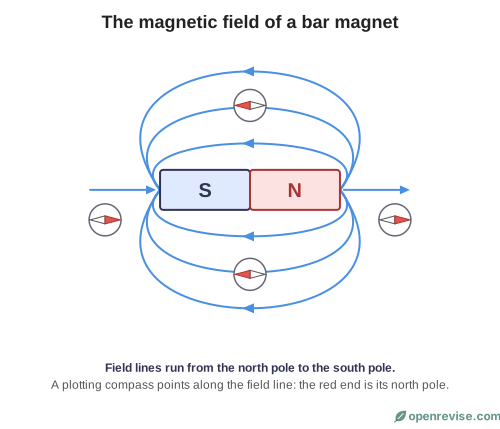
The magnetic field of a magnet can be drawn as magnetic field lines.
- Field lines show the direction of the force on a north pole placed in the field. So the lines go from the north pole to the south pole, outside the magnet.
- The lines are closest together where the field is strongest (at the poles) and get further apart as the field gets weaker with distance.
- Field lines never cross.
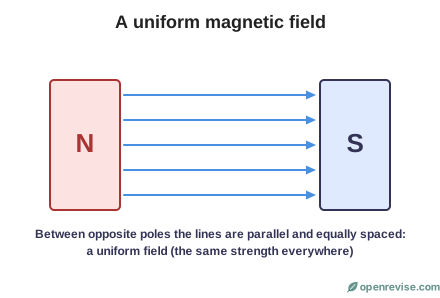
Between two opposite poles that are close together, the field lines are straight, parallel and equally spaced: this is a uniform field.
Plotting a magnetic field with a compass
A plotting compass is a small magnet that can turn freely. Its north-seeking end (the red end) lines up with the magnetic field at that point.
- Put a bar magnet on a sheet of paper, and place the compass near the north pole.
- Mark the position of both ends of the needle with pencil dots.
- Move the compass so that its tail is on the dot where the needle tip was, and mark the new tip.
- Repeat until you reach the south pole, and join the dots to make a field line. Add an arrow from north to south.
- Start again at a different point to build up the whole pattern.
You can also use iron filings: sprinkled around a magnet, they become induced magnets and line up along the field lines (but they do not show the direction).
The Earth's magnetic field
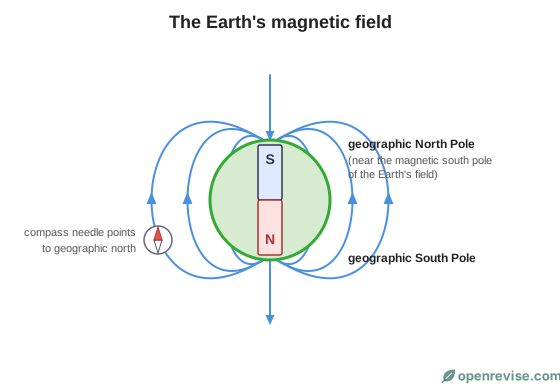
The Earth has its own magnetic field, which is like the field of a giant bar magnet. It is thought to be produced by the movement of molten iron and nickel in the Earth's outer core. A compass needle shows that the Earth has a field: the north-seeking end of a compass swings round to point towards the geographic north. Since unlike poles attract, this means that the magnetic pole of the Earth near the geographic North Pole is actually a magnetic south pole.
Uses of magnets. Compasses for navigation, fridge doors and cupboard catches, loudspeakers and motors, hard disks and credit card strips, and electromagnetic cranes (which are electromagnets, covered in the next lesson).
Test yourself on this lesson
9 exam questions · 21 marks · with mark schemes and model answers
Found a mistake?