7.2 Electromagnetism: wires and solenoids
The magnetic field around a current-carrying wire, the right-hand grip rule, solenoids and electromagnets, and what affects the strength of an electromagnet.
A current makes a magnetic field
Key terms
- Electromagnetism: the production of a magnetic field by an electric current.
- Solenoid: a long coil of wire, in which the magnetic field is strong and uniform inside.
- Electromagnet: a solenoid with an iron core. It acts as a magnet only while a current flows in it.
- Soft iron: a type of iron that is easily magnetised and demagnetised, so it is used for the cores of electromagnets.
In 1820 Hans Christian Oersted noticed that a compass needle placed near a wire moved when the current was switched on. This showed that an electric current produces a magnetic field around the wire. This is the link between electricity and magnetism.
The field around a straight wire
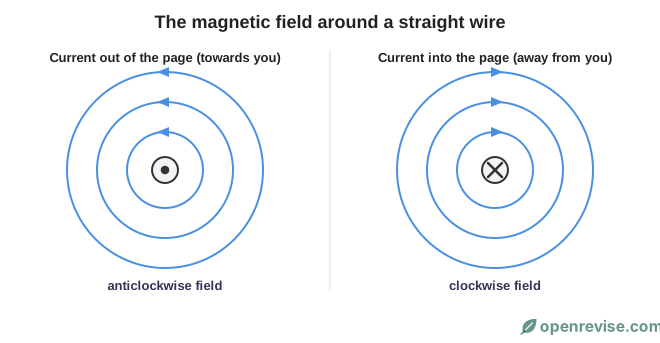
- The magnetic field lines form concentric circles around the wire, in a plane at right angles to the wire.
- The field is stronger close to the wire, and gets weaker with distance. The lines are drawn closer together near the wire.
- The field is stronger if the current is bigger.
- If you reverse the current, the direction of the field reverses.
The right-hand grip rule
To find the direction of the field, use the right-hand grip rule:
> Grip the wire with your right hand, with your thumb pointing in the direction of the conventional current. Your fingers curl in the direction of the magnetic field.
- If the current is coming out of the page (towards you, shown as a dot), the field goes anticlockwise.
- If the current is going into the page (away from you, shown as a cross), the field goes clockwise.
Solenoids
A single wire gives a weak field. If you wind the wire into a coil, the fields from each turn add together, to give a much stronger field. A long coil is called a solenoid.
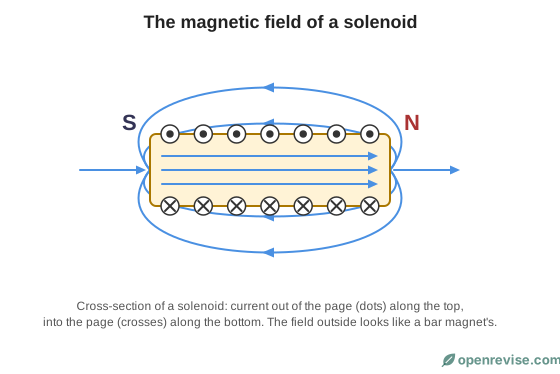
- Inside the solenoid the field is strong and uniform: the lines are straight, parallel and close together.
- Outside, the field is the same shape as the field of a bar magnet. One end of the solenoid is a north pole and the other is a south pole.
- Reversing the current swaps the north and south poles.
To find which end is north, grip the solenoid with your right hand so your fingers curl in the direction of the current. Your thumb points to the north pole.
Electromagnets
An electromagnet is a solenoid with a soft iron core. The iron becomes an induced magnet, which makes the magnetic field much stronger: it is often hundreds of times stronger than without the core. Unlike a permanent magnet, an electromagnet can be switched on and off, by switching the current on and off, and its strength can be changed by changing the current.
The strength of an electromagnet increases if:
- the current is increased;
- the number of turns of wire is increased;
- a soft iron core is used (or a larger one);
- the turns are packed closer together.
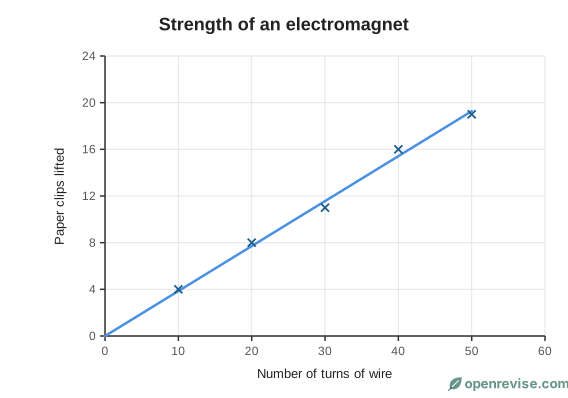
You can investigate this with a nail wrapped in wire and a supply. The number of paper clips that the electromagnet can pick up is a measure of its strength. In the results above, the strength increases in proportion to the number of turns.
Uses of electromagnets
- Scrap-yard cranes lift cars and iron and steel: they can be switched off to drop the load.
- Electric bells and buzzers: an electromagnet pulls a hammer to hit the bell, and breaks the circuit so the hammer springs back, and this repeats.
- Relays: a small current in an electromagnet closes a switch in a second circuit with a much larger current, so a low-voltage circuit can safely control a high-voltage one. Cars use a relay for the starter motor.
- Circuit breakers (which switch off when the current is too high), door locks, MRI scanners and maglev trains.
- Loudspeakers, motors and generators, covered in the next lessons.
Test yourself on this lesson
10 exam questions · 22 marks · with mark schemes and model answers
Found a mistake?