8.3 Orbits and satellites
How gravity provides the force for circular orbits, why the speed is constant but the velocity changes, why smaller orbits need higher speeds, and natural and artificial satellites. For Separate Science.
Orbits
Key terms
- Orbit: the path of an object that moves around another object because of gravity.
- Satellite: an object that orbits a larger object. It may be natural (a moon) or artificial (made by people).
- Geostationary orbit: an orbit above the equator with a period of 24 hours, so the satellite stays above the same point on the Earth.
- Orbital period: the time taken for one complete orbit.
The Moon goes round the Earth, the Earth goes round the Sun, and hundreds of artificial satellites go round the Earth. All of these are orbits, and they all happen for the same reason: gravity.
Gravity provides the centripetal force
In an earlier lesson, you saw that an object moving in a circle needs a resultant force towards the centre, called the centripetal force. For a planet or a satellite, this force is provided by gravity.
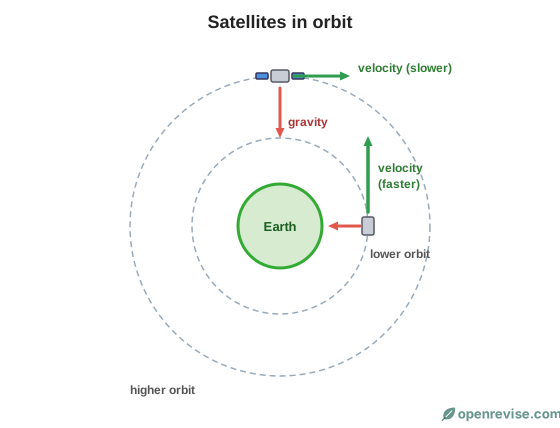
- The gravitational force always points towards the centre of the object being orbited.
- The velocity of the satellite is along the tangent, at right angles to the force.
- Because the force is at right angles to the motion, it changes the direction of the satellite, but not its speed.
So in a circular orbit, the speed is constant, but the velocity is changing, because the direction is always changing. The satellite is accelerating, towards the centre, even though it never gets any closer. An orbiting satellite is actually falling continually towards the Earth, but its sideways velocity means it keeps missing it.
Speed and orbital radius
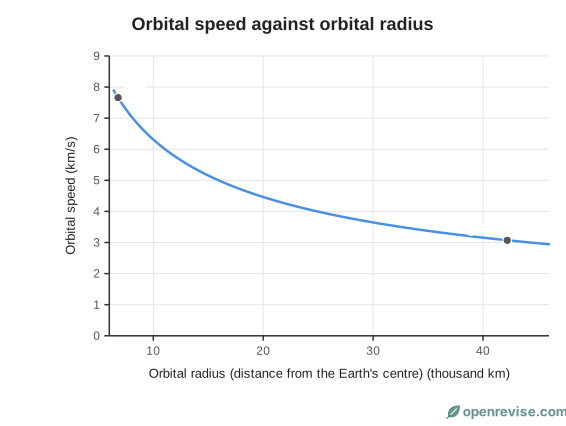
For a stable circular orbit, the speed and the radius are linked:
- closer to the Earth (a smaller orbit), the gravitational force is stronger, so the satellite must move faster to stay in orbit;
- further from the Earth (a larger orbit), gravity is weaker, so the satellite moves more slowly, and takes longer to go round.
If a satellite's speed changes, its orbital radius must change. If the speed is just right, the orbit is circular. The same thing happens with the planets: Mercury moves much faster than Neptune.
Calculating the speed. The speed is the distance divided by the time. For one orbit, the distance is the circumference 2 \pi r and the time is the orbital period T:
v = \frac{2 \pi r}{T}
Worked example 1: the International Space Station. The ISS orbits at r = 6.8 \times 10^6 \text{ m} from the centre of the Earth and takes 93 minutes (5580 s) per orbit.
v = \frac{2 \pi \times 6.8 \times 10^6}{5580} = 7700 \text{ m/s} (about 7.7 km/s, or 28 000 km/h)
Worked example 2: a geostationary satellite. The orbital radius is 4.2 \times 10^7 \text{ m} and the period is 24 hours (86 400 s).
v = \frac{2 \pi \times 4.2 \times 10^7}{86\,400} = 3100 \text{ m/s}
This is much slower than the ISS, as the orbit is much bigger.
Natural and artificial satellites
- Natural satellites: the Moon orbits the Earth, and the planets orbit the Sun (the Sun is orbited by planets, so they are also satellites in this sense).
- Artificial satellites are put into orbit by rockets. The type of orbit depends on the job:
| Satellite | Orbit | Use |
|---|---|---|
| Communications and TV | Geostationary (about 36 000 km above the equator, period 24 h) | A fixed dish can always point at the satellite |
| Weather and Earth observation | Low polar orbit (about 800 km, period about 100 minutes) | Passes over every part of the Earth as it turns underneath |
| Satellite navigation (GPS) | Medium orbit (about 20 000 km, period about 12 h) | Positioning: a group of many satellites, so that several are always in view |
| Space telescopes (such as Hubble) | Low orbit (about 540 km) | Above the atmosphere (see the lesson on observing the Universe) |
Weight and weightlessness
The astronauts on the ISS appear to float, but gravity has not gone: at the height of the ISS, the Earth's gravitational field strength is still about 90% of its value on the ground. The astronauts feel "weightless" because they are in free fall together with the station: both are falling at the same rate around the Earth, so there is no contact force between them.
(Edexcel) The gravitational field strength g is different on different bodies: about 9.8 N/kg on the Earth, 1.6 N/kg on the Moon and 3.7 N/kg on Mars. The weight of an object is W = m g, so the same mass weighs less on the Moon.
Test yourself on this lesson
9 exam questions · 21 marks · with mark schemes and model answers
Found a mistake?