8.2 The life cycle of a star
The life cycle of a star from nebula to protostar, main sequence, red giant and white dwarf, and for massive stars, red supergiant, supernova, neutron star or black hole, and how elements are made. For Separate Science.
The life cycle of a star
Key terms
- Protostar: a hot, dense ball of gas formed when a nebula collapses, before nuclear fusion begins.
- Main sequence star: a stable star in which hydrogen nuclei are fusing to form helium. The Sun is a main sequence star.
- Red giant: a large, cool star formed when a star like the Sun has used up its hydrogen.
- White dwarf: the small, hot, dense core that is left when a red giant loses its outer layers.
- Supernova: a huge explosion at the end of the life of a massive star.
- Neutron star: an extremely dense star left after a supernova.
- Black hole: a region of space where the gravity is so strong that nothing, not even light, can escape.
Stars are not permanent. They are born, they live for millions or billions of years, and they die. What happens to a star depends mostly on its mass.
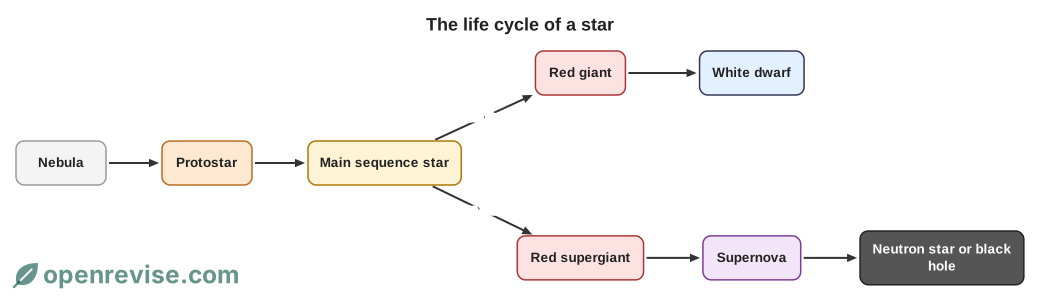
Birth of a star
- Nebula. A star starts as a huge cloud of gas and dust called a nebula, mostly hydrogen. Gravity pulls the material together into clumps.
- Protostar. As a clump collapses, the particles gain kinetic energy and the temperature rises. This forms a hot, dense protostar.
- Main sequence. When the temperature of the core reaches about 10 million °C, hydrogen nuclei have enough energy to overcome their repulsion, and nuclear fusion begins: hydrogen is fused into helium, releasing enormous amounts of energy. The star is now a main sequence star.
The main sequence: a balance of forces
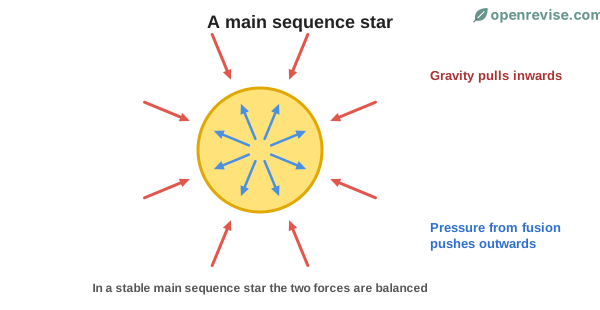
A main sequence star is stable because there are two forces in balance:
- gravity pulls all of the star's material inwards;
- the outward pressure caused by the energy released from fusion (the hot gas and radiation) pushes outwards.
This stage lasts for most of a star's life. The Sun is about 4.6 billion years old and will be on the main sequence for about 10 billion years in total. More massive stars use up their hydrogen faster, so they live much shorter lives.
| Mass of star (Sun = 1) | Time on the main sequence |
|---|---|
| 0.5 | More than 50 billion years |
| 1 (the Sun) | About 10 billion years |
| 10 | About 30 million years |
| 25 | About 7 million years |
A star like the Sun: red giant and white dwarf
- When the hydrogen in the core runs out, fusion in the core stops, and the outward pressure falls. Gravity wins and the core shrinks and heats up.
- The outer layers expand and cool. The star becomes a red giant. Fusion of helium into carbon and oxygen happens in the core. The Sun will become a red giant in about 5 billion years, and will swell to engulf Mercury and Venus, and perhaps Earth.
- Eventually the star runs out of fuel and the outer layers drift off into space as a cloud of gas, called a planetary nebula.
- The core remains as a white dwarf: a small, very hot, dense star, about the size of the Earth. No more fusion happens in it, and it slowly cools and fades.
A much more massive star: supernova
- When the hydrogen runs out, a massive star swells to become a red supergiant.
- In its core, fusion continues to make heavier and heavier elements, up to iron. Then fusion cannot release more energy.
- The core suddenly collapses under gravity, and the outer layers are blasted off in a huge explosion: a supernova. For a short time, a supernova can be as bright as a whole galaxy.
- What is left is a neutron star, an incredibly dense star made almost entirely of neutrons (a teaspoon of it would weigh billions of tonnes). If the remaining core is massive enough, gravity crushes it further into a black hole.
Where do the elements come from?
- Hydrogen and helium were made in the early Universe.
- Elements up to iron are made by nuclear fusion in the cores of stars.
- Elements heavier than iron are made in the extreme conditions of a supernova.
- The supernova scatters all these elements through space. They become part of new nebulae, from which new stars and planets can form.
Everything on Earth, including your body, is made of atoms that were made in stars that exploded long ago. The Sun is a second (or later) generation star, because it contains heavy elements.
Test yourself on this lesson
9 exam questions · 25 marks · with mark schemes and model answers
Found a mistake?