8.1 The Solar System
The Sun and the eight planets in order, dwarf planets, moons, asteroids and comets, the formation of the Solar System from a nebula, and how the geocentric model was replaced by the heliocentric model. For Separate Science.
Our place in space
Key terms
- Solar System: the Sun and all the objects that orbit it.
- Planet: a large, round object that orbits a star and has cleared its orbit of other large objects.
- Dwarf planet: a round object that orbits the Sun, but has not cleared other objects from its orbit.
- Moon (natural satellite): an object that orbits a planet.
- Galaxy: a huge group of billions of stars held together by gravity. Our galaxy is the Milky Way.
- Nebula: a giant cloud of gas and dust in space.
Our Solar System is made up of the Sun and everything that orbits it. The Sun is a star, a huge ball of hot gas which gives out light and other radiation because of nuclear fusion in its core. It contains 99.8% of all the mass of the Solar System, so its gravity controls the movement of everything else.
The planets
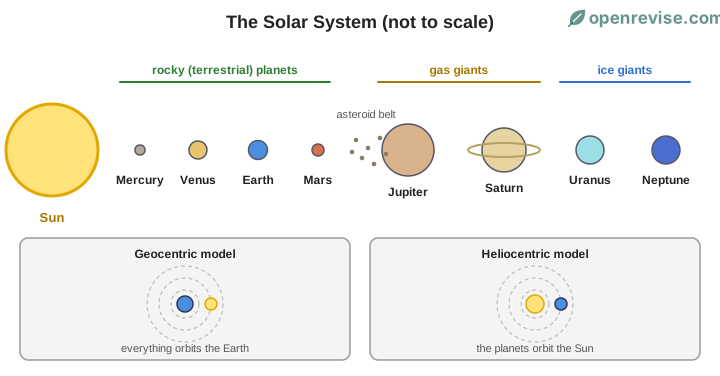
There are eight planets. In order from the Sun they are Mercury, Venus, Earth, Mars, Jupiter, Saturn, Uranus and Neptune. A memory aid is "My Very Easy Method Just Speeds Up Naming".
- The four inner planets (Mercury, Venus, Earth and Mars) are small, rocky (terrestrial) planets.
- Between Mars and Jupiter is the asteroid belt.
- The two largest planets, Jupiter and Saturn, are gas giants made mostly of hydrogen and helium.
- Uranus and Neptune are ice giants.
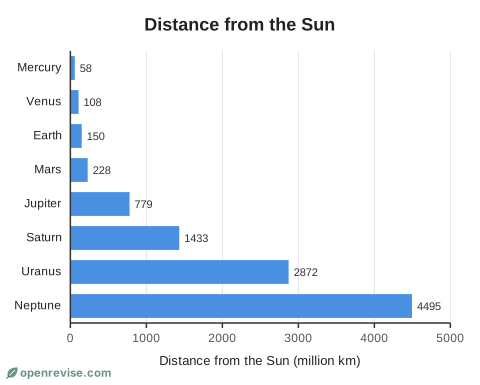
All the planets orbit the Sun in the same direction, in almost circular (slightly elliptical) orbits. The further a planet is from the Sun, the longer it takes to complete an orbit and the slower it moves.
| Planet | Distance from the Sun (million km) | Time for one orbit |
|---|---|---|
| Mercury | 58 | 88 days |
| Venus | 108 | 225 days |
| Earth | 150 | 365 days |
| Mars | 228 | 687 days |
| Jupiter | 779 | 11.9 years |
| Saturn | 1433 | 29.5 years |
| Uranus | 2872 | 84 years |
| Neptune | 4495 | 165 years |
Worked example. Light travels at 3.0 \times 10^8 \text{ m/s}. The Earth is 1.5 \times 10^{11} \text{ m} from the Sun. Calculate the time taken by sunlight to reach the Earth.
t = \frac{s}{v} = \frac{1.5 \times 10^{11}}{3.0 \times 10^8} = 500 \text{ s} (about 8.3 minutes)
Other objects
- Dwarf planets, such as Pluto, Ceres and Eris, orbit the Sun but are smaller and have not cleared their orbits. Pluto was called a planet until 2006.
- Moons are natural satellites that orbit planets. The Earth has one moon, Mars has two and Jupiter has more than ninety. Mercury and Venus have none.
- Asteroids are rocky lumps left over from the formation of the Solar System. Most are in the asteroid belt.
- Comets are balls of ice and dust in very elliptical orbits. As a comet gets close to the Sun, the ice turns to gas and the comet grows a tail of gas and dust that always points away from the Sun.
Our galaxy
The Sun is one of about 100 billion stars in the Milky Way, a spiral galaxy. The Sun is in one of the outer arms, and takes about 230 million years to orbit the centre. The Universe contains billions of galaxies.
How the Solar System formed
About 4.6 billion years ago, a nebula of gas and dust, mostly hydrogen and helium, together with heavier elements that came from earlier stars, began to collapse under its own gravity. Most of the material pulled together at the centre, and became so hot and dense that nuclear fusion started: this became the Sun. The rest of the material formed a spinning disc, and the dust and gas clumped together to make the planets, moons and asteroids. The inner planets were hot, so only rock and metal could form there. The cold outer planets could hold on to the lighter gases and ice.
Changing models of the Solar System
- In the geocentric model, the Earth was at the centre, with the Sun, Moon, planets and stars orbiting it. This was believed by the ancient Greeks, and later by Ptolemy. It seemed to fit what people could see, because the Sun and stars appear to move across the sky.
- In 1543, Copernicus proposed the heliocentric model, with the Sun at the centre and the planets orbiting it. It explained the odd movements of the planets across the sky more simply.
- In 1609-1610, Galileo used a telescope and saw the phases of Venus and four moons orbiting Jupiter. The moons showed that not everything orbits the Earth, and the phases of Venus could not be explained by the geocentric model.
- Kepler showed that planets move in ellipses, and Newton used the theory of gravity to explain the orbits.
The new model was resisted for a long time, but was accepted as the evidence and observations improved. This is how science works: a model is replaced when the evidence does not fit it.
Test yourself on this lesson
9 exam questions · 21 marks · with mark schemes and model answers
Found a mistake?