6.12 Lenses
Convex and concave lenses, focal length, ray diagrams for real and virtual images, and magnification = image height / object height. For Separate Science.
Lenses
Key terms
- Lens: a piece of transparent material, usually glass or plastic, with curved surfaces, that refracts light to form an image.
- Convex (converging) lens: a lens that is thicker in the middle than at the edges, which brings parallel rays of light together at a point.
- Concave (diverging) lens: a lens that is thinner in the middle than at the edges, which makes parallel rays of light spread out.
- Principal focus (F): the point where rays parallel to the principal axis meet after passing through a convex lens (or appear to come from, for a concave lens).
- Focal length: the distance from the centre of the lens to the principal focus.
A lens forms an image of an object by refracting (bending) light rays. The principal axis is a line drawn through the centre of the lens at right angles to it.
- A convex lens is a converging lens. Rays parallel to the axis are bent so that they meet at the principal focus, on the other side of the lens. A lens has a focus on each side, at the same distance from the lens. The more strongly the lens bends the light, the shorter its focal length.
- A concave lens is a diverging lens. Rays parallel to the axis spread out, as if they come from a principal focus on the same side as the incoming light.
Real and virtual images
Key terms
- Real image: an image formed where light rays actually meet. It can be shown on a screen.
- Virtual image: an image formed where rays only appear to come from. It cannot be shown on a screen, but can be seen by looking into the lens.
Ray diagrams
To draw a ray diagram, trace two rays from the top of the object. Where they cross (or appear to cross) is the top of the image. Use these three rules for a convex lens:
- A ray parallel to the axis is refracted so that it passes through the principal focus on the other side.
- A ray through the centre of the lens carries on in a straight line (undeviated).
- A ray that passes through the principal focus on the near side comes out parallel to the axis.
Object beyond 2F (a camera):

The rays meet on the other side of the lens, so the image is real, inverted (upside down) and smaller than the object. A camera works like this, and so does the human eye (the image is inverted on the retina, and the brain turns it upright).
Object between F and 2F: the image is real, inverted, and bigger. This is how a projector works.
Object closer than F (a magnifying glass):
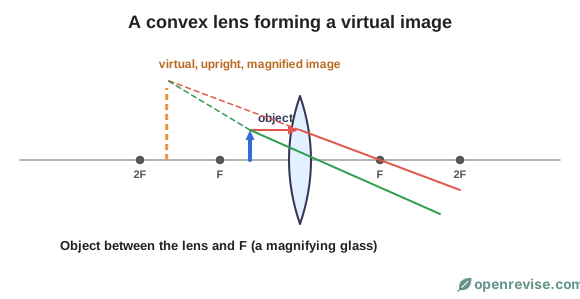
The rays spread out after the lens, so they do not meet. They appear to come from a point behind the object, so the image is virtual, upright and magnified, and on the same side of the lens as the object. You see the image by looking through the lens.
| Position of the object | Image |
|---|---|
| Beyond 2F | Real, inverted, smaller |
| Between 2F and F | Real, inverted, larger |
| Closer than F | Virtual, upright, larger (magnifying glass) |
Concave lens
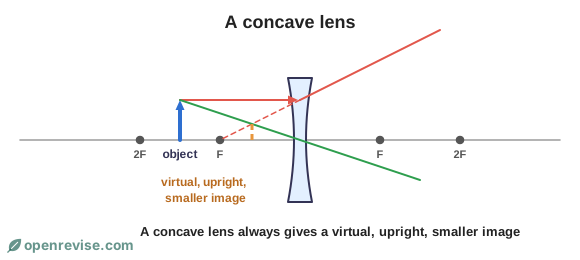
A concave lens spreads the rays out, so they never meet. For any position of the object the image is virtual, upright and smaller, on the same side of the lens as the object. Concave lenses are used in glasses to correct short sight.
Magnification
The magnification tells you how many times bigger than the object the image is:
\text{magnification} = \frac{\text{image height}}{\text{object height}}
Magnification has no unit, because it is a ratio of two lengths, and the two lengths must be in the same units.
Worked example 1. An object is 2.0 cm tall and its image is 6.0 cm tall. Calculate the magnification.
\text{magnification} = \frac{6.0}{2.0} = 3.0
Worked example 2. A magnifying glass has a magnification of 4. An insect is 3.0 mm long. Calculate the length of the image.
\text{image height} = 4 \times 3.0 = 12 \text{ mm}
Uses of lenses
- Cameras and the eye: convex lenses form a real image on a film, sensor or retina.
- Magnifying glasses, microscopes and telescopes: convex lenses.
- Glasses: a convex lens for long sight (the eye lens cannot focus on near objects), a concave lens for short sight.
Test yourself on this lesson
9 exam questions · 21 marks · with mark schemes and model answers
Found a mistake?