6.11 Black body radiation and the temperature of the Earth
How all objects emit electromagnetic radiation, how intensity and wavelength depend on temperature, perfect black bodies, and the factors that decide the temperature of the Earth. For Separate Science.
All objects emit radiation
Key terms
- Black body: an object that absorbs all of the radiation that hits it, and is also the best possible emitter of radiation at any temperature.
- Intensity: the amount of radiation energy that falls on a unit area each second.
- Equilibrium (thermal): when the rate at which an object absorbs radiation equals the rate at which it emits it, so its temperature stays constant.
- Greenhouse gas: a gas in the atmosphere, such as carbon dioxide, methane and water vapour, which absorbs infrared radiation.
Every object emits and absorbs electromagnetic radiation, whatever its temperature. You emit infrared radiation, as do the walls of your room, and so do ice cubes. The kind and amount of radiation depend on the temperature of the object.
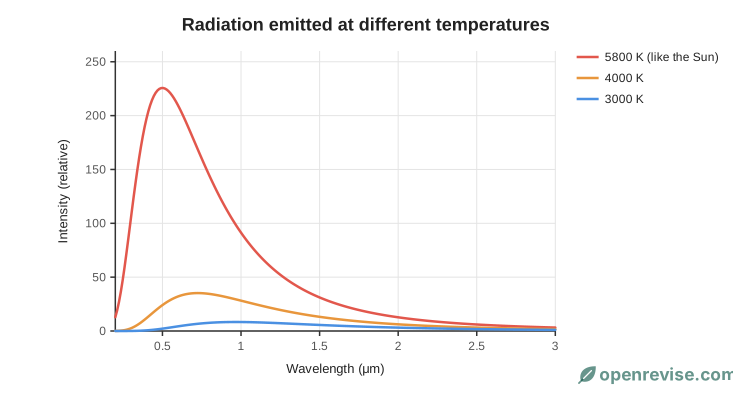
The graph shows the intensity of radiation at each wavelength for three objects at different temperatures. Looking at the curves:
- A hotter object emits more radiation at every wavelength, so the curve is higher. The total radiation emitted increases rapidly with temperature.
- The peak wavelength (the wavelength where the intensity is greatest) gets shorter as the temperature increases.
This explains the colours that things glow. A very hot object, such as the Sun at about 5800 K, has a peak in the visible part of the spectrum, so it glows white-yellow. A cooler object such as a hot electric ring glows dull red, since the peak is in the infrared and only the red end of the visible spectrum is emitted. Objects at room temperature emit almost only infrared, which we cannot see.
Perfect black bodies
A perfect black body is an object that:
- absorbs all of the radiation that falls on it (it does not reflect or transmit any), and
- emits the maximum possible radiation for its temperature.
Nothing is a perfect black body, but a matt black surface is a good approximation, and so are stars. This links to the Leslie cube experiment: matt black surfaces are the best absorbers and the best emitters, while shiny surfaces are the poorest at both.
Constant temperature
An object's temperature depends on the balance between the radiation it absorbs and the radiation it emits:
- if it absorbs more than it emits, its temperature rises, and so it begins to emit more;
- if it emits more than it absorbs, its temperature falls, and so it emits less;
- if the rates are equal, the temperature stays constant.
For example, a rock in the sunshine warms up until it is emitting energy at the same rate that it absorbs it. If a cloud covers the Sun, absorption falls, and the rock cools until a new balance is reached.
The temperature of the Earth
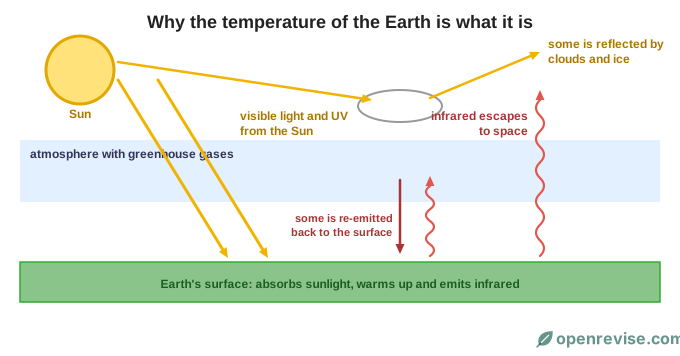
The Earth's temperature stays fairly constant, because of a balance between the radiation it receives from the Sun and the radiation it emits.
- The Sun's radiation, mostly visible light, passes through the atmosphere. Some is reflected back to space by clouds, ice and light-coloured surfaces. The rest is absorbed by the land and oceans, which warms them.
- The warm surface emits infrared radiation, as it is much cooler than the Sun, and emits at longer wavelengths.
- Some infrared passes out to space. But greenhouse gases in the atmosphere absorb much of it, and re-emit it in all directions, including back towards the surface. This keeps the Earth about 33 °C warmer than it would be without an atmosphere. This is the natural greenhouse effect.
Factors that change the Earth's temperature
- Greenhouse gases: more carbon dioxide and methane in the atmosphere means more infrared is absorbed and re-emitted to the surface, so the surface warms up until the radiation going out balances the radiation coming in. This is global warming.
- Reflectivity: more ice and cloud reflects more sunlight, and so the Earth cools. Melting ice makes the surface darker, so more is absorbed, and the warming increases.
- Volcanic ash and dust reflect and absorb sunlight, and can cause temporary cooling.
- Changes in the Sun's output, and the Earth's orbit and tilt, over very long timescales.
- Day and night, and seasons: the surface warms in the day and cools at night.
Test yourself on this lesson
9 exam questions · 20 marks · with mark schemes and model answers
Found a mistake?