6.9 Uses and dangers of electromagnetic waves
The uses of each part of the electromagnetic spectrum, why they are suited to those uses, and the dangers of ultraviolet, X-rays and gamma rays.
Uses and dangers of electromagnetic waves
Key terms
- Ionising radiation: radiation with enough energy to remove electrons from atoms. Ultraviolet, X-rays and gamma rays are ionising.
- Absorb: to take in the energy of a wave, which makes the material warmer.
- Transmit: to let waves pass through.
- Mutation: a change in the genes of a cell.
Different parts of the electromagnetic spectrum have different properties, because they have different wavelengths, frequencies and energies. This makes each one useful for different jobs. Some also have dangers.
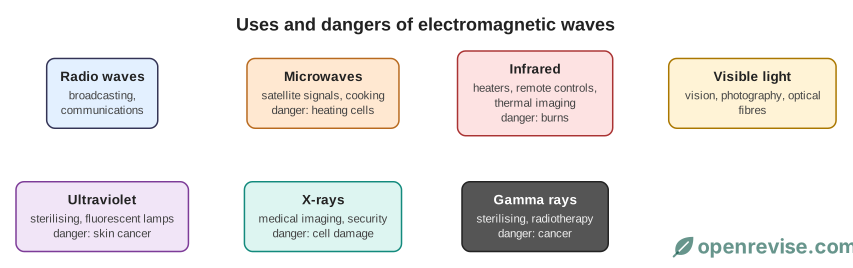
Radio waves
- Uses: television and radio broadcasting, communications, and Bluetooth. Long-wavelength radio waves can diffract around hills and be reflected from the upper atmosphere, so they can be received over long distances.
- Danger: none known at normal levels.
Microwaves
- Uses: satellite communications and mobile phones (they pass through the atmosphere), and cooking in microwave ovens. The microwaves are absorbed by water molecules in food, so the food heats up from the inside.
- Danger: can heat body cells and cause internal heating. Microwave ovens have a metal screen to keep the waves inside.
Infrared
- Uses: electric heaters and grills, thermal imaging cameras (night vision, finding people), remote controls, security systems, and optical fibre communication.
- Danger: too much infrared can cause skin burns.
Visible light
- Uses: seeing, photography, optical fibres and lasers (communications, surgery).
- Danger: a very bright light (such as a laser) can damage the retina of the eye.
Ultraviolet (UV)
- Uses: sterilising water and equipment (kills microorganisms), fluorescent lamps (UV makes the coating glow), detecting forged banknotes, and sun tanning beds.
- Danger: UV is ionising. It can cause sunburn, skin cancer (by damaging DNA), and eye damage, such as cataracts. Sun cream and sunglasses protect against UV.
X-rays
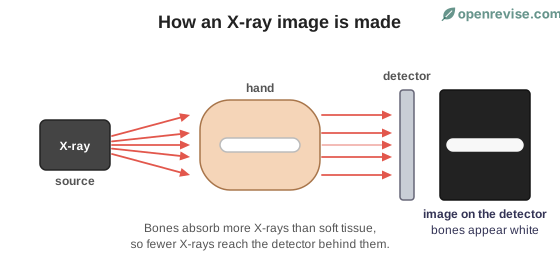
- Uses: medical imaging of bones and teeth, and in airport security scanners. X-rays pass through soft tissue but are absorbed by dense materials like bone and metal, so the bones show up on the image.
- Danger: X-rays are ionising. They damage or kill cells and can cause mutations and cancer. Radiographers stand behind lead screens, and patients wear lead aprons to protect other parts of the body, and scans are used only when necessary.
Gamma rays
- Uses: sterilising medical equipment and food, radiotherapy to kill cancer cells, and medical tracers.
- Danger: gamma rays are very strongly ionising and can cause cancer and kill cells. They are used with careful shielding (lead, concrete).
| Radiation | Danger | Why |
|---|---|---|
| Microwaves | Internal heating of body cells | Absorbed by water in cells |
| Infrared | Skin burns | Absorbed by skin and heats it |
| Ultraviolet | Sunburn, skin cancer, eye damage | Ionising: damages DNA |
| X-rays and gamma rays | Cell damage, cancer | Ionising: damages DNA |
Mobile phones and Wi-Fi
Mobile phones and Wi-Fi use microwaves and radio waves. These are non-ionising, and at the very low power levels used they cannot heat the body significantly. Many scientific studies, which have been checked by other scientists (peer review), have not found evidence of harm from normal use, but research continues, because the technology is new and used by so many people. This is a good example of how evidence is used to decide what the risks are.
Infrared and thermal imaging
All objects emit infrared radiation. Hotter objects emit more, and at a shorter wavelength. A thermal imaging camera detects the infrared radiation and shows the hotter areas as brighter colours. It can be used to find people at night, to find heat loss from houses, and to check for fevers.
Ionising and non-ionising radiation
Ultraviolet, X-rays and gamma rays have the highest frequencies, and have enough energy to ionise atoms, which can damage DNA. The lower-frequency waves (radio waves, microwaves, infrared and visible light) are non-ionising: they do not have enough energy to do this, although they can still heat things.
Test yourself on this lesson
9 exam questions · 22 marks · with mark schemes and model answers
Found a mistake?