6.10 Required practical: infrared radiation from surfaces
Required practical: investigate how the surface of an object affects the amount of infrared radiation it emits (and absorbs), using a Leslie cube and an infrared detector.
Aim
To investigate how the amount of infrared radiation emitted by a surface depends on the nature of the surface: for example, matt black, matt white, dull metal and shiny metal.
Key terms
- Emitter: a surface that gives out radiation.
- Absorber: a surface that takes in radiation.
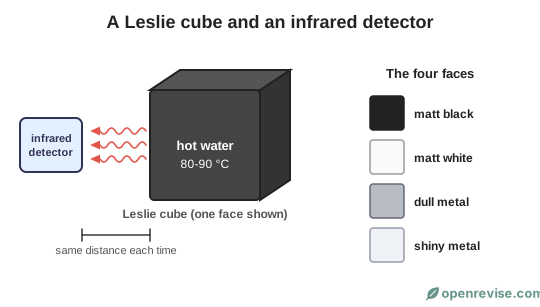
- Leslie cube: a hollow metal cube with four different surfaces on its sides, that can be filled with hot water.
- Infrared detector: an instrument that measures the intensity of infrared radiation, for example a thermopile or a radiation sensor.
All objects emit infrared radiation. The hotter the object, the more it emits. The nature of the surface also matters: some surfaces are better emitters than others. The same surfaces are also better or worse absorbers.
Apparatus
- a Leslie cube with four faces (matt black, matt white, dull metal and shiny metal)
- a kettle to boil water, and a heat-resistant mat
- an infrared detector (or a radiation sensor and data logger)
- a ruler to measure the distance, a thermometer, and a stopwatch
Method
- Place the Leslie cube on a heat-resistant mat. Carefully fill it with hot water from a kettle, to the same level each time, and put the lid on. Use a thermometer to check the temperature of the water.
- Place the infrared detector a fixed distance (for example 5 cm) from the first face. The detector should be pointing at the middle of the face.
- Read the detector and record the reading. Do this as soon as the reading is steady.
- Turn the cube so that the next face is in front of the detector and measure again at the same distance. Do this quickly, since the water cools down.
- Repeat for all four faces. Then repeat the whole set in a different order, and calculate a mean for each surface.
Variables
| Type of variable | In this experiment |
|---|---|
| Independent | The type of surface (matt black, matt white, dull metal, shiny metal) |
| Dependent | The reading on the infrared detector (the intensity of infrared radiation) |
| Control | The temperature of the water, the distance from the detector, the area of the face, the detector |
Results
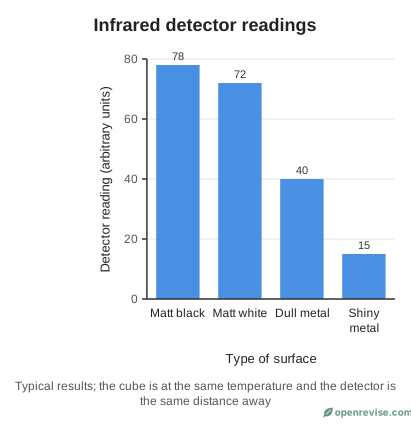
The matt black surface gives the highest reading, and the shiny metal surface the lowest. Therefore:
- dark, matt surfaces are good emitters of infrared radiation;
- light, shiny surfaces are poor emitters.
The same is true for absorption: a matt black surface is also the best absorber of infrared radiation, while a shiny surface reflects most of it. You can check this by placing two metal plates, one matt black and one shiny, the same distance from a radiant heater, and measuring how quickly their temperatures rise: the matt black plate warms up faster.
Uses
These results explain real-life situations:
- Solar panels and the radiators of central heating are often painted matt black, to absorb or emit as much radiation as possible.
- Emergency blankets and the inside of a flask are shiny, to reflect radiation and reduce heat transfer.
- Houses in hot countries are often painted white, to reflect radiation and stay cooler.
Errors and precautions
- The water cools down during the experiment, so the measurements need to be done quickly and the order changed to remove bias. Alternatively, use a cube kept at a constant temperature.
- Keep the distance and the angle of the detector the same each time.
- The detector may also pick up infrared from other sources such as the room. Shield the detector, and record the reading with no cube to correct for it.
- Safety: boiling water can cause scalds. Fill the cube carefully on a mat, with the lid on, and do not move the cube while it is full.
Test yourself on this lesson
9 exam questions · 19 marks · with mark schemes and model answers
Found a mistake?