6.7 Ultrasound, echoes and seismic waves
Higher tier: using ultrasound and echoes for medical scans and sonar, calculating distances from time and speed, and how P-waves and S-waves reveal the structure of the Earth. For Separate Science.
Ultrasound
Key terms
- Ultrasound: sound waves with a frequency higher than 20 kHz, which is too high for humans to hear.
- Echo: a reflected sound wave.
- Sonar: a method that uses echoes of sound (or ultrasound) in water to find the depth of water or to locate objects.
- Seismic wave: a wave produced by an earthquake that travels through the Earth.
When a sound or ultrasound wave reaches a boundary between two different materials, some of it is reflected (an echo) and some is transmitted. By measuring the time it takes for an echo to return, and knowing the speed of the wave, you can work out how far away the boundary is.
Calculating distances from echoes
The wave travels to the boundary and back, so it covers twice the distance. The distance to the boundary is:
d = \frac{v \times t}{2}
where v is the wave speed, and t is the time from sending the wave to receiving the echo.
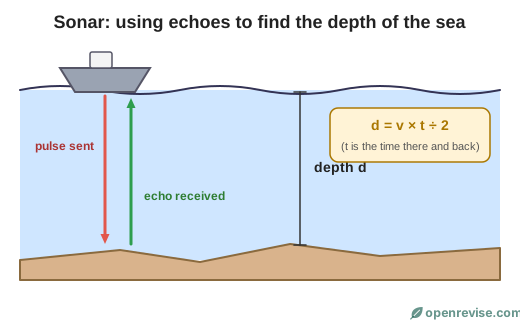
Worked example 1: sonar. A ship sends a pulse of ultrasound down to the sea bed and receives the echo 0.40 s later. The speed of sound in sea water is 1500 m/s. Calculate the depth of the sea.
d = \frac{1500 \times 0.40}{2} = 300 \text{ m}
Worked example 2: a bat. A bat sends out a pulse of ultrasound and hears the echo from an insect 0.010 s later. The speed of sound in air is 330 m/s. The insect is \frac{330 \times 0.010}{2} = 1.65 \text{ m} away.
Uses of ultrasound
- Medical scanning. An ultrasound probe sends pulses of ultrasound into the body, and detects the echoes from the boundaries between different tissues. A computer uses the time delays to build up an image. It is used to look at unborn babies (it is safe, since ultrasound is non-ionising), and to look at organs such as the heart and liver. A gel is put on the skin to make sure that the ultrasound enters the body rather than being reflected by air.
- Breaking kidney stones. High-intensity ultrasound can break up stones without surgery.
- Industrial uses. Ultrasound can show cracks and flaws in metal, because the pulses are reflected from the crack. It can also be used for cleaning delicate objects.
- Sonar. Ships and submarines measure depth and find shoals of fish or other objects underwater.
Seismic waves
An earthquake sends out seismic waves that travel through the Earth. They are detected by instruments called seismometers all around the world. There are two main types:
| Property | P-waves (primary) | S-waves (secondary) |
|---|---|---|
| Type of wave | Longitudinal | Transverse |
| Travel through | Solids and liquids | Solids only |
| Speed | Faster, and arrive first | Slower, and arrive second |
What seismic waves tell us about the Earth

Scientists studied where seismic waves were detected after earthquakes:
- S-waves were detected only on the near side of the Earth, not on the far side. They cannot travel through a liquid, so part of the Earth's core must be liquid.
- P-waves are detected on the far side, but they arrive later than expected and in unexpected places (there is a shadow zone). Their speed and direction change suddenly at the boundary of the core, which shows that the core is made of a different material from the mantle. The waves are refracted (they bend) when they change speed.
- The P-wave speed and direction also change at the boundary between the outer and inner core. From this, scientists worked out that the inner core is solid.
Seismic waves also change direction gradually as they travel through the mantle, because the density and the properties of the rock change with depth. These observations led to the model of the Earth with a crust, a solid mantle, a liquid outer core and a solid inner core.
Test yourself on this lesson
9 exam questions · 23 marks · with mark schemes and model answers
Found a mistake?