6.6 Sound waves and hearing
Higher tier: how sound travels as vibrations in different materials, frequency and pitch, amplitude and loudness, how the ear works, and the range of human hearing. For Separate Science.
Sound waves
Key terms
- Sound wave: a longitudinal wave caused by vibrations, which travels through a solid, liquid or gas by passing vibrations from particle to particle.
- Pitch: how high or low a sound is. It depends on the frequency.
- Loudness: how loud a sound is. It depends on the amplitude.
- Infrasound: sound with a frequency below the range of human hearing (below 20 Hz).
- Ultrasound: sound with a frequency above the range of human hearing (above 20 kHz).
Sound is made when something vibrates, such as a guitar string, a loudspeaker cone or your vocal cords. The vibrating object pushes and pulls the nearby particles, making a series of compressions and rarefactions that travel outwards. Sound is a longitudinal wave.
Because sound is passed from particle to particle, it needs a medium and cannot travel through a vacuum.
Speed of sound in different materials
| Material | Speed of sound (m/s) |
|---|---|
| Air | 330 |
| Water | 1500 |
| Steel | 5000 |
Sound travels fastest in solids, slower in liquids and slowest in gases. The particles in a solid are close together and strongly bonded to their neighbours, so a vibration is passed on quickly. In a gas, the particles are far apart, so it takes longer for a collision to happen.
When a sound wave goes from air into water or a solid, its frequency stays the same (it is set by the source), but its speed increases, so, as v = f \lambda, its wavelength is longer. When it goes back to air, the speed and wavelength fall again.
Pitch and loudness
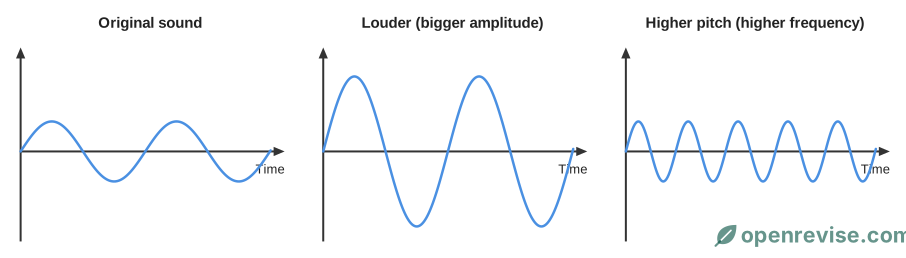
You can look at a sound with a microphone connected to an oscilloscope, which shows the wave as a trace.
- Higher frequency: more waves in the same time, so the sound has a higher pitch.
- Greater amplitude: taller waves, so the sound is louder.
How the ear works
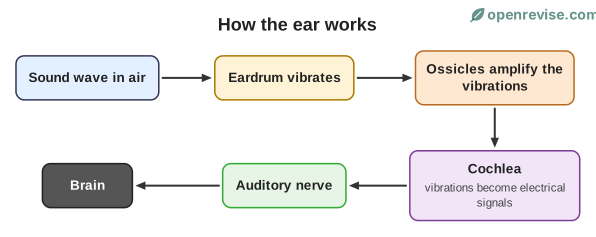
The ear is designed to convert sound waves into vibrations of solids and then into nerve signals.
- The outer ear collects the sound waves and passes them down the ear canal.
- The sound waves make the eardrum (a thin membrane) vibrate.
- The vibrations pass through three tiny bones, the ossicles, which amplify (increase) them.
- The last bone passes the vibrations into the cochlea, a coiled tube full of liquid, where the vibrations are detected by hair cells and converted into electrical signals.
- These travel along the auditory nerve to the brain, which we experience as sound.
Because the eardrum and the other parts of the ear can only vibrate over a certain range of frequencies, we can only hear a limited range.
Reflection and absorption of sound
Sound waves can be reflected, absorbed or transmitted at a boundary. Hard, smooth surfaces such as bare walls reflect sound well, which is why you can hear echoes in an empty hall or a tunnel. Soft, rough materials such as curtains, carpets and foam absorb sound, so there is less echo. Concert halls and recording studios use a mix of both to get the sound they want, and sound-proofing uses thick, soft layers to absorb sound.
Worked example 1: sound in different materials. A sound travels 1000 m along a steel rail, at 5000 m/s, and through the air at 330 m/s.
- Time in steel: t = \frac{s}{v} = \frac{1000}{5000} = 0.20 \text{ s}
- Time in air: t = \frac{1000}{330} = 3.0 \text{ s}
The sound arrives much earlier through the steel, which is why people used to put an ear to the rail to hear a train long before they could hear it through the air.
The range of human hearing
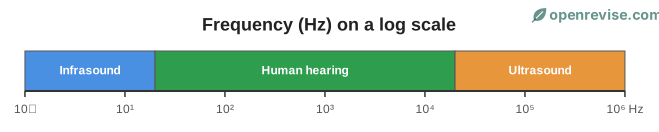
- A healthy young person can hear frequencies from about 20 Hz to 20 000 Hz (20 kHz).
- Sounds below 20 Hz are called infrasound. Elephants and whales use it to communicate.
- Sounds above 20 kHz are called ultrasound. Bats use it to find their way, and dogs can hear up to about 45 kHz.
- The range of hearing gets smaller with age, mostly at the upper end. Loud noises over time can damage the hair cells in the cochlea, which is why people wear ear protection.
Worked example 2. The speed of sound in air is 330 m/s. Calculate the wavelengths of sound at the limits of human hearing.
- At 20 Hz: \lambda = \frac{330}{20} = 16.5 \text{ m}
- At 20 000 Hz: \lambda = \frac{330}{20\,000} = 0.0165 \text{ m} (1.65 cm)
Test yourself on this lesson
9 exam questions · 20 marks · with mark schemes and model answers
Found a mistake?