Viewing as
Teacher view: planning notes, the answers to every question, and the teacher copies of the files.
History · Crime and punishment in Britain, c1700-c1900
Prisons and Prison Reform
From filthy, corrupt gaols to the silent cells of Pentonville - how prison became the main punishment, and what reformers like John Howard and Elizabeth Fry changed.
Teacher resources
The teacher copies: slides with the questions built in, the answers, and anything else attached to this lesson for whoever is teaching it.
- Prisons and Prison Reform - Teacher Slides.pptx Teacher The lesson slides with the teacher's notes on each slide, and every question and mark scheme built in. Built from the lesson script on 23 September 2026. View
- Prisons and Prison Reform - Teacher Notes.docx Teacher The complete notes with the teacher's notes and every model answer in full. Built from the lesson script on 23 September 2026. View
Student handouts
The same files the students see, to print or hand out.
- Prisons and Prison Reform.pptx Built from the lesson script on 23 September 2026. View
- Prisons and Prison Reform - Completed Notes.docx The full notes for the lesson, every gap filled in - to check against, or to revise from. Built from the lesson script on 23 September 2026. View
- Prisons and Prison Reform - Exam Questions.docx Built from the lesson script on 23 September 2026. View
Learning Objectives
- 1Describe conditions in eighteenth-century prisons.
- 2Explain the work of John Howard, Elizabeth Fry and Robert Peel in reforming prisons.
- 3Explain how the separate system worked at Pentonville, and assess whether it succeeded.
Setting the Scene
In the 1700s prisons were mainly used to hold people awaiting trial, and debtors. They were run for profit by gaolers, who charged prisoners for food and bedding. As the Bloody Code and transportation declined, prison became the main punishment for serious crime, and reformers pushed for prisons that would change criminals rather than simply hold them.
- 1777 John Howard publishes The State of the Prisons.
- 1813 Elizabeth Fry first visits the women's section of Newgate Prison.
- 1823 Robert Peel's Gaols Act reforms prisons.
- 1842 Pentonville Prison opens, using the separate system.
- 1865 Prison Act introduces harsher conditions: "hard labour, hard fare, hard board".
- 1877 The government takes control of all prisons.
Prisons Before Reform
Eighteenth-century gaols were dirty, crowded and corrupt.
-
Profit
Gaolers were not paid a wage; they charged prisoners fees for food, bedding and even for being released.
-
Mixing
Men, women, children, debtors and murderers were often kept together.
-
Disease
Gaol fever (typhus) spread quickly in filthy, crowded conditions.
-
Schools of crime
First-time offenders learned from hardened criminals.
The Reformers
Three people who changed how prisons were run.
-
John Howard
A sheriff in Bedfordshire who inspected prisons across Britain and Europe and published The State of the Prisons in 1777.
-
Elizabeth Fry
A Quaker who from 1813 worked with women prisoners at Newgate, teaching them reading, sewing and the Bible.
-
Robert Peel
As Home Secretary he passed the Gaols Act of 1823, putting some of the reformers' ideas into law.
-
Howard's ideas
Gaolers should be paid a wage, prisons inspected, and prisoners kept clean and healthy.
-
Fry's ideas
Women warders for women prisoners, education, useful work and religious teaching.
-
Peel's Gaols Act
Paid gaolers, regular visits by chaplains, women warders, and education for prisoners.
The Separate and Silent Systems
Two competing ideas for how to reform prisoners.
-
Separate system
Prisoners were kept in their own cells almost all the time, so they could reflect on their crimes and could not be corrupted by others.
-
Silent system
Prisoners worked together but were forbidden to speak, and were punished if they did.
-
Hard labour
Prisoners did pointless, exhausting work such as the treadwheel, the crank or picking oakum.
-
The aim
To make prison hard enough to deter, while giving prisoners the chance to reform.
Pentonville Prison
Pentonville opened in London in 1842 as a model of the separate system. Each of its 520 prisoners had his own cell, where he ate, slept and worked alone.
Life at Pentonville
- Cells Each prisoner had a cell with a toilet, a hammock and work such as weaving or shoemaking.
- Masks Prisoners wore masks or peaked caps outside their cells so they could not recognise each other.
- Chapel Prisoners sat in separate cubicles in chapel.
- Effects Long isolation caused mental illness and suicides.
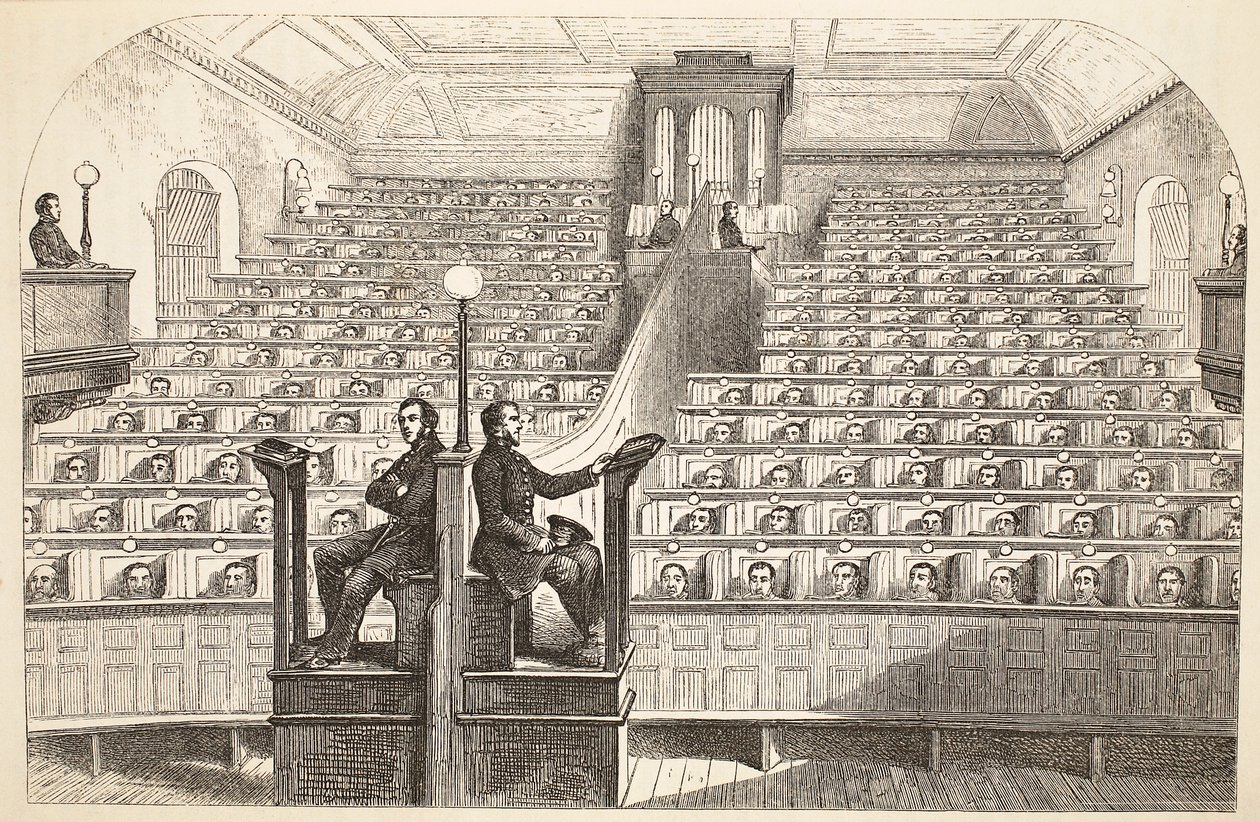
The chapel at Pentonville: separate even in church.
Did Pentonville Succeed?
Successes
- Cleaner and healthier than eighteenth-century gaols.
- Kept first-time offenders away from hardened criminals.
- Gave prisoners work, religious teaching and time to reflect.
- Became a model for dozens of new prisons.
Failures
- Isolation caused mental illness and suicides.
- It did not clearly reduce reoffending.
- It was expensive to build and run.
- The separate system was gradually abandoned later in the century.
Summary & Exam Focus
- Eighteenth-century gaols were dirty, mixed and run for profit.
- John Howard and Elizabeth Fry campaigned for cleaner, fairer prisons.
- Peel's Gaols Act of 1823 put reform into law.
- Pentonville (1842) used the separate system - with mixed results.
Exam focus
Explain why there were changes to prisons in the period c1700-c1900. (12 marks) (12 marks)
Link the changes to causes - reformers, the decline of the Bloody Code and transportation, new ideas about reform.
Key terms
The vocabulary this lesson expects you to use. Each one is linked from the first place it appears above.
- Gaoler
- The person who ran a prison.
- Gaols Act
- Peel's 1823 law reforming how prisons were run.
- Separate system
- Keeping prisoners alone in their cells to reflect and reform.
- Silent system
- Prisoners worked together but were not allowed to speak.
- Hard labour
- Exhausting, often pointless work such as the treadwheel or the crank.
- Treadwheel
- A large wheel prisoners had to walk on for hours.
- Pentonville
- The model prison opened in London in 1842.
Questions and answers
9 questions set on this lesson, with the mark schemes and model answers open.
Explain one way in which prisons in the eighteenth century were different from prisons in the late nineteenth century.
Mark scheme — 4 marks available
- A valid difference identified — 1-2 marks
- Supported with specific knowledge of both periods — 3-4 marks
Model answer
In the eighteenth century prisons were run for profit by gaolers who charged prisoners fees for food and bedding, and men, women, children and debtors were often mixed together in filthy conditions. By the late nineteenth century prisons were run by the government - which took control of all prisons in 1877 - with paid staff, and prisoners were kept apart, as in the separate system at Pentonville. So the difference is that prisons changed from private, corrupt gaols to state-run institutions.
Explain why there were changes to prisons in the period c1700-c1900. You may use the following in your answer: John Howard; the end of transportation. You must also use information of your own.
Mark scheme — 12 marks available
- Level 1 (1-3) — A simple or general answer
- Level 2 (4-6) — Some explanation of one or more reasons, with some knowledge
- Level 3 (7-9) — A developed explanation linked to the question, with accurate knowledge
- Level 4 (10-12) — An analytical explanation of several reasons, with knowledge that goes beyond the stimulus points
Model answer
One reason was the work of reformers. John Howard, a sheriff in Bedfordshire, inspected prisons across the country and published The State of the Prisons in 1777, exposing corruption, disease and the fees charged by gaolers. Elizabeth Fry worked with women prisoners at Newgate from 1813 and showed that education and work could improve them. Their campaigns made the public and politicians aware that prisons needed to change. A second reason was that prison became the main punishment. As the Bloody Code was dismantled in the 1820s and transportation declined before finally ending in 1868, judges needed somewhere to send serious criminals. This meant many more prisons were needed, and new prisons such as Pentonville in 1842 were built for the purpose. A third reason, beyond the stimulus, was government action and new ideas about punishment. Robert Peel's Gaols Act of 1823 introduced paid gaolers, chaplains and women warders, and the government took control of all prisons in 1877. New ideas that prisoners could be reformed, through the separate and silent systems, shaped how the new prisons were designed.
"The separate system at Pentonville was a failure." How far do you agree? Explain your answer. You may use the following in your answer: prisoners' cells; mental illness. You must also use information of your own. (16 marks, plus 4 for spelling, punctuation, grammar and specialist terminology)
Mark scheme — 16 marks available
- Level 1 (1-4) — A simple or generalised answer
- Level 2 (5-8) — Some analysis, with a judgement that is asserted
- Level 3 (9-12) — Analysis of both sides with accurate knowledge and a supported judgement
- Level 4 (13-16) — Sustained analysis, knowledge beyond the stimulus, and a clear, justified judgement
- SPaG (4) — Accurate spelling, punctuation and grammar, with specialist terms such as separate system and hard labour
Model answer
On the one hand, there is strong evidence it failed. Prisoners at Pentonville spent almost all their time alone in their cells, and even wore masks outside them and sat in separate cubicles in chapel. This long isolation caused mental illness, and there were suicides. It did not clearly reduce reoffending, it was expensive to build and run, and the separate system was gradually abandoned later in the century as it was seen as too harsh and too costly. On the other hand, it had real successes. Each prisoner had a clean cell with a toilet, which made Pentonville far healthier than eighteenth-century gaols where gaol fever spread. Keeping prisoners apart stopped first-time offenders learning from hardened criminals, and prisoners were given work and religious teaching. Pentonville became a model, and dozens of new prisons were built on its design, showing that the authorities saw it as an improvement. Overall, Pentonville succeeded in making prisons cleaner, more orderly and less corrupt, but it failed in its main aim of reforming prisoners, and its isolation did serious harm. So the statement is largely true in terms of reform, but not in terms of prison conditions.
How were gaolers paid in the eighteenth century?
Why: They were not paid a wage - they charged prisoners fees for food, bedding and release.
Who published The State of the Prisons in 1777?
Why: John Howard, a sheriff in Bedfordshire, who inspected prisons across Britain and Europe.
What was the separate system?
Why: Prisoners were kept alone in their cells almost all the time to reflect on their crimes.
Which prison opened in 1842 as a model of the separate system?
Why: Pentonville, in London, with 520 separate cells.
Which reformer worked with women prisoners at Newgate?
Why: Elizabeth Fry, a Quaker, from 1813.
What did Peel's Gaols Act of 1823 introduce?
Why: Paid gaolers, chaplain visits, women warders for women prisoners and education.