Viewing as
Teaching this? The teacher view adds 2 files, the mark schemes and the model answers.
History · Crime and punishment in early modern England
Vagabondage
Why being poor and on the road became a crime in Tudor England, and how the authorities tried to tell the "deserving" poor from the "undeserving".
Learning Objectives
- 1Explain why the number of poor, wandering people increased in the sixteenth century.
- 2Describe the laws against vagabondage and the punishments they set.
- 3Explain why vagabonds were feared, and how attitudes to the poor changed by 1601.
Setting the Scene
In the 1500s, growing numbers of poor people took to the roads looking for work. The authorities called them vagabonds or vagrants, and many feared them as thieves and troublemakers. Being poor, able-bodied and without work in your own parish became a crime.
- 1531 A law separates the "impotent" poor, who may beg with a licence, from able-bodied beggars, who are whipped.
- 1536-41 The dissolution of the monasteries ends much of the charity the poor relied on.
- 1547 Vagrancy Act: vagabonds can be branded and made slaves for two years.
- 1566 Thomas Harman's pamphlet describes the "tricks" of vagabonds.
- 1572 Vagabonds Act: whipping and boring through the ear.
- 1601 Poor Law: every parish must look after its own poor.
Why Were There More Vagabonds?
Several changes pushed people off the land and onto the road.
-
Population growth
The population grew fast, so there were more people than jobs.
-
Rising prices
Prices rose much faster than wages, pushing families into poverty.
-
Enclosure
Landowners fenced off land for sheep, so fewer farm workers were needed.
-
The monasteries
Their dissolution (1536-41) ended the food and shelter they had given the poor.
-
Bad harvests
Failed harvests meant hunger and higher food prices.
-
Soldiers
Men returning from wars often came home with no work.
Why Vagabonds Were Feared
The authorities saw wandering poor people as a threat to order.
-
Crime
Vagabonds were blamed for theft and begging with tricks - pretending to be sick or injured.
-
Rebellion
Groups of poor, unemployed men could join rebellions, as in Kett's Rebellion in 1549.
-
Burden
Towns did not want to pay to support strangers from other parishes.
-
Idleness
People believed that able-bodied men who did not work were lazy and sinful.
Laws Against Vagabondage
The laws grew harsher, then began to separate the deserving from the undeserving poor.
-
1531 Act
What it did: Licensed the impotent poor to beg. Punishment: Able-bodied beggars whipped
-
1547 Vagrancy Act
What it did: Treated able-bodied vagrants as criminals. Punishment: Branded with a V and two years as a slave; repealed in 1550
-
1572 Vagabonds Act
What it did: Vagabonds punished; parishes to collect for the deserving poor. Punishment: Whipped and a hole burned through the ear; repeat offenders could be hanged
-
1576 Act
What it did: Houses of correction set up. Punishment: Vagrants made to work
-
1601 Poor Law
What it did: Each parish must support its own poor through a poor rate. Punishment: Able-bodied poor made to work; beggars punished
Punishing a Vagabond
Punishments for vagabondage were public and painful. They were meant to shame the vagabond, warn others, and send them back to their own parish.
Tudor punishments
- Whipping Tied to a cart and whipped until bloody.
- Branding A V burned into the skin under the 1547 Act.
- Ear boring A hole burned through the ear under the 1572 Act.
- Houses of correction Hard work for the able-bodied idle.
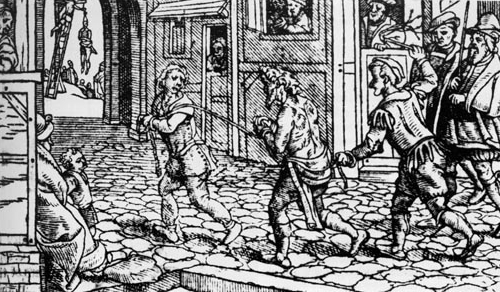
A vagabond whipped through the streets, sixteenth century.
Thomas Harman on Vagabonds
Harman described vagabonds as cunning tricksters, such as "counterfeit cranks" who faked illness - pamphlets like his made people see the poor as criminals rather than victims.
These rowsey, ragged rabblement of rakehells... lurk in every corner, deceiving the people.
Deserving and Undeserving Poor
Deserving poor
- The old, sick, disabled and orphaned.
- Could not work through no fault of their own.
- Given relief by their parish, paid for by the poor rate.
Undeserving poor
- Able-bodied people who did not work.
- Seen as lazy, sinful or criminal.
- Punished as vagabonds or made to work in houses of correction.
Summary & Exam Focus
- Economic and social change pushed more people onto the roads.
- Vagabonds were feared as thieves and potential rebels.
- Punishments included whipping, branding and ear boring.
- The 1601 Poor Law separated the deserving poor from the undeserving.
Exam focus
Explain why vagabondage was seen as a serious crime in the sixteenth century. (12 marks) (12 marks)
Explain the fears behind the laws - crime, rebellion, the cost to parishes - not just the causes of poverty.
Key terms
The vocabulary this lesson expects you to use. Each one is linked from the first place it appears above.
- Vagabond
- A poor, able-bodied person who wandered from place to place without work.
- Vagrancy
- The crime of being a vagabond.
- Enclosure
- Fencing off common land, often for sheep farming.
- Dissolution of the monasteries
- Henry VIII's closure of the monasteries, 1536-41.
- House of correction
- A place where vagrants were made to work.
- Poor rate
- A local tax to support the deserving poor.
- Counterfeit crank
- A beggar who pretended to be ill to get money.
Downloads
Free to keep, print and annotate.
- Vagabondage.pptx Built from the lesson script on 23 September 2026. View
- Vagabondage - Completed Notes.docx The full notes for the lesson, every gap filled in - to check against, or to revise from. Built from the lesson script on 23 September 2026. View
- Vagabondage - Exam Questions.docx Built from the lesson script on 23 September 2026. View
Something here looks wrong?
Tell us what and we will go and look. It goes to whoever writes these pages, nobody else, and we do not ask who you are — so there is nothing to sign and nothing comes back to you.